Fürstenfeldbruck, Germany UAP Encounter, 1948 — USAAF Box 7 #221
U.S. Army Air Forces records from 1948 document an unidentified object performing horizontal flight and climbing near Fürstenfeldbruck, Germany.
Historical Context
The period following the Second World War was a time of significant geopolitical instability and rapid technological advancement. In 1948, the occupation of Germany by Allied forces created a landscape where military surveillance and aerial patrols were frequent. The presence of the United States Army Air Forces (USAAF) in West Germany meant that American military personnel were constantly monitoring the skies for both conventional enemy movements and the emerging phenomenon of unidentified aerial phenomena. This era coincided with the dawn of the Cold War, a period characterized by intense atmospheric scrutiny and the development of early jet propulsion and rocket technologies.
During this specific timeframe, the phenomenon of “flying saucers” had begun to capture the global imagination. The public consciousness had been fundamentally altered by the Kenneth Arnold sighting in June 1947 and the subsequent reports surrounding the Roswell incident in July 1947. These events triggered a wave of sightings across North America and Europe, leading military and governmental agencies to begin formalizing the documentation of anomalous aerial tracks. The 1948 incident in Fürstenfeldbruck occurred within this broader cultural and military context of heightened aerial awareness and the initial efforts to categorize unknown objects in the sky.
The Incident Documentation
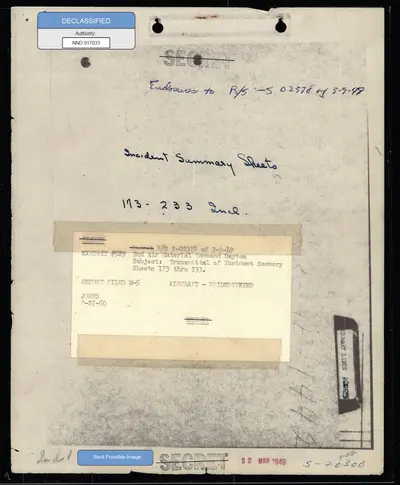
The documentation regarding the 1948 encounter near Fürstenfeldbruck, Germany, is preserved within the U.S. Army Air Forces “Check-List - Unidentified Flying Objects” series. Specifically, this event is identified as Incident #221, located in Box 7 of file 38_143685. The details of the case were made available to the public on May 8, 2026, following their release by the Department of War through the Presidential Unsealing and Reporting System for UAP Encounters (PURSUE).
The summary provided within the official form records indicates that an unspecified observer reported a sighting in the vicinity of Fürstenfeldbruck. The technical description of the object’s movement noted a pattern of horizontal flight followed by a climb. The records do not provide specific details regarding the identity of the observer or the exact duration of the sighting, focusing instead on the flight path and the classification of the object as unidentified. This type of reporting was characteristic of the era’s military logs, which prioritized the flight dynamics and trajectory of the observed phenomenon over subjective descriptions.
Classification and Investigation Status
The case is classified as a visual sighting, a category that includes reports made by both ground-based observers and personnel stationed in aircraft. Such sightings were the primary method of UAP detection during the late 1940s, as radar technology was still in its relative infancy and lacked the resolution to provide definitive identification of many small or highly maneuverable objects.
Under the oversight of the All-domain Anomaly Resolution Office, all records released via the PURSUE program, including the Fürstenfeldbruck encounter, are officially designated as unresolved. The federal government has maintained a strictly neutral stance regarding the nature of these 1947-era incidents. There has been no official determination that these sightings were anomalous, nor has there been a conclusive determination that they were the result of conventional phenomena.
The scientific and military community has proposed several conventional candidates to explain the high volume of sightings during the 1947-1948 period. These possibilities include the atmospheric effects of Project Mogul balloon flights, which were active over the American Southwest at the time, as well as the testing of experimental jet and rocket aircraft. Additionally, researchers have considered the possibility that atmospheric optical effects or the misidentification of astronomical objects at unusual angles could account for the reported sightings. The Fürstenfeldbruck incident remains part of this ongoing historical inquiry into the unidentified aerial activity of the post-war era.