San Marcos, Texas UFO Sighting (July 7, 1947) — FBI Files
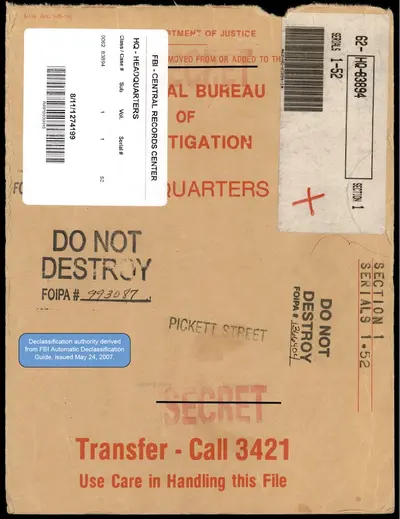
An FBI-recorded report from July 1947 details a potential information leak regarding a disc-launching invention in San Marcos, Texas.
Historical Context
The summer of 1947 represents a pivotal era in the history of unidentified aerial phenomena in the United States. Following the Kenneth Arnold sighting in June 194
7, the American public and government agencies became increasingly preoccupied with reports of disc-shaped objects traversing the skies. This period, often characterized by the emergence of the “flying saucer” phenomenon, coincided with the early stages of the Cold War and heightened anxieties regarding technological superiority and airspace security. During this time, the Federal Bureau of Investigation maintained specific protocols for processing reports of unidentified objects, particularly when those reports originated near or involved the protection of vital national installations. Field offices in cities such as Knoxville, Albuquerque, and Los Angeles were tasked with routing such sightings to headquarters to ensure that any potential threats to domestic security were properly evaluated.
The geographic region of San Marcos, Texas, situated within the central part of the state, was subject to the same heightened scrutiny as other parts of the country during this wave of sightings. The era was also marked by the Roswell incident in July 1947, which further contributed to the atmospheric tension surrounding unexplained aerial events. While many contemporary sightings were attributed to conventional phenomena such as weather balloons, experimental aircraft, or astronomical bodies like Venus and the Moon, the official documentation from this period often reflects a state of investigative uncertainty.
The San Marcos Incident
On July 7, 1947, an unidentified-object incident was recorded in San Marcos, Texas. The details of this specific case were not made available to the general public until May 8, 2026, when they were released through the Presidential Unsealing and Reporting System for UAP Encounters (PURSUE). The released documentation includes a letter from an individual identified as Woodson C. Cope, which provides a unique perspective on the nature of the sighting.
The contents of the document suggest a concern regarding the security of a private technological development. Cope proposed that a device he had invented in 1945 possessed the capability to launch a disc-shaped object silently over a distance of several miles. He utilized a multi-spring catapult design for this purpose and expressed a suspicion that the sighting in San Marcos might have been the result of a leakage of information regarding his invention. The document contains the specific notation that a possible leakage of information had resulted in a situation where his device, or a variation thereof, could conceivably catapult a disc.
The released file does not specify the exact number of witnesses present during the event, nor does it provide a detailed description of the object’s flight path. However, the witnesses involved described the object as being disc- or saucer-shaped, aligning with the prevailing descriptions of unidentified objects during the 1947 phenomenon.
Investigative Status and Classification
As of the current archival period, all records released under the PURSUE program are designated as unresolved by the All-domain Anomaly Resolution Office (AARO) by default. The federal government has maintained a neutral stance regarding the San Marcos case, neither concluding that the event was anomalous nor confirming that it was the result of conventional technology. The investigation has not ruled out the possibility of clandestine human activity, such as the use of experimental propulsion or launch systems, nor has it dismissed the possibility of natural or atmospheric phenomena.
In the broader context of 1940s aerial sightings, investigators often weighed such reports against known candidates such as the Project Mogul series of high-altitude balloons or atmospheric optical effects like lenticular clouds and sundogs. The San Marcos file remains a distinct entry in the FBI archives, primarily due to its focus on the potential intersection between private technological innovation and unidentified aerial activity.