Houston, Texas UFO Sighting (December 19, 1947) — USAF Files
U.S. government investigators documented a report of "flying disks" over Houston, Texas, in December 1947, as revealed by declassified military files.
Background
On December 19, 1947, in Houston, Texas, U.S. government investigators recorded an unidentified-object incident later released to the public on May 8, 2026, as part of the Presidential Unsealing and Reporting System for UAP Encounters (PURSUE). This sighting occurred during a period of intense public and military scrutiny regarding aerial phenomena. The incident is one of the first wave of “flying saucer” reports that swept the United States following the Kenneth Arnold sighting of June 1947 and the Roswell incident of July 1947. During this era, the sudden influx of reports regarding metallic, disc-shaped objects created a sense of national preoccupation, as the post-war aviation boom and the dawn of the Cold War heightened sensitivities toward any unidentified presence in the American airspace.
The case appears in U.S. Department of Defense documents, specifically within files maintained by federal law enforcement and military intelligence. The geographical context of Houston, a major hub for energy and transportation, placed the event in a region of significant economic and logistical importance. Such sightings in populated or industrial areas often triggered immediate investigative responses from local and federal agencies to determine if the objects posed a threat to civil aviation or national security.
What the document records
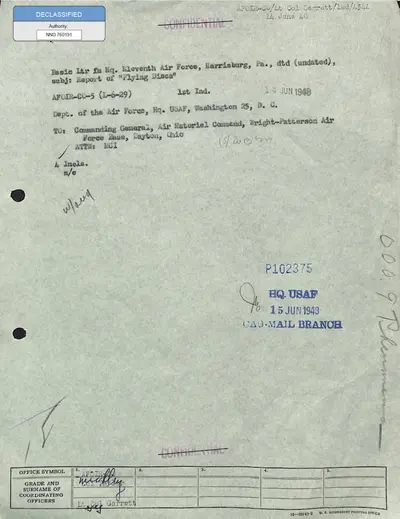
The FBI office in Houston, Texas, received a report concerning “Flying Disks.” The report was prepared by the Tenth Air Force Resident Agent. The enclosed summary details the information gathered regarding these unidentified objects. While the documentation provides a formal account of the investigative steps taken by the Tenth Air Force, the number of witnesses is not specified in the released document.
The nature of the report suggests a standardized intelligence-gathering process. During the late 1940s, the Air Force was actively working to categorize aerial phenomena, often utilizing resident agents to bridge the gap between local law enforcement observations and military intelligence analysis. The use of the term “Flying Disks” reflects the prevailing nomenclature of the time, a term popularized by the media and the public in the months following the Arnold sighting. The documentation focuses on the gathering of information rather than the definitive identification of the objects, a common characteristic of early Unidentified Aerial Phenomena (UAP) reporting.
Type of case
The case is a visual sighting reported by ground or air observers. This classification places the Houston incident within the broader category of optical encounters, where the primary evidence rests on the testimony of individuals who observed the objects moving through the atmosphere. Such cases are historically difficult to verify through physical evidence, relying instead on the corroboration of multiple observers and the analysis of flight patterns or light characteristics.
Status
All records released under the PURSUE program are designated unresolved by the All-domain Anomaly Resolution Office (AARO) by default. The federal government has not concluded that the events were anomalous, has not concluded that they were conventional, and has not ruled out either possibility. The ambiguity of the Houston report is consistent with the broader lack of resolution found in many declassified files from the mid-twentieth century.
Conventional candidates for sightings of this period include experimental aircraft, weather balloons, especially the Project Mogul series in the late 1940s, atmospheric optical phenomena such as sundogs and lenticular clouds, and astronomical objects including Venus, the Moon, and meteors near the horizon. The presence of high-altitude reconnaissance technology and the evolving landscape of post-war aerospace engineering provided several plausible, albeit often classified, explanations for unidentified aerial activity during this specific window of history.