Lt Col John Wemgh, Executive UAP Encounter, 1948 — USAAF Box 7 #187
An archived 1948 U.S. Army Air Forces report details an unidentified flying object sighting near the location of Lt Col John Wemgh, Executive.
Historical Context of the 1948 Saucer Wave
The year 1948 represented a pivotal moment in the history of aerial anomaly reporting within the United States. Following the high-profile Kenneth Arnold sighting in June 1947 and the subsequent events surrounding the Roswell incident in July 1947, the American public and military apparatus entered a period of heightened vigilance regarding unidentified aerial phenomena. This era, often characterized by the term “flying saucer” reports, saw a significant surge in sightings that prompted the United States Army Air Forces to begin systematic documentation. During this period, the distinction between known aeronautical technology and unknown phenomena was frequently blurred by the rapid advancement of post-war aviation, including the emergence of early jet propulsion and experimental rocket designs.
The reporting of such incidents during the late 1940s was often handled through internal military checklists designed to categorize and track anomalies that could potentially impact national security. These records were not always intended for public consumption, often serving as raw data for intelligence assessment rather than formal investigative reports. The emergence of these documents in the modern era provides a window into how the military attempted to parse the distinction between atmospheric optical illusions, classified experimental hardware, and truly anomalous objects.
Case Documentation: Incident #187
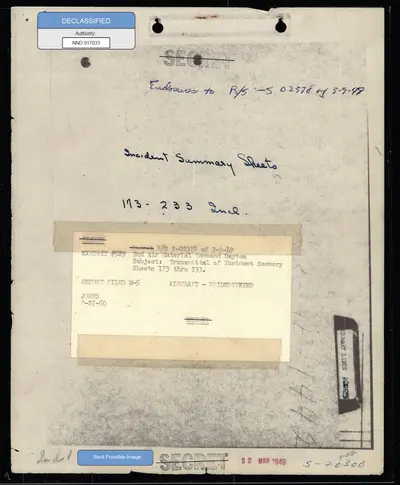
The specific event documented as Incident #187 in the “Check-List - Unidentified Flying Objects” series originated from the U.S. Army Air Forces archives. This particular entry is preserved within Box 7 of file 38_143685. The details of the sighting were officially brought to light by the Department of War on May 8, 2026, following their release through the Presidential Unsealing and Reporting System for UAP Encounters (PURSUE).
The summary provided within the official form records a visual sighting of an unidentified object. The report indicates that the sighting occurred near the location identified as Lt Col John Wemgh, Executive. While the documentation confirms the occurrence of the sighting, the specific nature of the object and the identity of the observer remained unspecified in the archived summary. The case is classified as a visual sighting, meaning the phenomenon was observed directly by ground or air-based personnel, rather than being detected solely through radar or other electronic means.
Analytical Status and Potential Classifications
As of the current archival assessment, the status of Incident #187 remains unresolved. Under the mandates of the All-domain Anomaly Resolution Office, all records released through the PURSUE program are officially designated as unresolved. The federal government has maintained a neutral stance regarding this 1948 encounter, having reached no definitive conclusion as to whether the object was anomalous in nature or a product of known, conventional technology.
The investigation of 1947-era incidents typically considers several conventional candidates that could account for such sightings. During the late 1940s, the United States Southwest was the site of active Project Mogul balloon flights, which were designed to detect Soviet nuclear tests and could easily be mistaken for unidentified craft. Additionally, the era saw the testing of experimental jet and rocket aircraft, as well as various atmospheric optical effects and the misidentification of astronomical objects due to unusual viewing angles. Because the government has not ruled out either the possibility of conventional hardware or anomalous origins, the case of the Lt Col John Wemgh, Executive encounter remains a subject of ongoing historical and scientific inquiry within the archives of Spooky Valley.