Cleveland, Ohio UFO Sighting (May 25, 1948) — USAF Files
A 1948 U.S. government report details an FBI agent's observation of a fast-moving, phosphorescent flying disc over Cleveland, Ohio.
Historical Context
The sighting in Cleveland, Ohio, occurred during a period of intense public and governmental preoccupation with unidentified aerial phenomena. The summer of 1947 had fundamentally altered the American consciousness regarding the skies, following the Kenneth Arnold sighting in June and the subsequent Roswell incident in July. These events initiated a wave of “flying saucer” reports across the United States, characterized by descriptions of metallic, disc-shaped objects performing maneuvers that defied contemporary aerodynamic understanding. During this era, the transition from the Second World War to the early Cold War meant that the American public and intelligence agencies were hyper-vigilant toward any unidentified movement in the atmosphere, often viewing such objects through the lens of potential Soviet technological advancements.
Geographically, Cleveland served as a significant industrial and logistical hub in the Great Lakes region, making it a high-traffic area for both civilian and military aviation. Such a location provided numerous vantage points for observers, ranging from ground-based personnel to pilots navigating the corridors of the midwestern United States. The atmosphere of the late 1940s was also marked by the emergence of advanced surveillance technologies and the early stages of atmospheric monitoring, which contributed to a heightened state of observation regarding the upper reaches of the troposphere and stratosphere.
The Cleveland Incident
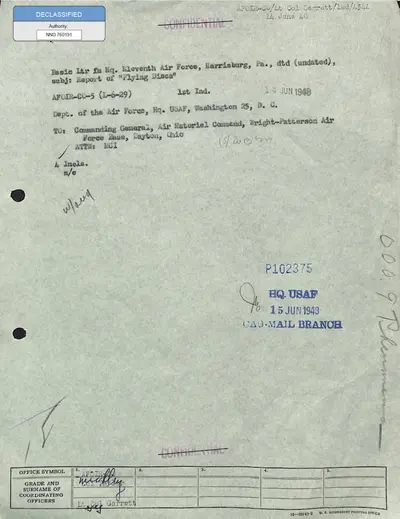
On May 25, 1948, U.S. government investigators recorded an unidentified-object incident that remained largely out of the public eye for decades. The details of this specific event were released to the public on May 8, 2026, as part of the Presidential Unsealing and Reporting System for UAP Encounters (PURSUE). The documentation for this case is found within official U.S. Department of Defense files, indicating that the event was processed through formal government channels.
The primary account within the released document originates from an FBI agent stationed in Cleveland, Ohio. This agent reported observations of what appeared to be flying discs. The object was characterized by a phosphorescent quality, suggesting a self-luminous or reflective property that made it visible against the darkened sky. According to the agent’s report, the object was moving at great speed and was traveling at an estimated altitude of between 6 and 8 miles. The agent specifically noted that the object’s heading was 90 degrees, though the document does not provide further details regarding its trajectory or its specific maneuverability, stating only that such capabilities remained unknown at the time of the report. While the document confirms the presence of these observations, it does not specify the total number of witnesses involved in the sighting.
Analytical Classification
This case is classified as a visual sighting reported by ground or air observers. In the taxonomy of unidentified aerial phenomena, such reports are categorized by the direct ocular observation of an object’s light emission or physical structure. The Cleveland report is notable for its source, as the involvement of an FBI agent adds a layer of officiality to the observation that distinguishes it from purely civilian accounts of the period.
The status of the Cleveland sighting remains officially unresolved. Under the protocols of the All-domain Anomaly Resolution Office (AARO), all records released under the PURSUE program are designated as unresolved by default. The federal government has maintained a neutral stance regarding the nature of the object, having neither concluded that the event was anomalous nor confirmed that it was the result of conventional technology. The possibility of either an unidentified phenomenon or a known physical object remains open.
When analyzing sightings from the late 1940s, researchers often consider several conventional candidates. These include experimental aircraft developed during the post-war era or weather balloons, specifically those associated with the Project Mogul series, which were designed to detect high-altitude nuclear tests. Other possibilities include atmospheric optical phenomena, such as sundogs or lenticular clouds, which can create illusions of solid, moving objects. Furthermore, astronomical objects like the Moon, Venus, or meteors passing near the horizon are frequently evaluated as potential explanations for luminous, fast-moving sightings during this period of history.