Columbus, Chic UFO Sighting (May 15, 1948) — USAF Files
U.S. government documents reveal a 1948 unidentified object report from the N.Y. Central system in Columbus, Chic, released via the PURSUE program.
Historical Context
The period following the summer of 1947 is characterized by a significant surge in reported unidentified aerial phenomena across the United States. This era, often referred to by historians of the phenomenon as the first wave of “flying saucer” reports, was ignited by the Kenneth Arnold sighting in June 1947 and the subsequent, highly controversial Roswell incident in July 1947. During this time, the American public and military intelligence were grappling with the implications of objects appearing in the sky that did not conform to the known capabilities of contemporary aircraft. The geopolitical climate of the early Cold War added a layer of tension to these sightings, as the possibility of advanced Soviet technology or extraterrestrial presence became a subject of intense scrutiny by both civilian and military authorities.
The phenomenon of unidentified objects during the late 1940s was often analyzed through the lens of emerging aerospace technology and atmospheric science. The emergence of high-altitude reconnaissance and the development of sophisticated radar systems meant that objects previously invisible to the naked eye were now being tracked by ground-based instrumentation. This period saw the rise of various explanations for such sightings, ranging from the highly classified Project Mogul balloon arrays designed to detect nuclear tests, to more mundane atmospheric phenomena like lenticular clouds or bright planetary alignments.
The Columbus, Chic Incident
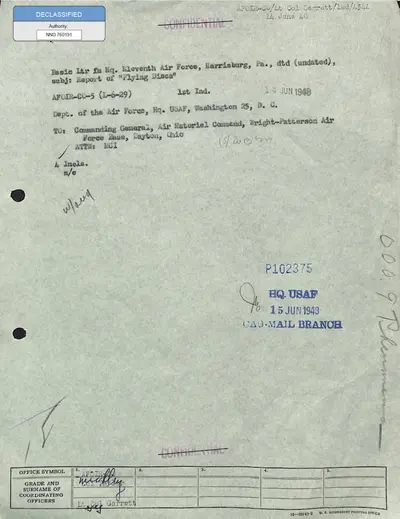
On May 15, 1948, an unidentified-object incident occurred in Columbus, Chic. The details of this specific event were preserved within U.S. Department of Defense documents and remained classified for decades. The information regarding this sighting only reached the public domain on May 8, 2026, following the implementation of the Presidential Unsealing and Reporting System for UAP Encounters (PURSUE). This release was part of a broader governmental effort to increase transparency regarding anomalous aerial observations.
The primary evidence for the event consists of a letter originating from the N.Y. Central system located in Columbus, Chic. This correspondence serves as the official record of the report, notifying authorities of an observed phenomenon. While the document confirms that an incident was reported by the N.Y. Central system, the text of the letter does not provide specific descriptive details regarding the appearance, trajectory, or behavior of the object in question. Furthermore, the released documentation does not specify the number of individuals who witnessed the event, leaving the scale of the observation undocumented.
Classification and Investigation Status
The Columbus sighting is classified as a visual sighting, a category of case involving observations made by either ground-based or air-based observers. In the context of the 1948 reporting era, such sightings were often processed through various military and civil aviation channels, though the level of investigative follow-up varied significantly depending on the perceived threat level of the object.
As of the current archival status, all records released under the PURSUE program are designated as unresolved by the All-domain Anomaly Resolution Office (AARO). By default, the federal government maintains a neutral stance regarding the nature of these events. The official position is that the government has not concluded that the Columbus incident was anomalous, nor has it concluded that the event was the result of a conventional source. The possibility of both extraterrestrial and terrestrial explanations remains open.
When evaluating such historical sightings, investigators often consider a variety of conventional candidates. These include experimental military aircraft testing, weather balloons, and various atmospheric optical phenomena such as sundogs. Astronomical objects, including the Moon, Venus, or meteors passing near the horizon, are also frequently cited as potential sources for unidentified light phenomena. The Columbus, Chic report remains a subject of study within the broader context of mid-century unidentified aerial phenomena research.