Mecr Bermel, Bew Mexico UAP Encounter, 1947 — USAAF Box 7 #2
An unidentified flying object was recorded by the U.S. Army Air Forces near Mecr Bermel, Bew Mexico, during the height of the 1947 saucer wave.
Historical Context
The year 1947 represents a pivotal moment in the history of aerial anomaly documentation. Following the widespread media attention surrounding the Kenneth Arnold sighting in June and the subsequent Roswell incident in July, the United States experienced a surge in reports of unidentified flying objects, often referred to at the time as flying saucers. This period marked the beginning of a systemic, albeit fragmented, effort by military and governmental bodies to catalog aerial phenomena that defied immediate identification. The geographic region of the American Southwest, including areas like Bew Mexico, became a frequent focal point for such reports due to its vast, open airspace and the presence of various high-altitude experimental programs and surveillance initiatives.
During this era, the scientific and military understanding of such phenomena was in its infancy. The emergence of jet propulsion and early rocket technology introduced new types of aerial signatures into the atmosphere, complicating the ability of ground and air observers to distinguish between known man-made craft and truly anomalous objects. This ambiguity fueled a period of intense public interest and heightened military scrutiny, as the potential for technological breakthroughs or new aerial threats became a central concern for national security.
The Mecr Bermel Incident
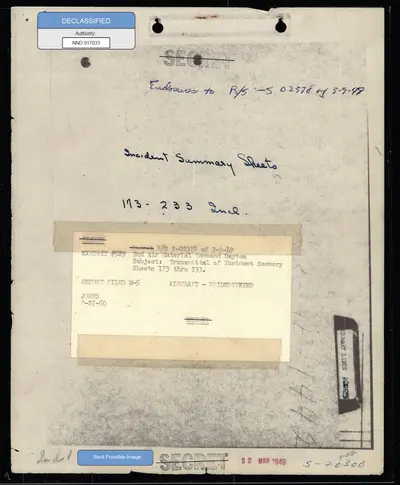
In 1947, near Mecr Bermel, Bew Mexico, the U.S. Army Air Forces recorded an unidentified-object incident that became Incident #2 in the “Check-List - Unidentified Flying Objects” series archived in Box 7 of file 38_143685. The records pertaining to this specific encounter were released by the Department of War on May 8, 2026, as part of the Presidential Unsealing and Reporting System for UAP Encounters (PURSUE). This case is categorized as one of the first wave of “flying saucer” reports that characterized the summer of 1947.
The documentation for Incident #2, found within the U.S. Army Air Forces “Check-List - Unidentified Flying Objects” series, provides a brief summary of the event. The records indicate that an unspecified observer reported a sighting near Mecr Bermel. The nature of the observation was a visual sighting, with the observer positioned on the ground in the right front seat of a car. While the specific characteristics of the object were not detailed in the summary, the event was formally logged as a visual sighting reported by a ground observer.
Investigation and Classification
The investigation of 1947-era incidents often lacked the sophisticated sensor arrays available to modern analysts, relying heavily on the descriptive capabilities of human witnesses. The Mecr Bermel case, like many others from this period, remains part of a larger body of evidence that is currently categorized as unresolved. All records released under the PURSUE program are designated as unresolved by the All-domain Anomaly Resolution Office. The federal government has maintained a neutral stance regarding these historical encounters, having not concluded that these 1947-era incidents were anomalous, nor having concluded they were conventional. The possibility of either conclusion remains open within official records.
When analyzing the legitimacy of such sightings, researchers often consider several conventional candidates that were active in the American Southwest during the late 1940s. These include the Project Mogul balloon flights, which were designed to detect Soviet nuclear tests via high-altitude acoustic sensors. Other potential explanations involve the testing of experimental jet and rocket aircraft, various atmospheric optical effects, or astronomical objects that may have been misidentified due to unusual viewing angles. The Mecr Bermel sighting exists within this complex framework of historical ambiguity and ongoing scientific inquiry.