Anacostia, Naval UAP Encounter, 1947 — USAAF Box 7 #123
An archived U.S. Army Air Forces report details a 1947 unidentified object sighting near Anacostia, Naval, released via the PURSUE program in 2026.
Historical Context of the 1947 Wave
The summer of 1947 represents a pivotal era in the history of aerial anomaly documentation. Following the conclusion of World War II, the rapid advancement of aeronautical engineering led to a period of intense atmospheric activity and increased civilian and military observation of the skies. This period is characterized by a sudden surge in reports of unidentified flying objects, often referred to in contemporary media as “flying saucers.” This phenomenon was largely catalyzed by the Kenneth Arnold sighting in June 1947 and the subsequent Roswell incident in July 1947. During this time, the United States military and various government agencies began formalizing the collection of such reports, attempting to distinguish between emerging experimental aerospace technology and potentially anomalous phenomena.
The geopolitical landscape of the late 1940s also played a significant role in how these sightings were processed. As the Cold War began to take shape, the ability to monitor airspace became a matter of national security. The emergence of high-altitude reconnaissance capabilities and the development of early jet propulsion meant that the distinction between known aircraft and unidentified objects was often blurred. Consequently, many reports from this era were treated with a mixture of scientific curiosity and intense military scrutiny, as the Department of War sought to identify any potential incursions by foreign powers.
Incident #123: The Anacostia Naval Sighting
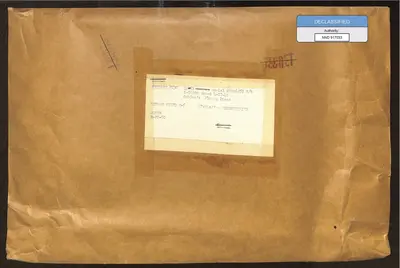
In 1947, near Anacostia, Naval, the U.S. Army Air Forces recorded an unidentified-object incident that became Incident #123 in the “Check-List - Unidentified Flying Objects” series archived in Box 7 of file 38_143685. The specific details of this encounter remained classified for decades, only becoming part of the public record when the Department of War released the documents on May 8, 2026, as part of the Presidential Unsealing and Reporting System for UAP Encounters (PURSUE).
The documentation provided by the U.S. Army Air Forces “Check-List - Unidentified Flying Objects” series identifies this as a visual sighting reported by ground or air observers. The summary records indicate that an unspecified observer reported a sighting near the Anacostia, Naval location. While the specific trajectory, duration, or physical characteristics of the object are not detailed in the released summary, the entry serves as a formal acknowledgment of an unidentified aerial phenomenon observed during the height of the 1947 saucer wave.
Investigation and Classification
The investigation of Incident #123 falls under the broader category of visual sightings, a type of case involving direct optical observation of an object in the sky. At the time of the report, such sightings were often cross-referenced with known flight paths and meteorological data to determine if the object could be attributed to conventional means. The archival nature of the report in the “Check-List” series suggests a systematic approach to tracking these occurrences, even if the individual entries lacked the depth of modern sensor-based data.
Under the current oversight of the All-domain Anomaly Resolution Office, all records released through the PURSUE program are officially designated as unresolved. The federal government maintains a neutral stance regarding the Anacostia encounter, having neither concluded that the object was anomalous nor confirmed it as a conventional craft. The possibility of either remains open within the official record.
When analyzing the 1947-era sightings, researchers often consider several conventional candidates that could explain such encounters. These include the Project Mogul balloon flights, which were active over the American Southwest at the time and were designed to detect high-altitude nuclear tests. Other possibilities include the testing of experimental jet and rocket aircraft, atmospheric optical effects such as sun dogs or reflections, and the misidentification of astronomical objects when viewed at unusual angles. The Anacostia incident remains a subject of study within this framework of historical aerial anomalies.