Albuquerque, New Mexico UFO Sighting (September 29, 1947) — USAF Files
U.S. government investigators recorded a 1947 report involving claims of Russian-launched flying discs targeting American military installations.
Historical Context
The late summer and early autumn of 1947 represent a pivotal period in the history of modern aerial anomaly documentation. Following the June 194 suddenly widespread media coverage of the Kenneth Arnold sighting and the subsequent July 1947 reports surrounding the Roswell incident, the United States experienced a significant surge in unidentified flying object reports. This era, often characterized by the emergence of the “flying saucer” phenomenon, coincided with the early stages of the Cold War. As the geopolitical landscape shifted toward a state of heightened tension between the United States and the Soviet Union, public and military interest in unidentified aerial phenomena became inextricably linked to national security and the potential for technological breakthroughs by foreign adversaries.
Albuquerque, New Mexico, served as a critical hub for such concerns during this period. The region was, and remains, a central node for American aerospace development and military operations. The presence of significant aircraft manufacturing facilities and sensitive military installations meant that any unidentified aerial activity in the New Mexico skies was viewed through a lens of strategic importance. The atmosphere of the late 1940s was one of intense scrutiny regarding airspace integrity, as the advent of the jet age and the development of long-range reconnaissance capabilities made the monitoring of the upper atmosphere a primary objective for the Department of Defense.
The Incident Records
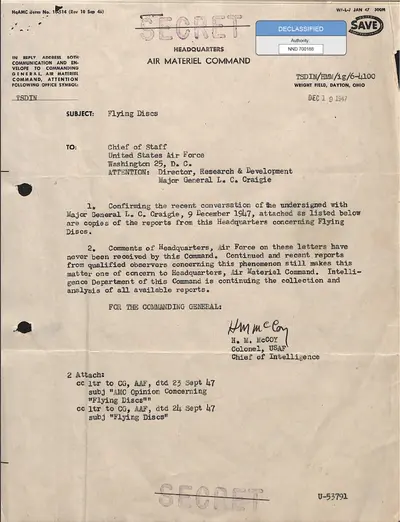
On September 29, 1947, in Albuquerque, New Mexico, U.S. government investigators recorded an unidentified-object incident. These specific records were later released to the public on May 8, 2026, as part of the Presidential Unsealing and Reporting System for UAP Encounters (PURSUE). The documentation for this specific event appears within official U.S. Department of Defense files.
The contents of the released document detail a specific communication received by military leadership. A woman contacted General Brentnall to present a theory regarding the nature of “Flying Discs.” According to her claim, these objects were being launched from a Russian laboratory located in Central Mexico. The informant posited that these discs were being intentionally aimed at United States atomic and aircraft installations for the express purpose of gathering targeting data. While the document records the presentation of this theory, it notes that no further investigation was pursued based on the claim provided by the woman.
The released documentation does not specify a number of witnesses associated with the sighting or the claims made. However, the case is categorized by the inclusion of reports involving figures or beings associated with the object, a characteristic common to several high-profile aerial anomaly reports of the mid-twentieth century.
Classification and Resolution Status
Under the framework of the All-domain Anomaly Resolution Office (AARO), all records released through the PURSUE program are designated as unresolved by default. The federal government has maintained a position of neutrality regarding the Albuquerque incident, having neither concluded that the events were anomalous nor confirmed that they were the result of conventional phenomena. The possibility of both remains open within official archives.
During the 1947 period, several conventional explanations were frequently applied to aerial sightings. These included the presence of experimental aircraft, the observation of weather balloons—specifically those associated with the Project Mogul series active in the late 1940s—and various atmospheric optical phenomena such as sundogs or lenticular clouds. Additionally, astronomical objects like Venus, the Moon, or meteors near the horizon were often identified as the source of unconfirmed aerial tracks. The Albuquerque report remains a subject of study within this broader context of mid-century aerial observations.
Sources
- [Original release on war.gov](https://www.war.gov/medialink/ufo/release_1/18_100754_ general 1946-7_vol_2.pdf)
- Department of War UFO Disclosure Portal
- AARO (All-domain Anomaly Resolution Office)