Yukon Mothership UAP
On December 11, 1996, dozens of witnesses across the Yukon Territory observed an enormous UAP estimated at over a mile long. The craft had multiple lights and moved silently across the sky. UFO researchers conducted extensive investigation, calling it one of Canada's best documented cases.
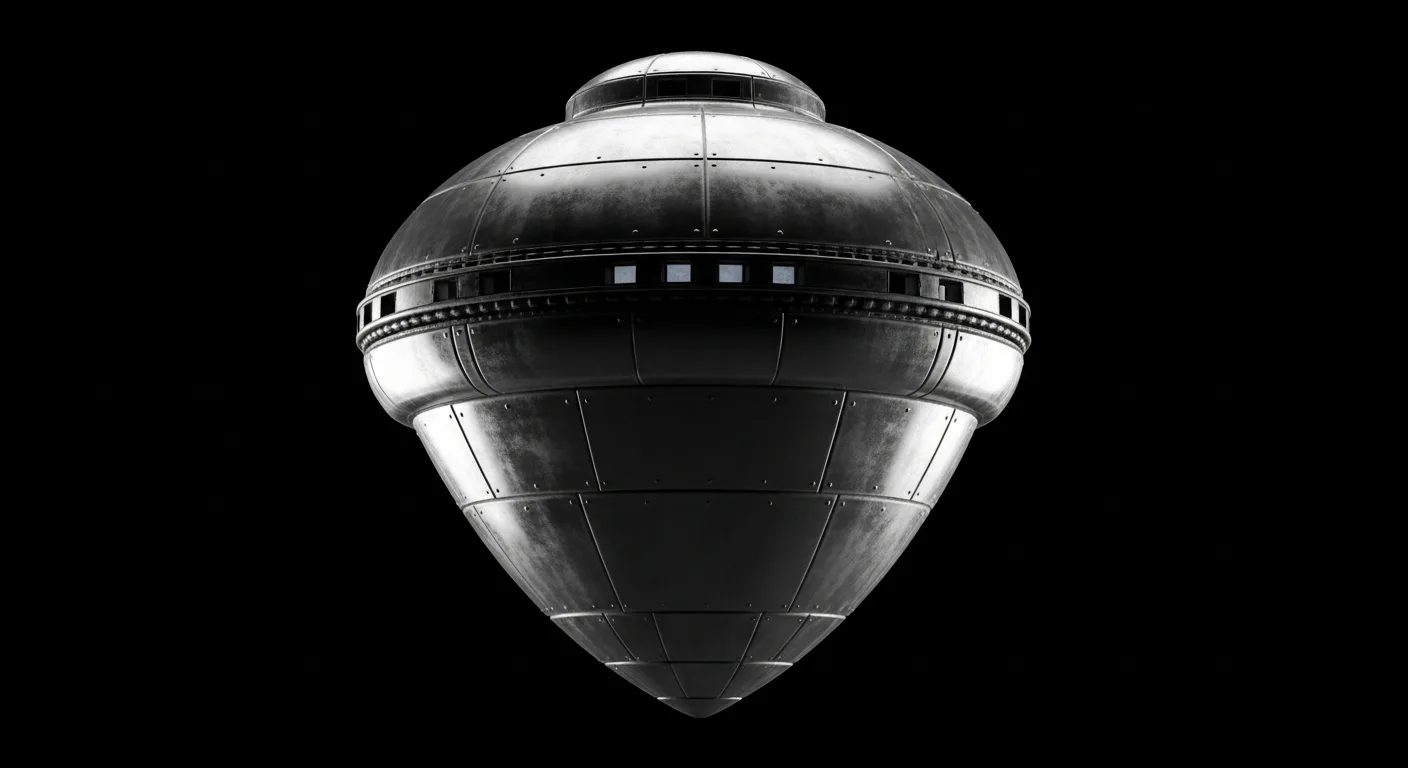
On the evening of December 11, 1996, the vast wilderness of Canada’s Yukon Territory became the stage for one of the most remarkable UFO sightings in the nation’s history. Across a stretch of frozen highway spanning more than two hundred miles, at least thirty-one witnesses in separate communities independently reported seeing the same object drifting through the subarctic sky. What they described was not some distant point of light or fleeting streak across the heavens. It was an enormous craft, estimated by investigators to be well over a mile in length, moving slowly and silently over the boreal forests at shockingly low altitude. The sheer scale of the object, the number of credible witnesses, and the meticulous investigation that followed have earned the Yukon Mothership incident a place among Canada’s most compelling and best-documented UAP cases.
The Yukon in December
To appreciate the circumstances of this sighting, one must understand the particular character of the Yukon Territory in midwinter. By December, the region is locked in near-perpetual darkness. The sun barely crests the horizon before retreating, leaving the landscape illuminated for only a handful of hours each day. Temperatures plunge to forty below, and the communities scattered along the Alaska Highway and the Klondike Highway exist as small islands of warmth and light in an immense ocean of wilderness. Towns like Carmacks, Pelly Crossing, and Fox Lake are separated by long stretches of empty road winding through spruce forests and frozen river valleys, with populations measured in the hundreds rather than thousands.
This isolation is precisely what makes the Yukon sighting so compelling. The witnesses were not clustered in a single location where mass hysteria or a shared misidentification might explain their reports. They were spread across an enormous geographic area, in separate communities with no rapid means of communication between them. Many did not learn until days or weeks afterward that others had seen the same thing. When their accounts were finally collected and compared, the consistency was striking and deeply unsettling.
The evening of December 11 was clear and cold, the kind of still winter night when sound carries for miles and the sky is a crystalline dome of stars. These were ideal conditions for observation, and the witnesses who stepped outside that evening had an unobstructed view of whatever passed over their communities.
First Contact: Fox Lake
The earliest reports came from the Fox Lake area, a small community situated along the highway between Whitehorse and Carmacks. Shortly after darkness had fully settled, residents noticed unusual lights in the sky to the north. At first, some assumed they were seeing aircraft navigation lights or perhaps the northern lights beginning one of their periodic displays. But the lights were too large, too steady, and too low. They did not flicker or dance like aurora borealis. They moved with deliberate purpose, maintaining a fixed relationship to one another as if attached to a single enormous structure.
One Fox Lake witness, a woman who had lived in the Yukon for decades and was thoroughly familiar with the northern sky, stepped onto her porch to get a better look. What she saw stopped her cold. An immense dark shape was moving across the sky, blotting out the stars behind it. The object was so large that it filled a substantial portion of her field of vision, and it was close enough that she could make out structural details on its underside. Rows of lights, some white and some with a faint colored tinge, were arranged in what appeared to be deliberate patterns along the craft’s surface. The object moved with agonizing slowness, as if it had no particular destination in mind and all the time in the world to get there.
Most remarkably, the object made no sound whatsoever. In the profound silence of a Yukon winter night, where a snapping twig can be heard from hundreds of yards away, this enormous craft glided past without producing so much as a whisper. No engine noise, no rotor wash, no sonic disturbance of any kind. The silence was, for many witnesses, the most unnerving aspect of the entire experience. Something that large, moving through the atmosphere at such low altitude, should have produced tremendous noise. Its silence seemed to violate the basic physics that governed every aircraft the witnesses had ever encountered.
Carmacks and Beyond
As the object continued its slow transit to the southeast, it passed over or near the village of Carmacks, a community of several hundred people situated at the junction of the Klondike Highway and the Yukon River. Here, additional witnesses independently observed the craft. Their descriptions matched those from Fox Lake with remarkable precision: an enormous dark structure, rows of lights, impossibly low altitude, and absolute silence.
A truck driver who was on the highway between Carmacks and Pelly Crossing had one of the closest encounters. He noticed the lights ahead of him and initially assumed they belonged to some kind of large aircraft, perhaps a military transport on a nighttime exercise. As he continued driving, the lights grew larger and closer, and he gradually realized that what he was seeing was far too large and far too low to be any conventional aircraft. He pulled his truck to the shoulder and stepped out into the frigid air.
The object passed almost directly overhead. The driver later estimated that it was no more than a few hundred feet above the treetops. At that range, the sheer scale of the craft was overwhelming. It stretched from one horizon to the other, or so it seemed, a dark mass punctuated by rows of steady lights. The driver could make out what appeared to be rectangular sections or panels on the underside, as if the craft were composed of multiple connected segments. He stood in the bitter cold watching it pass for what he estimated was several minutes, an eternity for an object to take to cross his field of view, and a testament to its extraordinary size.
The sighting continued as the craft moved over Pelly Crossing and other small communities along its path. At each location, witnesses emerged from their homes or vehicles to stare upward in astonishment. Some called neighbors; others simply watched in stunned silence. A few attempted to photograph the object, but in the pre-smartphone era of 1996, with nothing but consumer film cameras readily available, and given the combination of darkness and the object’s dark surface, no photographs of sufficient quality were produced.
What the Witnesses Saw
When the accounts from all thirty-one known witnesses were eventually compiled and analyzed, a remarkably consistent picture emerged. The object was described as enormous, vastly larger than any known aircraft. Most witnesses struggled to find adequate comparisons for its size, falling back on descriptions like “bigger than a football field” or “it blocked out a huge section of the sky.” When investigators later used the witnesses’ angular size estimates and calculated distances to arrive at an actual dimension, the figure they produced was staggering: the object appeared to be at least one mile in length, and possibly larger.
The craft’s shape was generally described as elongated, more rectangular or cigar-shaped than disc-shaped, though some witnesses perceived it as having a rounded or irregular outline. Several witnesses independently reported that the object appeared to be composed of multiple connected sections, almost like a train of linked compartments or a series of barges lashed together. This segmented appearance was one of the most distinctive and consistently reported features.
The lights were arranged in rows along the object’s underside and sides. Most witnesses described them as steady white or yellowish lights, though some reported seeing lights of other colors, including red and green. The lights did not blink or flash in the manner of conventional aircraft navigation lights. Several witnesses described what appeared to be a row or bank of windows along a portion of the craft, as if illuminated from within. This detail, the suggestion of windows and therefore of interior spaces, was particularly striking, as it implied a craft built to be inhabited rather than a natural phenomenon or piece of space debris.
The object’s movement was uniformly described as slow and steady. It did not accelerate, decelerate, or change direction during any of the observed periods. It simply drifted across the sky at what witnesses estimated to be a leisurely walking pace or perhaps the speed of a blimp, far too slow for a conventional airplane at such low altitude, which would have stalled and fallen from the sky. And through it all, the silence persisted. Not a single witness reported hearing any sound from the object.
The Investigation
The Yukon sighting might have faded into the vast archive of unverified UFO reports had it not been for the diligent work of Martin Jasek, a professional engineer and UFO researcher associated with UFO*BC, a British Columbia-based research organization. Jasek learned of the sighting shortly after it occurred and recognized its potential significance. Over the following months and years, he conducted an exhaustive investigation that would elevate the Yukon case from local curiosity to international prominence.
Jasek traveled repeatedly to the Yukon to conduct in-person interviews with witnesses. He approached each interview with methodical precision, asking witnesses to describe what they had seen in their own words before showing them any other accounts or asking leading questions. He had witnesses draw what they had observed, producing a collection of sketches that, when compared, showed striking similarities despite being produced independently by people who had not communicated with one another about their experiences.
The investigation benefited from the character of the witnesses themselves. These were not UFO enthusiasts or attention-seekers. They were truck drivers, homemakers, First Nations community members, highway workers, and other ordinary residents of the Yukon going about their winter routines. Many were reluctant to discuss what they had seen, fearing ridicule. Several agreed to share their accounts only on condition of anonymity. Their reluctance to come forward actually strengthened their credibility, as these were people reporting something they had seen despite having no desire for the attention it might bring.
Jasek painstakingly mapped each witness’s location at the time of their sighting, the direction they were facing, and the apparent position and movement of the object. When these data points were plotted together, they traced a coherent flight path across the Yukon Territory, confirming that the witnesses in different communities had indeed been observing the same object as it moved across the region. The geographic spread of the sightings also allowed Jasek to triangulate the object’s approximate altitude and size, producing the remarkable estimate of over one mile in length.
Ruling Out the Ordinary
A critical component of Jasek’s investigation was the systematic elimination of conventional explanations. He checked military flight records, commercial aviation logs, and weather data for the evening in question. No military exercises were scheduled in the area. No commercial flights matched the object’s reported position, altitude, or flight path.
Weather balloons and satellites were considered and rejected. No balloon could account for the object’s reported size, and satellites do not hover at treetop level or present the kind of structural detail the witnesses described. The northern lights, while active in the region, produce a distinctive visual signature nothing like what was reported. A meteor or satellite reentry would have lasted seconds, not the minutes that witnesses spent watching the object traverse the sky.
Could the witnesses have seen a formation of conventional aircraft flying in tight arrangement? The silence and the apparent structural unity of the object argued powerfully against this. Conventional aircraft in formation produce significant engine noise, and even at a distance their individual identities are apparent to the trained eye. The Yukon witnesses were not seeing separate objects moving together. They were seeing a single, unified mass.
The possibility of atmospheric optical illusions, such as temperature inversions creating mirages of distant lights, was similarly untenable. The detail reported by close-range witnesses, including apparent windows, structural features, and the clear occlusion of stars behind a solid body, ruled out any explanation involving the refraction or reflection of light from distant sources. Whatever the witnesses saw, it was physically present in the sky above them.
Characteristics That Defy Explanation
Several features of the Yukon Mothership case set it apart from more ambiguous UAP reports and make conventional explanations particularly difficult to sustain.
The first is the object’s size. An airborne structure more than a mile in length has no parallel in human engineering, either in 1996 or today. The largest aircraft ever built, the Antonov An-225 Mriya, had a wingspan of roughly eighty-eight meters. The largest airships in history, the Hindenburg-class zeppelins, were approximately eight hundred feet long. Even the most conservative estimate of a mile, five thousand two hundred and eighty feet, exceeds the largest human-made aircraft by an order of magnitude.
The second is the silence. Any conventional craft of such size moving at low altitude through dense atmosphere would generate enormous aerodynamic noise. The complete absence of sound suggests either a propulsion system entirely unlike anything in current human technology or a phenomenon that does not interact with the atmosphere in expected ways.
The third is the slow speed at low altitude. Fixed-wing aircraft must maintain a minimum speed to generate sufficient lift, and an object the size of what was reported could not sustain flight at the described speed using any known aerodynamic principle. It would have needed some other means of staying aloft, pointing again to technology or physics beyond current human capability.
The fourth is the sheer number of independent witnesses spread across such a vast geographic area. A single witness can be mistaken. A group of witnesses in one location can influence each other’s perceptions. But thirty-one witnesses in multiple communities separated by hundreds of miles, all describing the same object with consistent details, represents a fundamentally different order of evidence.
A Place in Canadian UAP History
The Yukon Mothership sighting holds a distinguished position in the annals of Canadian ufology. Canada has a long and rich history of UAP encounters, from the famous Falcon Lake incident of 1967 in Manitoba to the Shag Harbour crash of the same year in Nova Scotia. The Yukon case is frequently cited alongside these classics as one of the most significant Canadian sightings, and some researchers rank it as the single best-documented multi-witness case in the country’s history.
The case is also notable for the quality of its investigation. Jasek’s methodical approach, conducting interviews before witnesses could compare notes, collecting independent drawings, mapping sighting locations, checking conventional explanations, and publishing his findings in detail, set a standard for UAP research that is frequently cited as a model for the field. His work demonstrated that civilian researchers, applying rigorous methodology, could produce documentation of UAP events that rivals or exceeds what government agencies typically generate.
The Yukon sighting occurred during a period of heightened UAP activity in northern Canada and Alaska that some researchers have noted but never fully explained. The remote, sparsely populated regions of the subarctic may see more UAP activity than is commonly recognized, simply because there are so few people present to observe and report it. The December 1996 event was witnessed only because the object happened to pass over the thin ribbon of highway and the small communities strung along it. Had its path been fifty miles to either side, it would have traversed nothing but uninhabited wilderness, and no human eye would have recorded its passage.
An Enduring Mystery
For the people who saw the Yukon Mothership, the experience was not an abstract data point in a researcher’s file. It was a moment that divided their lives into before and after. Many described a profound sense of awe mixed with fear, the overwhelming realization that they were seeing something that should not exist, something that overturned their understanding of what was possible. Some witnesses reported difficulty sleeping in the days and weeks following the sighting. Others found themselves scanning the sky obsessively, hoping and dreading in equal measure that the object might return.
The passage of decades has not dimmed these memories. Witnesses interviewed years after the event recalled details with vivid clarity, their accounts remaining consistent with what they had reported in the immediate aftermath. Whatever psychological processes govern the formation and preservation of memory, the Yukon sighting clearly produced the kind of deep, indelible impression that researchers associate with experiences of overwhelming significance.
More than a quarter century after that cold December evening, the Yukon Mothership remains unexplained. No government has claimed responsibility for the object. No military program has been revealed that could account for it. No natural phenomenon has been identified that matches the witnesses’ descriptions. The case sits in the uncomfortable category of events that are too well-documented to dismiss but too extraordinary to easily accept.
The Yukon wilderness keeps its own counsel. The spruce forests and frozen rivers along the highway between Whitehorse and Dawson City look much the same today as they did in 1996. The communities where the witnesses lived and watched continue their quiet existence at the edge of the habitable world. The sky above them remains vast and dark in the long winter nights, offering no answers to those who search it for a return of what passed through on that singular evening. Whatever crossed the Yukon sky on December 11, 1996, whether it was a craft from somewhere beyond our understanding, a phenomenon of atmospheric physics yet to be catalogued, or something else entirely, it left behind thirty-one people who know what they saw, an investigator’s meticulous file of evidence, and a mystery that the passage of time has done nothing to resolve.
Sources
- CIA UFO/UAP Reading Room — Declassified CIA documents on UAP