The Ilkley Moor Alien Encounter
A former policeman photographed an alien entity on a Yorkshire moor.
On the morning of December 1, 1987, a former police officer named Philip Spencer set out to cross Ilkley Moor in West Yorkshire with a camera and a compass, hoping to photograph the strange lights that had been reported over the moorland in recent weeks. What he brought back from that crossing was something far more extraordinary than lights in the sky: a photograph that appears to show a small, humanoid entity standing on the open moor, the only image of its kind taken in the United Kingdom and one of the most debated pieces of photographic evidence in the history of UFO research. Spencer also returned with a compass whose polarity had reversed, a gap in his memory that hypnotic regression would later fill with disturbing recollections, and a story that has resisted explanation for nearly four decades. The Ilkley Moor encounter stands as one of Britain’s most compelling alien contact cases, combining photographic evidence, physical effects, missing time, and abduction memories in a single incident witnessed by a man whose professional background lends weight to his account.
The Moor Above Ilkley
Ilkley Moor is part of a larger moorland known as Rombalds Moor, a vast expanse of heather, peat bog, and gritstone outcrops that rises above the spa town of Ilkley in West Yorkshire. The moor is one of the most famous landscapes in England, immortalized in the Yorkshire anthem “On Ilkla Moor Baht ‘at” and cherished by walkers, historians, and nature lovers for its wild beauty and its extraordinary concentration of prehistoric remains.
The moor’s surface is dotted with cup-and-ring marks, ancient carvings pecked into the gritstone boulders by people who lived here during the Bronze Age, between three thousand and four thousand years ago. The purpose of these carvings is unknown, though theories range from astronomical maps to ritual markers to territorial boundaries. The Swastika Stone, one of the most elaborate prehistoric carvings in Britain, sits on the moor’s edge, its complex pattern echoing designs found thousands of miles away in Scandinavia and the Mediterranean. The Twelve Apostles, a circle of standing stones on the moor’s southern slopes, bears witness to ceremonial activities that predated written history by millennia.
This deep antiquity gives Ilkley Moor an atmosphere that is qualitatively different from the surrounding lowlands. Walking on the moor, particularly in the early morning mist or the fading light of a winter afternoon, one has the sense of moving through a landscape that is not entirely of this time, a place where the distant past feels very close and the boundaries between eras seem permeable. The prehistoric people who carved the stones and erected the circles clearly found something significant about this place, and their marks on the landscape suggest a relationship with the moor that went beyond the merely practical.
The moor has also generated a modern folklore of unusual phenomena. Lights in the sky over Ilkley Moor have been reported intermittently for decades, bright objects that move in ways inconsistent with conventional aircraft and that sometimes hover for extended periods before departing at high speed. These reports have attracted the attention of UFO researchers, who have identified the moor as another possible window area, a location where anomalous phenomena occur with greater frequency than the statistical average. Whether the ancient carvings and the modern sightings are connected in any meaningful way is a question that has fascinated researchers but that remains, like so much about Ilkley Moor, unanswered.
Philip Spencer
The witness to the Ilkley Moor encounter, Philip Spencer, was a former police officer who had left the force and was living in the Ilkley area at the time of his experience. His background in law enforcement is significant for several reasons. Police officers are trained in observational skills, in the accurate recording of events, and in distinguishing between what they have actually seen and what they think they might have seen. Spencer brought these professional habits to an experience that most people would have found overwhelming, and his conduct in the aftermath of the encounter reflects the discipline and methodical approach of his training.
Spencer was also a keen photographer, which is why he had his camera with him on the morning of the encounter. He had heard reports of unusual lights over the moor and decided to try to photograph them, setting out early in the morning when the lighting conditions would be most interesting and the moor most likely to be deserted. He carried a camera loaded with film and a compass to help him navigate across the featureless moorland. Both items would become significant pieces of evidence.
It is important to note that Spencer initially used a pseudonym when his case became public, and some early accounts refer to him under this assumed name. His decision to protect his identity was understandable given the ridicule that often accompanies claims of alien encounter, and his eventual willingness to be identified by his real name reflects his confidence in the truth of his account.
The Encounter on the Moor
Spencer set out across the moor in the early morning darkness of December 1, 1987, following a path from the village of Menston toward Ilkley. The morning was cold and overcast, typical of a December day in the Pennines, with limited visibility and a raw wind blowing across the open moor. The path he followed crossed areas of rough heather and peat, with gritstone boulders scattered across the landscape and occasional outcrops rising from the moorland surface.
As Spencer made his way across the moor, he noticed movement among the boulders ahead. A small figure was visible on the slope, apparently standing upright and facing in his direction. Spencer’s first assumption was that he was looking at another walker, someone else who had decided to brave the winter moor in the early morning. But as he looked more carefully, he realized that the figure was wrong in ways that he could not immediately articulate. It was too small, its proportions were strange, and its color, a greenish grey, was unlike any clothing he had ever seen.
The figure appeared to notice Spencer and made a gesture that he interpreted as a wave, raising one arm in a motion that seemed to beckon or acknowledge him. Spencer reacted instinctively, raising his camera and taking a photograph. The action was reflexive, the trained response of a photographer confronted with an unexpected subject, and Spencer squeezed the shutter without taking time to compose the shot properly or to adjust his settings.
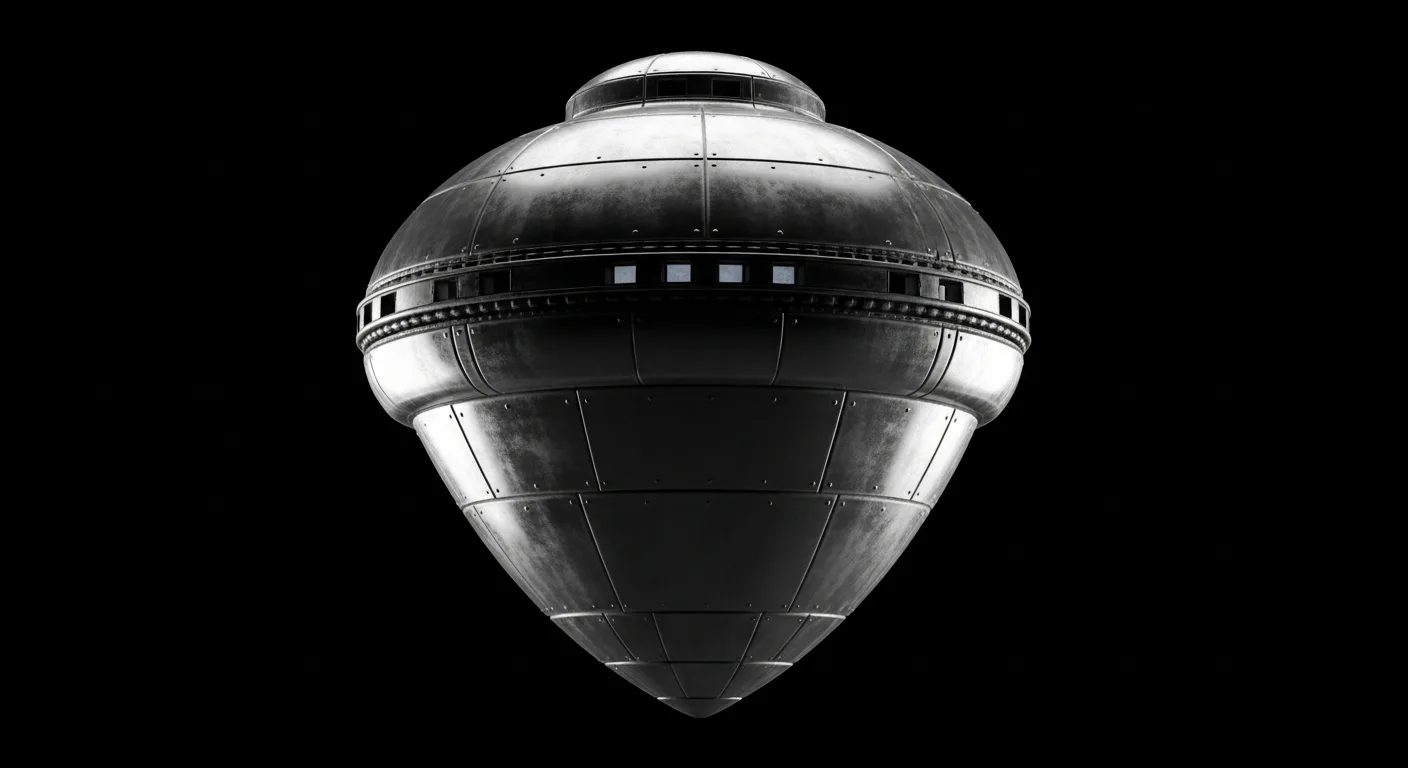
The figure then turned and moved away from Spencer, heading up the slope toward a rocky outcrop. Spencer gave chase, driven by a combination of curiosity and the professional instinct to investigate an unusual event. As he crested the rise, he saw the figure again, but now it was near what appeared to be a large, domed object resting on or hovering just above the ground. The object was metallic in appearance and of considerable size. Before Spencer could take another photograph, the object rose rapidly and departed, climbing at speed into the low cloud cover and vanishing from sight.
The Missing Time and Physical Evidence
Spencer continued across the moor to the village of Ilkley, arriving later than he had expected. The walk should have taken him a specific amount of time based on his pace and the distance, and the discrepancy between his expected and actual arrival time indicated that he had lost approximately one to two hours during the crossing. Spencer had no memory of anything that could account for this lost time. His recollection was of a continuous walk from the sighting of the entity to his arrival in Ilkley, but the clock told a different story.
The first piece of physical evidence Spencer discovered was his compass. Before setting out that morning, he had checked the compass and confirmed that it was functioning normally, with the needle pointing to magnetic north as expected. Upon his arrival in Ilkley, he checked the compass again and found that the polarity had reversed: the needle was pointing south. This reversal was subsequently confirmed by independent testing. Compass polarity reversal can be caused by exposure to a strong magnetic field, and the fact that Spencer’s compass had been functioning normally before the moor crossing and was reversed afterward suggested that he had been subjected to an unusual electromagnetic environment during his walk.
The compass was examined by experts who confirmed that the polarity reversal was genuine and not the result of manufacturing defect or normal wear. The strength of the magnetic field required to reverse a compass needle is considerable and would not be encountered in any normal outdoor environment. This physical evidence provided objective support for Spencer’s claim that something unusual had occurred on the moor, independent of his subjective experience and the controversial photograph.
The Photograph
The photograph that Spencer took on Ilkley Moor has been the most analyzed, debated, and controversial element of the entire case. The image shows a small figure standing on the open moorland, partially obscured by the terrain, with one arm raised in the gesture that Spencer described as a wave or beckoning motion.
The figure in the photograph is dark in color, humanoid in shape, and appears to be standing upright. Its proportions are unusual, with a head that seems large relative to its body and limbs that appear thin and elongated. The figure’s surface appears smooth, without visible clothing, hair, or other features that would identify it as a human being in outdoor attire. The image quality is limited by the conditions under which it was taken: early morning light, overcast sky, the distance between camera and subject, and the haste of the exposure.
The photograph was analyzed by multiple experts, with results that ranged from cautious validation to outright dismissal. Kodak examined the negative and confirmed that it had not been tampered with; the image on the negative was consistent with a single exposure of a genuine scene rather than a composite or double exposure. Wildlife photography experts examined the figure and concluded that it did not match the proportions of any known animal likely to be found on English moorland. Computer enhancement of the image revealed additional details consistent with a three-dimensional figure standing in the landscape rather than a flat cutout or model.
Critics of the photograph have proposed several alternative explanations. The most common suggestion is that the figure is a person, perhaps a child or small adult, wearing unusual clothing and photographed at a distance that makes positive identification impossible. Others have suggested that the figure might be an animal, a rock formation, or an artifact of the photographic process. The ambiguity of the image means that neither believers nor skeptics can claim definitive support for their position, and the photograph remains in the frustrating category of evidence that is suggestive but not conclusive.
The Hypnotic Regression
Like PC Alan Godfrey in Todmorden seven years earlier, Spencer was troubled by his missing time and eventually agreed to undergo hypnotic regression to explore what might have occurred during the gap in his memory. The sessions were conducted by Jim Singleton, an experienced clinical hypnotherapist, and were recorded for analysis.
Under hypnosis, Spencer recalled being taken from the moor into a craft, the domed object he had briefly glimpsed before it departed. He described being in a circular room that was white and brightly lit, without visible light sources. Small beings were present, similar in appearance to the entity he had photographed, approximately four feet tall with large heads and large, dark eyes. They communicated with him, though Spencer was unclear about whether this communication was verbal or telepathic.
Spencer described being shown images, projected onto a screen or directly into his mind, that depicted environmental destruction: polluted landscapes, dying ecosystems, and what he interpreted as warnings about humanity’s treatment of the Earth. This ecological message is a recurring element in abduction accounts from the 1980s and has been interpreted variously as evidence of genuine extraterrestrial concern, as a reflection of contemporary environmental anxieties projected into the abduction narrative, or as a confabulation influenced by the cultural context of the period.
He was also subjected to a physical examination, though his memories of this aspect of the experience were less detailed and more distressing. The examination involved being placed on a flat surface and scanned or probed by instruments he could not describe. The small beings conducted the examination with clinical efficiency, showing no emotion or response to Spencer’s discomfort.
The hypnotic regression memories are, as always, controversial. Critics argue that hypnosis does not recover genuine memories but instead facilitates the creation of false memories that the subject then experiences as real. Supporters counter that the emotional authenticity of Spencer’s responses during the sessions, his visible distress, his reluctance to describe certain details, and the consistency of his account with other abduction reports suggest that the memories, whatever their ultimate nature, represent something more than simple fantasy.
The Case for Authenticity
Several factors distinguish the Ilkley Moor case from the majority of alien encounter reports and contribute to its reputation as one of the most credible cases in British UFO research.
The photographic evidence, while ambiguous, exists. In a field where most claims are supported by nothing more than testimony, Spencer’s photograph provides a tangible artifact that can be examined, analyzed, and debated. The fact that the negative was verified as genuine by Kodak rules out the most straightforward forms of photographic hoaxing and ensures that any explanation must account for the presence of the figure in the landscape at the time the photograph was taken.
The compass polarity reversal provides physical evidence of an unusual electromagnetic event occurring during the time and in the location of Spencer’s experience. This evidence is independent of Spencer’s testimony and cannot be explained by suggestion, expectation, or psychological factors. Something happened on Ilkley Moor that morning that was powerful enough to reverse the polarity of a compass needle, and that something remains unexplained.
Spencer’s background as a former police officer, while not guaranteeing the truth of his account, provides a foundation of credibility that many witnesses lack. His training in observation and reporting, his familiarity with the distinction between fact and interpretation, and his professional commitment to accuracy all suggest that his account represents a sincere attempt to describe what he experienced rather than a fabrication or fantasy.
The consistency of Spencer’s account over the decades is also significant. He has told essentially the same story from the beginning, without the escalation or elaboration that might be expected from someone who was inventing or embellishing. His demeanor in interviews is measured and modest, lacking the grandiosity or attention-seeking behavior that sometimes accompanies dubious claims.
The Moor Remembers
Ilkley Moor continues to attract visitors drawn by its beauty, its history, and its mysteries. The prehistoric carvings still mark the stones, their meanings as obscure as they were four thousand years ago. The standing stones still stand, their alignment with the sky preserved across millennia. And the path that Spencer walked on that December morning in 1987 still crosses the moor, open to anyone who cares to follow it.
Unusual light phenomena continue to be reported over the moor, bright objects that move against the wind, hover over specific locations, and depart at speeds that conventional aircraft cannot match. Whether these lights are connected to Spencer’s experience, to the ancient carvings that mark the moor, or to something else entirely is a question that the moor does not answer. The landscape holds its secrets with the same impassive patience that has characterized it for thousands of years, its boulders and outcrops offering no commentary on the extraordinary events that may or may not have occurred among them.
The Ilkley Moor encounter remains one of the few British cases in which photographic evidence, physical effects, missing time, and recovered abduction memories converge in a single incident. The photograph, imperfect as it is, continues to be studied and debated. The compass, with its reversed polarity, continues to challenge those who would dismiss the case as mere fantasy. And Philip Spencer, the reluctant witness who set out to photograph lights and captured something else entirely, continues to maintain that what happened to him on the moor that morning was real, was physical, and was unlike anything he had ever experienced before or since.
The moor stretches away under grey Yorkshire skies, its heather and peat absorbing the rain that falls with such regularity on this elevated landscape. The ancient stones bear their inscrutable markings. The wind moves across the open ground with the same indifference it has shown for millennia. Whatever secrets Ilkley Moor holds, it holds them close, offering glimpses to those who cross its surface but never full revelation. Philip Spencer crossed the moor one December morning and came back changed, carrying evidence that something had happened but unable to prove exactly what. The moor itself, as always, says nothing.
Sources
- CIA UFO/UAP Reading Room — Declassified CIA documents on UAP
- UK National Archives — UFO Files — MoD UFO investigation records
- British Newspaper Archive — UK press archive