Men in Black Phenomenon
Strange men in black suits visit UFO witnesses, warning them to stay silent about their experiences. They drive vintage cars, speak robotically, and seem unfamiliar with basic human behavior.
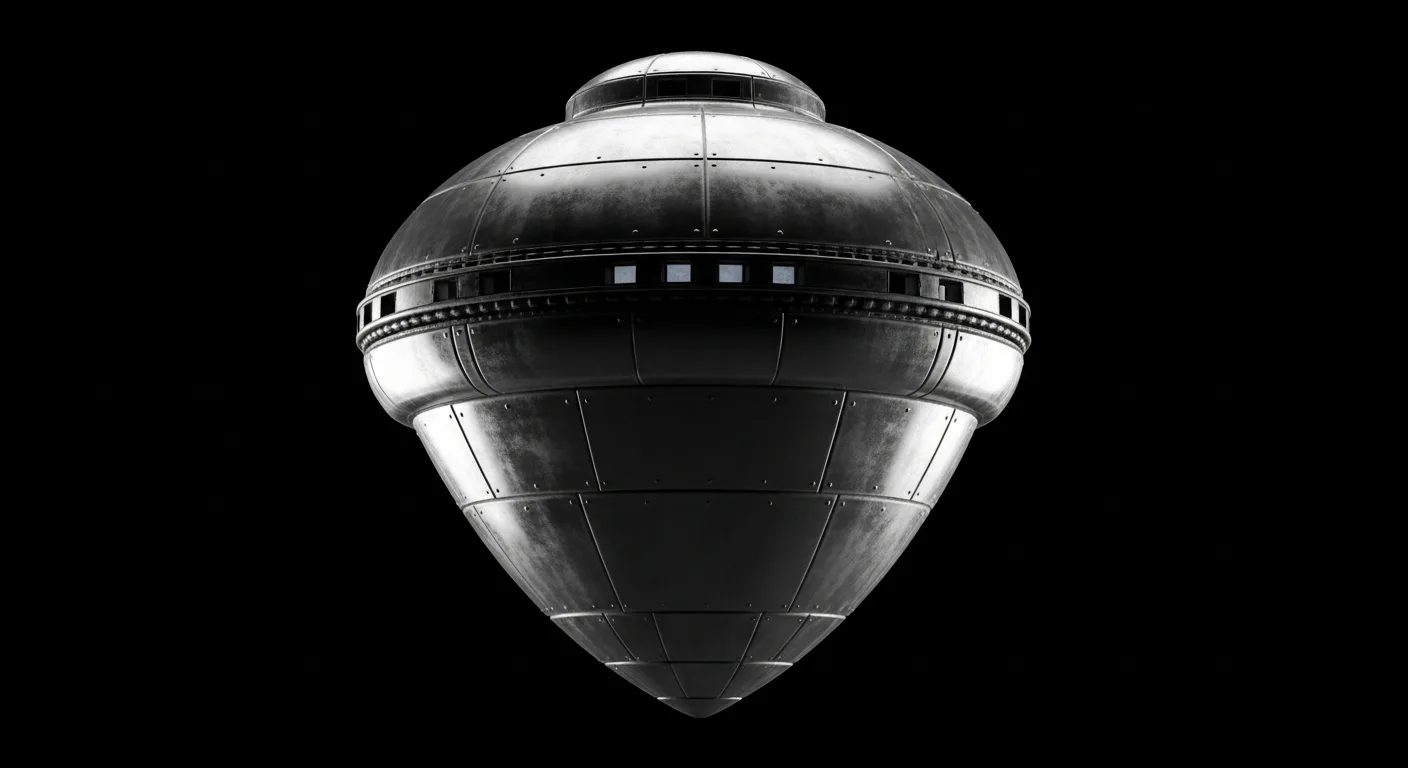
Men in Black arrive after you see something you weren’t supposed to see. Three men in black suits, driving vintage cars, speaking without inflection. They know your name. They know what you saw. And they tell you to forget it—all of it. The Men in Black have been visiting UFO witnesses since 1947, and no one knows who or what they are.
The phenomenon of the Men in Black is characterized by a series of reported encounters following sightings of unidentified flying objects. These encounters typically involve figures dressed in outdated black suits, speaking in a monotone voice that seems confused and robotic. Common elements across these reports include three men in black suits, often with pale or waxy skin, strange speech patterns, and a baffling lack of familiarity with ordinary objects such as pens or food. Frequently, they arrive in Black Cadillacs or other vintage vehicles, and they exhibit an unsettling knowledge of details not publicly available, accompanied by threats or warnings to remain silent.
Notable cases of reported MIB encounters include that of Albert Bender in 1953, the founder of the International Flying Saucer Bureau, who shut down his organization and refused to discuss UFOs for years after claiming to have been visited by three such figures. John Keel documented numerous MIB reports during his investigations in the 1960s, as detailed in his book “The Mothman Prophecies.” In 1976, Dr. Herbert Hopkins, a Maine doctor involved in a UFO case, was visited by a bald man in black with lipstick-like lips who made a coin vanish and warned Hopkins to destroy his files.
Several theories attempt to explain the existence of the Men in Black. The simplest explanation is that they are government intelligence operatives silencing witnesses. However, their behavior is often too bizarre for professional agents to convincingly portray. Alternatively, some believe they are extraterrestrials—or their agents—monitoring human UFO awareness, or perhaps even entities from another reality, interdimensional beings unfamiliar with our world. Other theories suggest they are tulpas, beings created by collective consciousness, or simply a hoax or folklore, a manufactured urban legend that people expect and therefore “see.”
What makes MIB reports particularly odd is their apparent unfamiliarity with human norms. Witnesses often report questions about what food is or how to use utensils, the presence of waxy, artificial skin, the absence of eyebrows or eyelashes, ill-fitting suits, and an inability to understand jokes or sarcasm.
The Men in Black have had a significant cultural impact, perhaps disproportionate to the actual number of credible reports. They directly inspired the comic book series and subsequent “Men in Black” film franchise, which transformed the figures from threatening enigmas into comedic government agents. They have shaped UFO research and literature for decades, contributed substantially to broader conspiracy culture, and influenced television and film narratives ranging from “The X-Files” to “Dark Skies.” The visual shorthand of the dark suit, the black sedan, and the intrusive visit has become so embedded in popular culture that it now operates almost independently of the actual reports it derives from.
The historical development of the phenomenon is itself worth tracing. The earliest reports cluster in the late 1940s and 1950s, contemporary with the foundation of the modern UFO era. Albert Bender’s 1953 account, in which he claimed three black-suited men appeared in his Connecticut home and made him so afraid that he disbanded the International Flying Saucer Bureau, is generally considered the foundational case. Gray Barker’s 1956 book “They Knew Too Much About Flying Saucers” amplified Bender’s account and effectively launched the MIB genre into public awareness. Through the 1960s John Keel collected dozens of similar reports during his Mothman investigations in West Virginia, and by the 1970s the phenomenon had crystallised into a recognisable subset of UFO experience.
The Hopkins case in 1976 is particularly significant in the literature. Dr. Herbert Hopkins, a Maine physician who had been involved in hypnotising a UFO witness, reported a visit from a man whose appearance was so anomalous—lipsticked mouth, no facial hair, ill-fitting suit—that the encounter strained even seasoned investigators’ willingness to accept it at face value. The visitor reportedly performed an apparent demonstration of paranormal ability by causing a coin in Hopkins’s palm to fade and disappear, before warning the doctor to destroy his case files and leave UFO research alone. Hopkins did so. The case has been retold in numerous publications and represents one of the higher-profile mid-period MIB encounters.
Skeptical analysis of the MIB phenomenon has produced a range of explanations. The simplest is that some reports reflect genuine government interviews conducted by agents of varying agencies, whose unfamiliarity with civilian conventions and instructions to behave with deliberate authority produced the strangeness witnesses describe. Others may reflect deliberate hoaxing by conspiracy enthusiasts or individuals seeking attention. A substantial proportion likely reflects genuine but ordinary encounters that have been retroactively reframed through the cultural template established by Bender, Barker, and Keel. The cumulative effect of decades of MIB literature has produced an expectation among UFO witnesses that visits of this kind are part of the experience, and expectation is a powerful shaper of memory.
Ultimately, the question remains: Are Men in Black government disinformation agents? Are they part of an alien monitoring program? Are they interdimensional entities? Or are they simply a collective hallucination shaped by decades of folklore and reinforced by media saturation? They have been reported for over seventy years, always after UFO sightings, always warning silence. Whatever they are, they remain one of the strangest aspects of UFO phenomena, a recurring figure at the boundary of the believable and the absurd, where the threatening and the comical occupy the same dark suit.
Sources
- Project Blue Book — National Archives — USAF UFO investigation files, 1947–1969
- CIA UFO/UAP Reading Room — Declassified CIA documents on UAP
- Chronicling America — Historic US newspapers (1690–1963)