Iran Military UAP Encounter (November 2020) — Mission Report
A 2020 mission report released via the PURSUE program details an unidentified object sighting recorded by U.S. government investigators in Iran.
Overview
In November 20
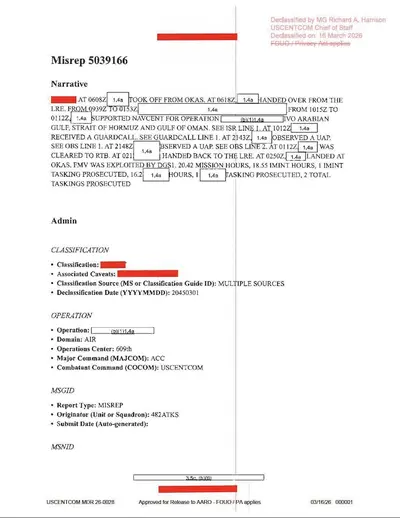
20, within the sovereign territory of Iran, U.S. government investigators recorded an unidentified-object incident that remained classified until its eventual release to the public on May 8, 2026. This disclosure occurred as a component of the Presidential Unsealing and Reporting System for UAP Encounters, known as PURSUE. The documentation regarding this specific event originates from U.S. Department of Defense archives and is categorized as a visual sighting reported by ground or air observers.
Historical Context and Documentation
The incident occurred during a period of heightened surveillance and systematic tracking of aerial anomalies, specifically during the era of the Advanced Aerospace Threat Identification Program and the subsequent Unidentified Aerial Phenomena Task Force. During this timeframe, the United States military and intelligence communities were transitioning from informal observation to more structured, standardized reporting protocols for objects of unknown origin. The document detailing the November 2020 encounter is a Mission Report, or MISREP, which serves as the standardized reporting form utilized by the U.S. military to document the specific circumstances, environmental conditions, and operational details surrounding military operations.
The release of this specific MISREP was made possible through the administrative functions of the PURSUE program, which was designed to provide transparency regarding previously withheld aerial data. While the released document provides a technical account of the encounter, it does not specify the exact number of witnesses involved in the sighting. The presence of such reports in Department of Defense files indicates that the event was captured through official investigative channels, even if the specific nature of the object remained unverified at the time of the report.
Phenomenological Analysis
The classification of this event as a visual sighting places it within a broad category of UAP encounters involving direct observation by personnel. In the study of aerial anomalies, visual sightings are often analyzed alongside radar tracks and electronic intelligence to determine if an object possesses physical properties inconsistent with known flight envelopes. The November 2020 case is characterized by this lack of definitive identification, leaving the object’s origin and composition a matter of ongoing archival interest.
Under the current regulatory framework, all records released through the PURSUE program are designated as unresolved by the All-domain Anomaly Resolution Office (AARO) by default. This designation reflects a rigorous scientific and intelligence-based standard of proof. The federal government has not reached a conclusion regarding whether the event was anomalous or produced by known technology. Consequently, the possibility of the object being an advanced, unidentified technology remains as valid in the official record as the possibility of it being a conventional phenomenon.
Potential Classifications
When evaluating unidentified aerial phenomena from this era, investigators typically consider a wide spectrum of conventional candidates. These include experimental aircraft or unmanned aerial systems developed by various nation-states, which may exhibit flight characteristics that appear unusual to observers. Atmospheric optical phenomena, such as the formation of sundogs or lenticular clouds, frequently create illusions of solid, moving objects. Additionally, astronomical objects such as the Moon, Venus, or meteors passing near the horizon can be misidentified as low-altitude craft during nocturnal or twilight operations. Historically, the investigation of such sightings has also been informed by the legacy of programs like the Project Mogul series of the late 1940s, which utilized high-altitude balloons to detect nuclear tests, illustrating the long-standing complexity of distinguishing between atmospheric debris and intentional aerial activity.
Sources
- Original release on war.gov
- Department of War UFO Disclosure Portal
- AARO (All-domain Anomaly Resolution Office)
- PURSUE record identifier: DOW-UAP-D064 (Release 01, May 8, 2026)