Mildenhall, England UFO Sighting (February 1, 1953) — FBI Files
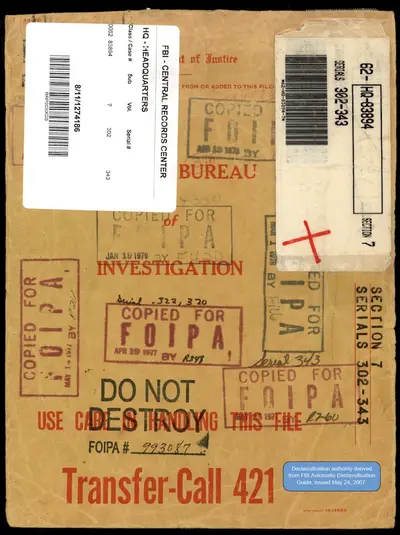
FBI documents reveal a 1953 report from Major Walkers regarding renewed interest in unidentified flying objects near Mildenhall, England.
Historical Context
The early 1950s represented a period of heightened tension and intense surveillance during the Cold War. Following the Soviet Union’s successful detonation of an atomic device in 1949, the United States and its allies maintained a state of constant vigilance regarding airspace security. This era was characterized by the emergence of the “flying saucer” phenomenon, a term popularized by sightings of unidentified aerial phenomena (UAP) in the late 1940s. During this time, the United States Air Force conducted various investigations, most notably through Project Blue Book and its predecessor programs, to determine whether these sightings represented Soviet technological advancements, secret experimental aircraft, or unknown natural phenomena.
The geography of the United Kingdom, particularly regions like Suffolk, played a critical role in this era of aerial monitoring. Bases such as RAF Mildenhall served as vital installations for United States Air Force operations, making the surrounding airspace a zone of high interest for both military and intelligence agencies. Because of the strategic importance of these installations, any reported anomaly in the vicinity was subject to rigorous reporting protocols. The Federal Bureau of Investigation maintained a structured system for handling such reports, utilizing field offices in cities such as Knoxville, Albuquerque, and Los Angeles to route information regarding potential threats to the protection of vital installations back to headquarters.
The 1953 Incident
On February 1, 1953, in Mildenhall, England, U.S. government investigators recorded an unidentified-object incident. The details of this specific event were not made available to the general public until May 8, 2026, when they were released as part of the Presidential Unsealing and Reporting System for UAP Encounters (PURSUE). The documentation regarding this case originated from a report made by Major Walkers, who contacted the FBI Legal Attache.
The report filed by Major Walkers did not describe a new, immediate sighting of an object in the sky, but rather focused on a renewed interest in the subject of “flying saucers.” In his communication, Major Walkers referenced a specific piece of media: an article published in a small New York newspaper during late 1946 or early 1947. This article had been written by a member of the U.S. Armed Forces. While the article brought attention to the phenomenon, the newspaper did not publish any subsequent follow-up stories regarding the subject. The released documentation does not specify the number of witnesses associated with the original 1946 or 1947 subject matter discussed by Major Walkers.
Classification and Analysis
The case is classified as a visual sighting reported by ground or air observers. Within the framework of mid-century investigations, such sightings were often analyzed against a variety of known variables. During the late 1940s and early 1950s, the presence of high-altitude surveillance projects, such as the Project Mogul series of weather balloons, provided a frequent conventional explanation for unidentified objects. Other common candidates for such reports included experimental aircraft, atmospheric optical phenomena like sundogs or lenticular clouds, and the movement of astronomical bodies such as Venus, the Moon, or meteors near the horizon.
Under the current oversight of the All-domain Anomaly Resolution Office (AARO), all records released through the PURSUE program are designated as unresolved by default. The federal government has maintained a neutral stance regarding the Mildenhall documentation, having reached no conclusion as to whether the events described were anomalous or conventional. The records remain part of the official archive of unidentified aerial phenomena, representing the bureaucratic efforts to track and categorize aerial anomalies during a period of global instability.