Circleville, Ohio UFO Sighting (June 1953) — FBI Files
In June 1953, a saucer-shaped object landed on a farm in Circleville, Ohio, leading to investigations by local authorities and the FBI.
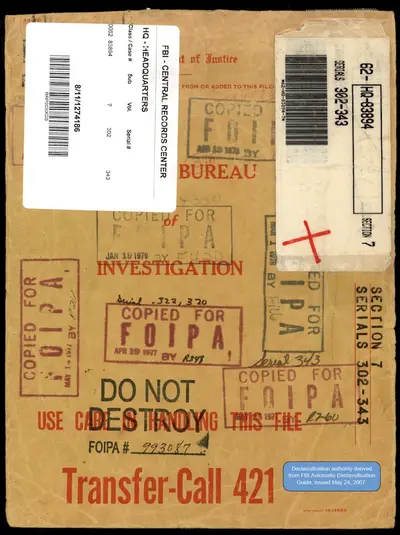
Background
In June 1953, in Circleville, Ohio, U.S. government investigators recorded an unidentified-object incident later released to the public on May 8, 2026, as part of the Presidential Unsealing and Reporting System for UAP Encounters (PURSUE). This case occurred during the height of the Cold War, a period characterized by intense atmospheric surveillance and heightened public anxiety regarding aerial intruders. The incident was investigated under the framework of the Air Force’s Project Blue Book or its predecessors, which were tasked with determining whether unidentified aerial phenomena posed a threat to national security. The documentation was filed with the Federal Bureau of Investigation, as the Bureau’s standing protocols required field offices in locations such as Knoxville, Albuquerque, and Los Angeles to route UFO reports to headquarters when they involved the potential protection of vital installations.
During this era, the United States government maintained a rigorous, albeit often secretive, monitoring system for any objects entering controlled airspace. The geopolitical climate of the 1950s meant that any unidentified craft was scrutinized through a lens of military capability, with investigators looking for evidence of Soviet technology or unauthorized reconnaissance. This specific case in Circleville emerged within a broader landscape of mid-century sightings that frequently involved disc-shaped or saucer-shaped descriptions, a terminology that became popularized following the Kenneth Arnold sighting in 1947.
What the document records
The primary account of the event originated from Bruce Stevenson, who reported a saucer-shaped object landing on his farm to local newspapers in June 1953. The legitimacy of the claim was bolstered by local law enforcement; Sheriff Radcliff confirmed the report and provided a character reference for the witness, stating that Stevenson was a trustworthy farmer. Following the initial report, Stevenson was visited by Jack Grant, an individual who claimed to be investigating flying saucer reports for the purposes of writing a book.
While the documentation provides specific details regarding the landing and the subsequent inquiries by Grant and local authorities, the released documents do not specify the total number of witnesses present during the event. This lack of a definitive witness count is common in many declassified files from this period, where the focus of the reporting often rested on the primary complainant and the official verification of their credibility by local officials.
Type of case
The witnesses involved in the June 1953 incident described the object as being disc- or saucer-shaped. This specific morphology was the most frequent descriptor used in unidentified aerial phenomena reports throughout the 1950s. Such descriptions often led investigators to consider various aerodynamic or optical possibilities, ranging from advanced propulsion systems to more mundane atmospheric occurrences.
Status
All records released under the PURSUE program are designated unresolved by the All-domain Anomaly Resolution Office (AARO) by default. The federal government has not concluded that the events were anomalous, has not concluded that they were conventional, and has not ruled out either possibility. This state of ambiguity reflects the broader difficulty in verifying mid-century sightings where physical evidence was often absent.
Conventional candidates for sightings of this period include experimental aircraft, weather balloons, particularly the Project Mogul series deployed in the late 1940s to detect Soviet nuclear tests, and atmospheric optical phenomena such as sundogs or lenticular clouds. Additionally, astronomical objects including Venus, the Moon, and meteors near the horizon were frequently misidentified as unidentified craft. The Circleville incident remains part of this ongoing historical ambiguity, awaiting further investigation or new technological analysis.