Dayton, Ohio UFO Sighting (October 1952) — FBI Files
In October 1952, a Navy photographer captured motion-picture film of unidentified objects over Dayton, Ohio, an incident later released via the PURSUE program.
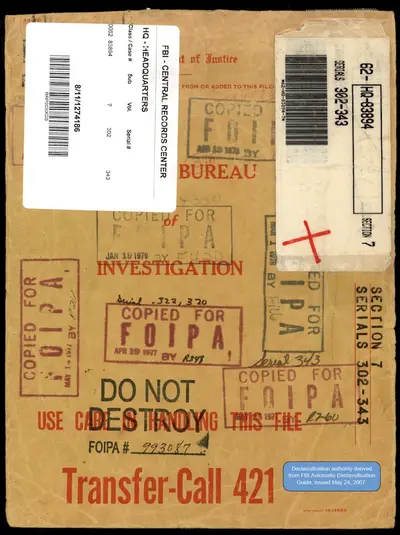
Background
In October 1952, in Dayton, Ohio, U.S. government investigators recorded an unidentified-object incident later released to the public on May 8, 2026, as part of the Presidential Unsealing and Reporting System for UAP Encounters (PURSUE). This event occurred during a period of heightened national anxiety regarding aerial unidentified phenomena. The incident is one of the first wave of “flying saucer” reports that swept the United States after the Kenneth Arnold sighting of June 1947 and the Roswell incident of July 1947. During this era, the Cold War landscape necessitated extreme vigilance regarding any unidentified aerial activity that could potentially represent Soviet technological advancements or incursions into American airspace.
The geographic location of Dayton played a significant role in the administrative handling of the report. As a hub for aeronautical engineering and military-industrial activity, the region was subject to rigorous monitoring. The case was filed with the Federal Bureau of Investigation, whose Knoxville, Albuquerque, Los Angeles, and other field offices routed UFO reports to headquarters under the Bureau’s standing protocols for the protection of vital installations. This systematic routing ensured that any sighting near sensitive military or technological infrastructure was centralized for federal review, reflecting the era’s focus on national security and the prevention of espionage.
What the document records
In October 1952, a Navy photographer captured approximately thirty-five feet of motion-picture film showing multiple objects in the sky. This physical evidence provided a level of empirical data that was rare among the many eyewitness accounts of the period. Experts at the Air Technical Intelligence Center studied the film and determined the objects were not weather balloons or other explainable phenomena. The analytical process involved scrutinizing the movement and characteristics of the objects captured on the medium to rule out known atmospheric or man-made distractions.
The investigators were unable to explain the sighting, and confirmed the objects could not be optical illusions as they were recorded on film. While the physical presence of the objects was captured on a medium that resisted the dismissal of mere visual trickery, the number of witnesses is not specified in the released document. The presence of motion-picture evidence elevated the case from a simple testimonial report to a documented anomaly requiring technical investigation by intelligence agencies.
Type of case
The case includes photographic or video evidence of the unidentified object. Such evidence is considered a high-priority category within the archive, as it provides a tangible record that can be subjected to forensic and technical scrutiny, distinguishing it from purely anecdotal accounts.
Status
All records released under the PURSUE program are designated unresolved by the All-domain Anomaly Resolution Office (AARO) by default. The federal government has not concluded that the events were anomalous, has not concluded that they were conventional, and has not ruled out either possibility. This lack of a definitive conclusion is standard for historical declassifications where the original investigative files do not contain a final determination of origin.
Conventional candidates for sightings of this period include experimental aircraft, weather balloons, especially the Project Mogul series in the late 1940s, atmospheric optical phenomena such as sundogs and lenticular clouds, and astronomical objects including Venus, the Moon, and meteors near the horizon. Despite the technical evaluation by the Air Technical Intelligence Center, the Dayton incident remains an open entry in the historical record of unidentified aerial phenomena.