Circleville, Ohio UFO Sighting (July 9, 1953) — FBI Files
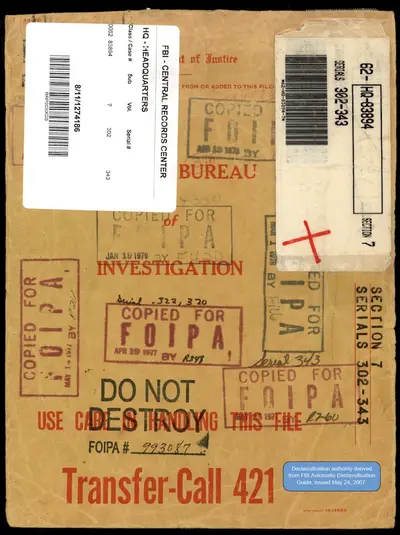
FBI records from July 1953 document an investigation into a saucer-shaped object sighting reported by Bruce Stevenson in Circleville, Ohio.
Background
On July 9, 1953, in Circelville, Ohio, U.S. government investigators recorded an unidentified-object incident later released to the public on May 8, 2026, as part of the Presidential Unsealing and Reporting System for UAP Encounters (PURSUE). The incident is a Cold War-era case investigated under the Air Force’s Project Blue Book or its predecessors. During this period, the United States was deeply immersed in a global struggle for technological and aerial supremacy, leading to heightened sensitivity regarding any unidentified objects in domestic airspace. The case was filed with the Federal Bureau of Investigation, whose Knoxville, Albuquerque, Los Angeles, and other field offices routed UFO reports to headquarters under the Bureau’s standing protocols for the protection of vital installations.
The geographical context of Circleville, situated in the heart of Ohio, placed it within a region of the American Midwest that frequently saw reports of aerial anomalies during the mid-twentieth century. During the 1950s, the phenomenon of the “flying saucer” captured the American zeitgeist, fueled by the advent of the jet age and the proliferation of mass media. The presence of the FBI in the investigation underscores the era’s preoccupation with national security and the potential for unidentified aerial phenomena to represent advanced foreign technology. Such investigations were often characterized by a bureaucratic approach, where local field offices acted as the primary intake points for reports that could potentially impact the safety of military or industrial infrastructure.
What the document records
The released FBI documentation details an interview conducted on July 9, 1953, with Bruce Stevenson regarding his report of a saucer-shaped object. During the interview, Stevenson noted that after his initial report received publicity, he was visited by an individual named Jack Grant. Grant, who investigated flying saucer reports as a hobby, claimed to have been previously checked by the FBI. Stevenson described Grant showing him various pictures of flying saucers during this encounter.
The number of witnesses to the original sighting is not specified in the released document. The presence of a civilian hobbyist like Grant, who was actively engaged in the study of aerial phenomena, reflects the broader culture of amateur investigation that emerged alongside official government inquiries during the 1950s. These private investigators often operated in the periphery of official channels, attempting to compile photographic evidence and corroborating accounts to supplement the work of military and intelligence agencies.
Type of case
The witnesses described the object as disc- or saucer-shaped. This specific morphology was the most common description for unidentified aerial phenomena reported throughout the 1940s and 1950s, following the widespread media coverage of the 1947 Kenneth Arnold sighting. Such descriptions often focused on the aerodynamic properties and the perceived stability of the craft while navigating the upper atmosphere.
Status
All records released under the PURSUE program are designated unresolved by the All-domain Anomaly Resolution Office (AARO) by default. The federal government has not concluded that the events were anomalous, has not concluded that they were conventional, and has not ruled out either possibility. This lack of resolution is a standard feature of historical UAP documentation, where the absence of physical debris or sensor data prevents a definitive classification.
Conventional candidates for sightings of this period include experimental aircraft, weather balloons, particularly the Project Mogul series used in the late 1940s to detect Soviet nuclear tests, and atmospheric optical phenomena such as sundogs and lenticular clouds. Additionally, astronomical objects including Venus, the Moon, and meteors near the horizon were frequently misidentified as unidentified objects due to the limitations of nocturnal observation and the lack of advanced radar tracking available to the general public at the time.