Yuba City, California UFO Sighting (April 9, 1950) — FBI Files
FBI records document a 1950 report from Lewis Ward regarding unidentified flying objects observed over Yuba City, California.
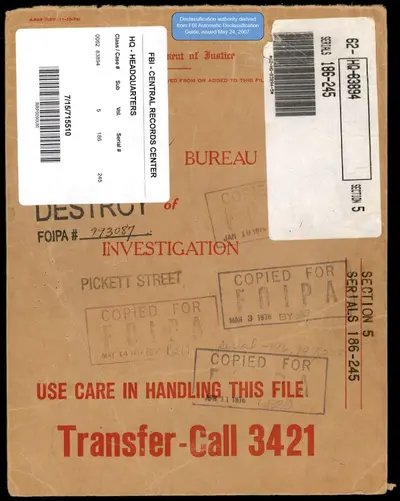
Background
On April 9, 1950, in Yuca City, California, U.S. government investigators recorded an unidentified-object incident later released to the public on May 8, 2026, as part of the Presidential Unsealing and Reporting System for UAP Encounters (PURSUE). This sighting occurred during a period of heightened public and military interest in aerial phenomena. The incident is categorized as part of the first wave of “flying saucer” reports that swept the United States following the Kenneth Arnold sighting of June 1947 and the Roswell incident of July 1947. During this era, the phenomenon of unidentified aerial phenomena was frequently interpreted through the lens of the emerging Cold War, as the United States grappled with the technological advancements of the Soviet Union and the possibility of clandestine aerial surveillance.
The geographic location of Yuba City, situated in the Sacramento Valley, placed the event within a region of California that often served as a backdrop for various aerial observations. At the time, the federal government utilized established bureaucratic channels to manage reports of unusual aerial activity. The case was filed with the Federal Bureau of Investigation, whose Knoxville, Albuquerque, Los Angeles, and other field offices routed UFO reports to headquarters under the Bureau’s standing protocols for the protection of vital installations. This systematic routing ensured that any potential threat to national security or critical infrastructure was documented by the central intelligence apparatus, even if the Bureau did not possess the technical mandate to investigate the physical nature of the objects themselves.
What the document records
The primary evidence for this event consists of a formal communication from a citizen named Lewis Ward. Ward submitted a letter to the FBI specifically regarding the presence of “flying saucers.” Following the receipt of this correspondence, an FBI agent conducted an interview with Ward to assess the validity and potential threat of the reported objects. Upon investigation, the agent determined that the subject matter fell outside the Bureau’s jurisdiction and subsequently advised Ward to contact the United States Air Force for further inquiry.
The released documentation provides limited information regarding the presence of other observers, as the specific number of witnesses is not specified in the released document. The records also include character observations regarding the informant. The agent noted that Ward’s acquaintances described him as odd and prone to exaggeration. Such assessments were common in mid-century investigations, where the credibility of witnesses was often weighed against their social reputation and perceived psychological stability.
Type of case
The case is classified as a visual sighting reported by ground or air observers. This type of report represents the most common form of unidentified aerial phenomena documentation from the mid-twentieth century, relying on the naked-eye observations of individuals located on the ground or within aircraft.
Status
All records released under the PURSUE program are designated unresolved by the All-domain Anomaly Resolution Office (AARO) by default. The federal government has not concluded that the events were anomalous, has not concluded that they were conventional, and has not ruled out either possibility. The lack of a definitive conclusion reflects the difficulty of verifying mid-century sightings without modern sensor data or corroborating radar tracks.
Conventional candidates for sightings of this period include experimental aircraft, weather balloons, particularly the Project Mogul series utilized in the late 1940s to detect Soviet nuclear tests, and atmospheric optical phenomena such as sundogs and lenticular clouds. Additionally, astronomical objects including Venus, the Moon, and meteors near the horizon are frequently cited as potential explanations for reports of bright, moving lights. The Yuba City report remains part of the historical record as an unverified encounter within the broader context of post-war aerial mystery.