Los Angeles, California UFO Sighting (August 20, 1952) — FBI Files
An FBI-recorded report from August 1952 details an unidentified aerial phenomenon observed over Los Angeles, California.
Historical Context of the Post-War Era
The early 1950s represented a period of heightened atmospheric tension and intense scrutiny regarding the skies over North America. Following the conclusion of World War II, the rapid advancement of aerospace technology and the onset of the Cold War created a climate where any unidentified aerial phenomenon was viewed through the lens of national security. The United States was navigating a landscape of burgeoning radar capabilities and the emergence of supersonic flight, which often blurred the line between known experimental craft and unknown intruders. This era was characterized by a surge in public and governmental interest in “flying saucer” phenomena, a trend ignited by the Kenneth Arnold sighting in June 1947 and the subsequent Roswell incident in July 1947. During this period, the presence of unidentified objects in the sky was not merely a matter of scientific curiosity but a potential indicator of foreign technological superiority.
The Los Angeles Incident of August 1952
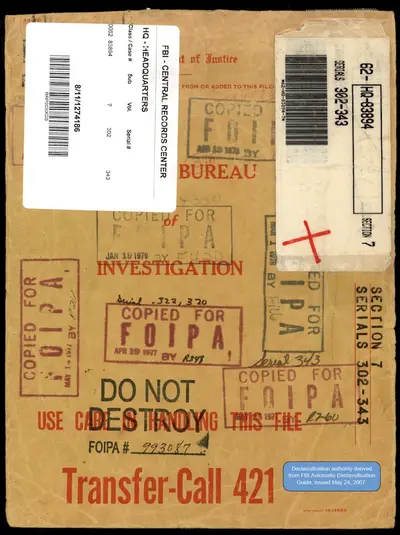
On August 20, 1952, in Los Angeles, California, U.S. government investigators recorded an unidentified-object incident that remained shielded from the public eye for decades. The documentation regarding this event was later released to the public on May 8, 2026, as part of the Presidential Unsealing and Reporting System for UAP Encounters (PURSUE). The case was formally filed with the Federal Bureau of Investigation. Under the Bureau’s standing protocols for the protection of vital installations, various field offices, including those in Knoxville and Albuquerque, were responsible for routing UFO reports to headquarters. This administrative process ensured that any aerial anomaly near significant infrastructure or sensitive sites was centralized for high-level assessment.
The primary evidence for this specific event resides in a letter written by a Mr. Lang on August 12, 1952. In this correspondence, Lang provided a detailed account of his observations regarding an unidentified aerial phenomenon. Due to the nature of the observations and the potential implications for national defense, the content of this letter was forwarded to the Secretary of the Air Force for formal review. The subject matter contained within the letter was deemed of significant interest to Air Force authorities, necessitating official oversight. While the document provides a detailed account of the sighting itself, the released records do not specify the total number of witnesses who observed the phenomenon alongside Mr. Lang.
Classification and Analytical Status
The case is classified as a visual sighting reported by ground or air observers. Such reports were common during the 1950s, as the proliferation of civilian aviation and improved meteorological monitoring increased the frequency of sightings across the continental United States. Within the archival framework of the Spooky Valley database, this incident is categorized as a visual encounter with an unidentified aerial phenomenon.
The official status of the case remains unresolved. All records released under the PURSUE program are designated as unresolved by the All-domain Anomaly Resolution Office (AARO) by default. The federal government has maintained a neutral stance regarding the 1952 Los Angeles sighting, having neither concluded that the event was anomalous nor confirmed that it was the result of conventional means. The possibility of both extraordinary and mundane origins remains open. Conventional candidates for sightings during this specific historical window include experimental high-altitude aircraft, weather balloons—specifically those associated with the Project Mogul series active in the late 1940s—and various atmospheric optical phenomena such as sundogs or lenticular clouds. Furthermore, astronomical objects such as Venus, the Moon, or meteors positioned near the horizon are frequently cited as potential explanations for unidentified lights observed during this era.