Chicago, Illinois UFO Sighting (March 6, 1952) — FBI Files
An artist in Chicago observed a metallic, disc-shaped object hovering at 7,000 feet before accelerating rapidly toward the south in March 1952.
Historical Context
The early 1950s represented a period of heightened atmospheric anxiety within the United States, characterized by the onset of the Cold War and the rapid advancement of aerospace technology. Following the Kenneth Arnold sighting in June 1947 and the subsequent Roswell incident in July 1947, the American public became increasingly sensitized to reports of unidentified aerial phenomena. This era saw a proliferation of “flying saucer” reports, often fueled by the emergence of new technologies such as high-altitude reconnaissance aircraft and sophisticated weather monitoring equipment. During this period, the phenomenon was frequently viewed through the lens of national security, as the possibility of unidentified objects in controlled airspace suggested potential incursions by foreign adversaries.
In response to these sightings, various government agencies established protocols to monitor and document unusual aerial activity. The Federal Bureau of Investigation (FBI) played a significant role in this data collection process. Under the Bureau’s standing protocols for the protection of vital installations, field offices in cities such as Knoxville, Albuquerque, and Los Angeles were tasked with routing UFO reports to headquarters. This systematic approach ensured that any sighting that could potentially impact the security of sensitive infrastructure or military installations was centralized for investigation.
The March 6, 1952 Incident
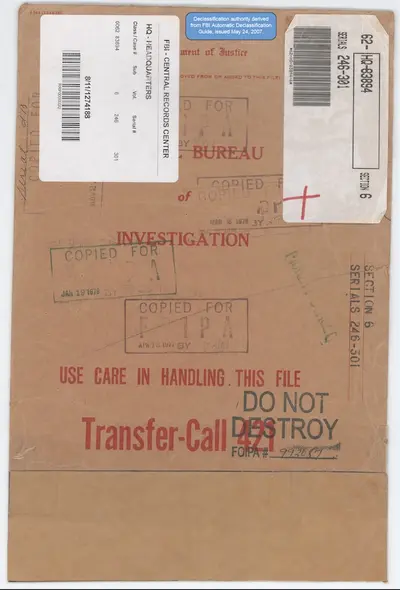
On March 6, 1952, an incident occurred in Chicago, Illinois, involving an unidentified object that was later documented by U.S. government investigators. The details of this specific case were not made available to the general public until May 8, 2026, when they were released as part of the Presidential Unsealing and Reporting System for UAP Encounters (PURSUE).
The primary witness to the event was an artist who was observing the sky through a south-facing window. The artist reported seeing a disc-shaped object emerge from a cloud located to the east. The object appeared to be positioned at an altitude of approximately 7,000 feet. According to the documentation, the object hovered motionlessly in mid-air for a split second before accelerating rapidly toward the south. The witness estimated the speed of the object to be between 600 and 700 mph.
The physical characteristics of the object were described with specific detail. The witness identified the object as circular and white with a distinct bluish tinge. The diameter of the disc was estimated to be roughly six feet. Furthermore, the artist noted that the object appeared to be constructed from a metal similar to aluminum. The speed of the departure was so significant that the witness remarked the movement appeared to flutter. While the document provides these specific observations, the total number of witnesses to the event is not specified in the released file.
Investigation and Classification
The investigation of the Chicago sighting followed the standard bureaucratic procedures of the era, with the report being processed through the FBI’s centralized reporting structure. As with many reports from this period, the case remains categorized by the All-domain Anomaly Resolution Office (AARO) as unresolved. Under the PURSUE program, all released records are designated as unresolved by default, meaning the federal government has not reached a definitive conclusion regarding the nature of the object. The government has neither confirmed that the event was anomalous nor concluded that it was the result of conventional technology.
In the broader context of mid-century aerial phenomena, researchers often consider several conventional explanations for such sightings. These include the presence of experimental aircraft, the deployment of weather balloons—specifically those associated with the Project Mogul series in the late 1940s—or atmospheric optical phenomena such as sundogs and lenticular clouds. Additionally, astronomical objects like Venus, the Moon, or meteors passing near the horizon are frequently evaluated as potential sources for unidentified lights. The Chicago case, however, remains a distinct entry in the archive due to the specific flight characteristics and metallic description provided by the witness.