Vaughn, New Mexico UFO Sighting (August 23, 1950) — FBI Files
FBI records detail an unidentified aerial object sighting in Vaughn, New Mexico, occurring during the height of the post-1947 flying saucer era.
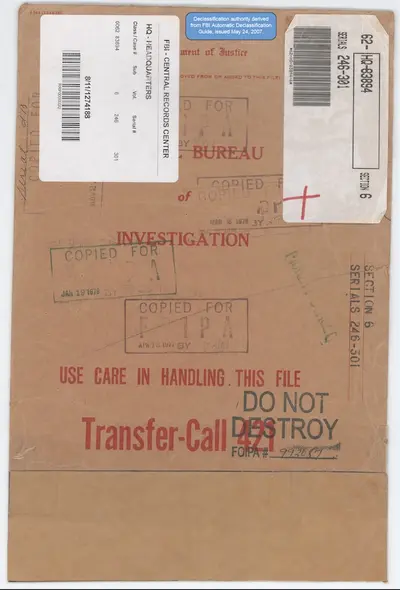
Background
On August 23, 1950, in Vaughn, New Mexico, U.S. government investigators recorded an unidentified-object incident later released to the public on May 8, 2026, as part of the Presidential Unsealing and Reporting System for UAP Encounters (PURSUE). The location of the sighting, Vaughn, sits within the high plains of eastern New Mexico, a region characterized by vast, sparsely populated landscapes and proximity to various sensitive military and scientific installations. This geographic context is significant, as the area’s isolation and low light pollution historically made it a prime location for observing aerial phenomena.
The incident occurred during a period of intense public and governmental preoccupation with unidentified aerial phenomena. This specific event is part of the first wave of “flying saucer” reports that swept the United States following the Kenneth Arnold sighting of June 1947 and the Roswell incident of July 1947. During this era, the sudden influx of reports regarding metallic, disc-shaped objects led to a heightened state of national security concern. The case was filed with the Federal Bureau of Investigation, whose Knoxville, Albuquerque, Los Angeles, and other field offices routed UFO reports to headquarters under the Bureau’s standing protocols for the protection of vital installations. This administrative process reflects how the federal government attempted to integrate anomalous sightings into existing domestic security frameworks, treating such reports as potential threats to the integrity of critical infrastructure.
Documented Observations and Investigations
The released documentation provides specific details regarding the investigative framework active at the time. Project Twinkle had been established by the Air Force, with assistance from Land-Air, Inc., specifically to gather data on unusual aerial phenomena observed near sensitive installations in New Mexico. Because the scope of Project Twinkle overlapped with national security interests, the Bureau was informed of the project, and arrangements were made to be advised if any information indicated Bureau jurisdiction. This indicates a coordinated, albeit compartmentalized, effort between military intelligence and domestic law enforcement to monitor the skies. As of October 9, 1950, the Air Force had not reported any new developments regarding the Vaughn incident to the Bureau.
While the document confirms the occurrence of a visual sighting reported by ground or air observers, the number of witnesses is not specified in the released text. The nature of the report remains classified as a visual sighting of an unidentified object.
Analysis of Phenomenon Type
The case is categorized as a visual sighting reported by ground or air observers. In the context of the 1950s, such sightings were often analyzed through the lens of Cold War-era technological competition. The federal government has not concluded that the events were anomalous, has not concluded that they were conventional, and has not ruled out either possibility. All records released under the PURSUE program are designated unresolved by the All-domain Anomaly Resolution Office (AARO) by default.
When evaluating sightings from this period, researchers often consider several conventional candidates. These include experimental aircraft developed during the rapid advancement of aerospace technology, or weather balloons, particularly the Project Mogul series deployed in the late 1940s to detect Soviet nuclear tests. Atmospheric optical phenomena, such as sundogs or lenticular clouds, frequently mimic the appearance of stationary or slow-moving craft. Additionally, astronomical objects including Venus, the Moon, and meteors near the horizon are common contributors to unidentified aerial reports. The Vaughn incident remains part of this broader historical pattern of unidentified aerial activity documented within the American Southwest.