Datil, New Mexico UFO Sighting (February 24-25, 1950) — FBI Files
FBI records detail a 1950 sighting in Datil, New Mexico, where a luminous object was photographed and analyzed by Dr. Lincoln LaPaz.
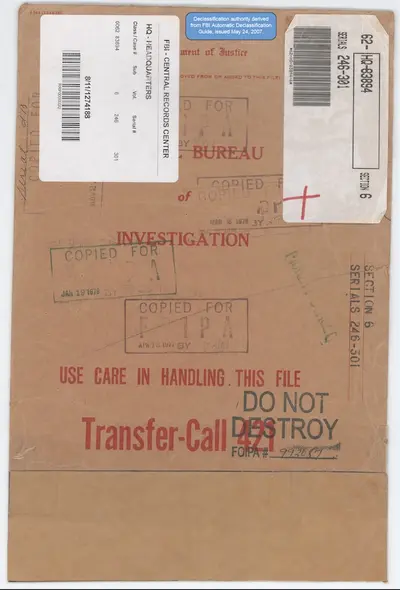
Historical Context
The period between 1947 and the early 1950s represents a foundational era in the study of unidentified aerial phenomena within the United States. Following the Kenneth Arnold sighting in June 1947 and the subsequent Roswell incident in July 1947, the American public and various government agencies became increasingly preoccupied with reports of “flying saucers.” During this era, the phenomenon was often viewed through the lens of the burgeoning Cold War, with many citizens and officials speculating whether such objects represented advanced Soviet technology or extraterrestrial visitors.
The geography of the American Southwest, particularly New Mexico, played a central role in this era of heightened surveillance. The state’s vast, sparsely populated landscapes and its concentration of sensitive military installations made it a frequent site for both astronomical observations and unidentified aerial reports. During this time, the Federal Bureau of Investigation maintained specific protocols for handling such reports, particularly when they appeared to involve the airspace near vital national installations. Field offices in cities such as Knoxville, Albuquerque, and Los Angeles were tasked with routing these sightings to headquarters to ensure that any potential threats to national security were documented and assessed.
The Datil Incident
On the night of February 24-25, 1950, an incident occurred near Datil, New Mexico, which was later documented in official government files. The records of this event were released to the public on May 8, 2026, as part of the Presidential Unsealing and Reporting System for UAP Encounters (PURSUE). The documentation includes a photograph taken by Corporal Stanfield, who was stationed at Holloman Air Force Base at the time of the observation. The photograph captured an unknown luminous object in the night sky, providing a rare piece of physical evidence for a contemporary sighting.
To determine the nature of the object, the Bureau sought the expertise of Dr. Lincoln LaPaz, a prominent astronomer known for his work in studying bolides and high-altitude phenomena. LaPaz conducted a rigorous analysis of the photographic evidence, focusing on the geometric and kinematic properties of the light source. His findings indicated that the object was perfectly round with an angular diameter of approximately 1/4 of a degree. Furthermore, his calculations revealed that the object was not stationary, as it moved at a rate exceeding half a degree per minute.
Based on these specific characteristics, LaPaz was able to systematically rule out several common astronomical explanations. He determined that the object could not be the moon, Venus, other known planets, or bright fixed stars that might appear out of focus. The movement recorded in the image was too rapid and the dimensions too specific to align with the predictable paths of these celestial bodies. While the released documents do not specify the total number of witnesses present during the sighting, the technical analysis provided a definitive rejection of standard astronomical candidates.
Classification and Status
The Datil case is categorized as an unidentified object sighting involving photographic evidence. Within the framework of modern investigation, the status of the incident remains officially unresolved. Under the protocols of the All-domain Anomaly Resolution Office (AARO), all records released through the PURSUE program are designated as unresolved by default. This designation reflects a lack of conclusive evidence to either prove the event was anomalous or to confirm it was the result of known, conventional phenomena.
The federal government has maintained a neutral stance, neither concluding that the event was caused by unidentified technology nor ruling out conventional explanations. During the late 1940s and early 1950s, several conventional candidates were frequently cited in similar reports. These included experimental aircraft testing, weather balloons—specifically those associated with the Project Mogul series—and various atmospheric optical phenomena such as sundogs or lenticular clouds. Additionally, meteors near the horizon or misidentified astronomical objects remained common subjects of investigation during this period of intense aerial scrutiny.