Los Alamos, New Mexico UFO Sighting (November 19, 1950) — FBI Files
On November 19, 1950, observers in Los Alamos, New Mexico, reported a vertical, green and yellow object in the sky, according to released FBI files.
Overview of the Incident
On November 19, 1950, in Los Alamos, New Mexico, U.S. government investigators recorded an unidentified-object incident that remained classified for decades. The details of this encounter were later released to the public on May 8, 2026, as part of the Presidential Unsealing and Reporting System for UAP Encounters (PURSUE). According to the documentation, observers in Los Alamos reported the presence of a vertical object in the sky, characterized by distinct green and yellow colors. The released document does not specify the exact number of witnesses involved in the sighting.
Historical and Geographical Context
The location of the sighting, Los Alamos, holds significant importance within the history of American scientific and military development. Situated in the Jemez Mountains of northern New Mexico, Los Alamos was the site of the Manhattan Project and remained a highly sensitive, restricted installation throughout the early Cold War. During the 1950s, the presence of nuclear research and high-level government operations necessitated rigorous monitoring of the surrounding airspace. Any unidentified aerial phenomenon appearing near such a vital installation would naturally trigger immediate scrutiny from federal authorities.
The timing of the report places it within the first wave of “flying saucer” phenomena that permeated the United States consciousness. This era was defined by a surge in unidentified aerial phenomena reports following the Kenneth Arnold sighting in June 1947 and the Roswell incident in July 1947. During this period, the public and the government were grappling with a new category of aerial anomaly that challenged existing understandings of aviation and atmospheric science.
Bureaucratic Processing and Investigation
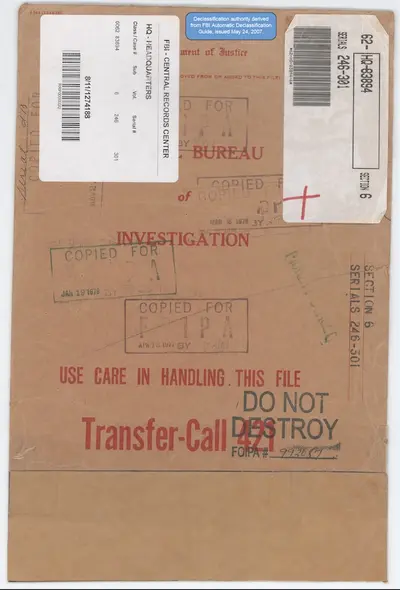
The administrative handling of the Los Alamos report reflects the standardized security protocols of the mid-twentieth century. The case was filed with the Federal Bureau of Investigation, which maintained a structured system for managing reports of unidentified objects. Field offices in Knoxville, Albuquerque, and Los Angeles, among others, were tasked with routing UFO reports to FBI headquarters. This routing followed the Bureau’s standing protocols specifically designed for the protection of vital installations. Because Los Alamos was a high-security site, the reporting of an unidentified object was treated as a matter of national security and potential espionage, rather than merely a meteorological or astronomical curiosity.
The investigation of such cases during this era often focused on determining whether the objects represented a threat to domestic security or a breach of restricted airspace. While the FBI focused on the investigative aspects of potential intelligence threats, the broader scientific community and military intelligence agencies were simultaneously attempting to categorize the nature of these sightings.
Classification and Potential Explanations
The Los Alamos sighting is classified as a visual sighting reported by ground or air observers. Under the current framework of the All-domain Anomaly Resolution Office (AARO), all records released under the PURSUE program are designated as unresolved by default. The federal government has maintained a position of neutrality regarding this specific event, having neither concluded that the object was anomalous nor confirmed it to be conventional.
In the context of the 1950s, several conventional candidates were often considered when evaluating such reports. These included experimental aircraft being tested in the American Southwest, or weather balloons, specifically those associated with the Project Mogul series active in the late 1940s. Atmospheric optical phenomena, such as sundogs or lenticular clouds, were also frequent subjects of investigation. Additionally, astronomical objects like Venus, the Moon, or meteors passing near the horizon could produce bright, colored lights that might be interpreted as maneuvering objects by observers. The Los Alamos case remains an unverified entry in the archive of mid-century aerial phenomena.