Chicago, Illinois UFO Sighting (July 28, 1950) — FBI Files
A 1950 FBI report details a publisher's claim of a privately funded, atomic-capable flying saucer observed over South Chicago.
Historical Context of the Post-War UFO Wave
The period following the end of the Second World War was characterized by intense technological competition and a heightened state of nuclear anxiety. In the summer of 1947, the Kenneth Arnold sighting and the subsequent reports surrounding the Roswell incident ignited a phenomenon known as the “flying saucer” wave. This era saw a surge in public interest regarding unidentified aerial phenomena, driven by the rapid advancement of aerospace technology and the onset of the Cold War. During this time, the presence of unknown objects in the sky was often interpreted through the lens of secret military developments or extraterrestrial visitation.
In the United States, the federal government maintained a systematic approach to monitoring such reports, particularly when they appeared to involve threats to national security. The Federal Bureau of Investigation (FBI) operated under standing protocols designed to protect vital installations and infrastructure. When field offices in cities such as Knoxville, Albuquerque, or Los Angeles received reports of unidentified objects, these files were routinely routed to the Bureau’s headquarters. This centralized processing ensured that any potential compromise of sensitive military or nuclear sites was documented and evaluated by federal investigators.
The July 1950 Chicago Incident
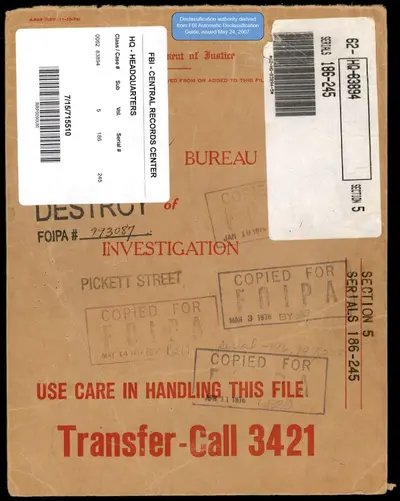
On July 28, 1950, an entry was recorded in the FBI files concerning an unidentified object observed over the south side of Chicago, Illinois. This specific document was later released to the public on May 8, 2026, as part of the Presidential Unsealing and Reporting System for UAP Encounters (PURSUE). The report originated from a letter delivered to the FBI by Robert Petrone, a publisher. The contents of the letter detailed an observation made in April of that same year.
The report described a craft that possessed highly specific, albeit unconventional, structural characteristics. According to the claims made in the letter, the object resembled a large fuel tank equipped with wings made of crystal glass and powered by jet engines. The letter asserted that the craft was designed for the purpose of long-range atomic bombing. The document further alleged that the project was financed by Howard Hughes and that the design was the work of a specific group of individuals, including Fred Spaunholdt, Frank Hoochpaw, and Carl Teichman.
The verbatim text from the FBI file emphasizes the claims of the author, stating that the saucer in question was not a military secret and was not yet owned by any government. The description provided by Petrone noted that the ship featured two large jet engines located on both sides. The identities of the alleged designers were specified as Fred Spaunholdt, a former Linco skywriter, Frank Hoochpaw, an aircraft mechanic, and Carl Teichman, identified as a German World War I ace. While the letter provided specific names and technical descriptions, the released document does not specify the total number of witnesses to the April sighting.
Investigation and Classification
The Chicago case is classified as being associated with a military installation or nuclear facility, reflecting the era’s preoccupation with the security of atomic capabilities. At the time of the report, the investigation focused on the potential for unauthorized technological advancements that could threaten the existing balance of power. Such reports were often scrutinized alongside other atmospheric or man-made phenomena. During the late 1940s and early 1950s, sightings were frequently attributed to experimental aircraft, weather balloons—such as those used in the Project Mogul series—or natural optical phenomena like sundogs and lenticular clouds.
As of the current record, the status of the incident remains unresolved. Under the protocols of the All-domain Anomaly Resolution Office (AARO), all records released through the PURSUE program are designated as unresolved by default. The federal government has maintained a neutral stance regarding this specific report, neither concluding that the event was the result of an anomalous phenomenon nor confirming that it was caused by a conventional source. The possibility of the craft being a known technological entity or an unidentified anomaly remains an open question within the archival record.