Wichita Falls, Texas UFO Sighting (Aug. 5, 1948) — FBI Files
An FBI investigation from August 1948 reveals government interest in unusual aircraft sightings following the mid-century wave of unidentified flying object…
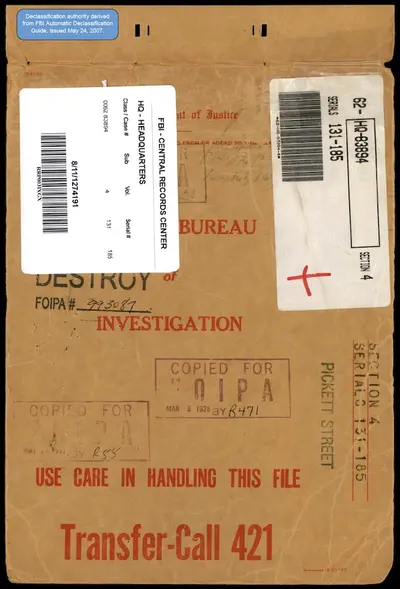
Historical Context of the Post-War Aerial Phenomenon Wave
The summer of 1948 occurred during a period of intense public and governmental scrutiny regarding unidentified aerial phenomena. This era followed the transformative Kenneth Arnold sighting of June 1947 and the highly publicized Roswell incident of July 1947, both of which catalyzed a national phenomenon often referred to as the “flying saucer” wave. During this period, the United States was navigating the early complexities of the Cold War, a geopolitical climate characterized by heightened anxiety regarding Soviet technological advancements and airspace security. As unidentified objects were reported across the continental United States, the federal government began implementing systematic methods to track and document these sightings to determine if they posed a threat to national interests or vital installations.
The geography of the American South and Southwest played a significant role in these reports, as the vast, open landscapes and frequent atmospheric disturbances provided frequent opportunities for visual sightings of unidentified objects. During the late 1940s, the scientific and intelligence communities struggled to categorize these sightings, often debating whether the objects were manifestations of advanced foreign technology, secret domestic aerospace projects, or natural atmospheric occurrences.
The Wichita Falls FBI Documentation
On August 5, 1948, in Wichita Falls, Texas, U.S. government investigators recorded an unidentified-object incident that remained shielded from the public eye for decades. This specific documentation was later released to the public on May 8, 2026, as part of the Presidential Unsealing and Reporting System for UAP Encounters (PURSUE). The records indicate that the Federal Bureau of Investigation (FBI) maintained a structured protocol for handling such reports. Field offices in locations such as Knoxville, Albuquerque, and Los Angeles were tasked with routing UFO-related intelligence to headquarters, particularly when the sightings occurred near sensitive or vital installations.
The specific document from the Wichita Falls office records an agent forwarding a formal request for information. This request pertained to unusual aircraft sightings reported near Montgomery, Alabama. In an effort to compile a comprehensive intelligence picture, the agent sought tear sheets of news stories published by the Associated Press (AP) and United Press (UP). This indicates that the Bureau was actively utilizing mainstream journalistic outputs to cross-reference and verify reports of aerial phenomena. The primary objective behind this specific request was the investigation of aerial phenomena and the subsequent sharing of gathered data with security officials to ensure the integrity of domestic airspace.
While the document details the administrative pursuit of news media records, the number of witnesses to the underlying sightings is not specified within the released text. The nature of the case is categorized as a visual sighting, which could have been reported by observers on the ground or from the air.
Classification and Resolution Status
The Wichita Falls case remains classified as an unresolved anomaly. Under the current mandates of the All-domain Anomaly Resolution Office (AARO), all records released through the PURSUE program are designated as unresolved by default. The federal government has maintained a position of neutrality, neither concluding that the events were anomalous nor confirming that they were the result of conventional objects.
During the late 1940s, several conventional candidates were frequently considered during investigations of this type. These included the deployment of experimental aircraft and the presence of weather balloons, specifically those associated with the Project Mogul series, which utilized high-altitude balloons to detect Soviet nuclear tests. Additionally, atmospheric optical phenomena such as sundogs, lenticular clouds, and various forms of light refraction were common misidentifications. Astronomical objects, including the Moon, Venus, and meteors appearing near the horizon, also frequently contributed to the high volume of reports during this period of heightened aerial surveillance.