Mantell incident — Fort Knox, Kentucky, 1948
In 1948, Captain Thomas F. Mantell and two other pilots pursued an unidentified object for approximately 25 minutes. Mantell reported the object was climbing and moving at 360 mph, matching his own speed. He lost contact after stating he was abandoni
Background
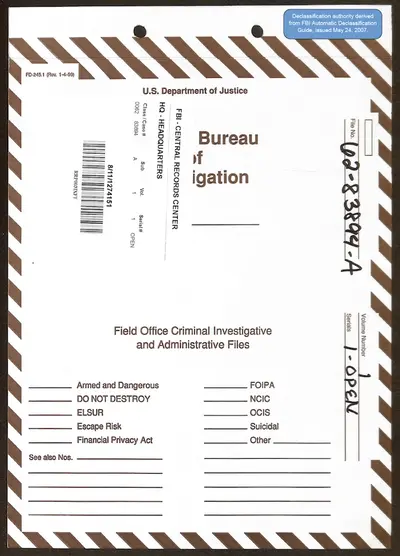
In 1948, in Fort Knox, Kentucky, U.S. government investigators recorded an unidentified-object incident later released to the public on May 8, 2026 as part of the Presidential Unsealing and Reporting System for UAP Encounters (PURSUE). The incident is one of the first wave of “flying saucer” reports that swept the United States after the Kenneth Arnold sighting of June 1947 and the Roswell incident of July 1947. The case was filed with the Federal Bureau of Investigation, whose Knoxville, Albuquerque, Los Angeles, and other field offices routed UFO reports to headquarters under the Bureau’s standing protocols for the protection of vital installations.
What the document records
In 1948, Captain Thomas F. Mantell and two other pilots pursued an unidentified object for approximately 25 minutes. Mantell reported the object was climbing and moving at 360 mph, matching his own speed. He lost contact after stating he was abandoning the chase due to oxygen levels, and his plane crashed near Fort Knox, disintegrating in mid-air.
The number of witnesses is not specified in the released document.
Verbatim from the file
“He’d “abandon the chase at 20,000ft. andon the chase as he hadn’t the oxygen."". “His body was later found near Fort Knox and the wreckage of his machine scattered over half a mile around.”. “Obviously his plane had disintegrated in mid-air.”
Type of case
The case is a visual sighting reported by ground or air observers.
Status
All records released under the PURSUE program are designated unresolved by the All-domain Anomaly Resolution Office (AARO) by default. The federal government has not concluded that the events were anomalous, has not concluded that they were conventional, and has not ruled out either possibility. Conventional candidates for sightings of this period include experimental aircraft, weather balloons (especially the Project Mogul series in the late 1940s), atmospheric optical phenomena such as sundogs and lenticular clouds, and astronomical objects including Venus, the Moon, and meteors near the horizon.