Mantell incident — Fort Knox, Kentucky, January 7, 1948
On January 7, 1948, Captain Thomas F. Mantell died following an aerial interception of an unidentified metallic object near Fort Knox, Kentucky.
Historical Context
The Mantell incident occurred during a period of intense public and governmental preoccupation with unidentified aerial phenomena. The early months of 1948 were characterized by a significant surge in “flying saucer” reports across the United States, a phenomenon triggered by the Kenneth Arnold sighting in June 1947 and the subsequent Roswell incident in July 1947. During this era, the sudden appearance of objects described as metallic or disc-shaped led to widespread speculation regarding advanced technology or extraterrestrial visitors. The geopolitical climate of the early Cold War also contributed to heightened sensitivity regarding any unidentified objects appearing near strategic military installations.
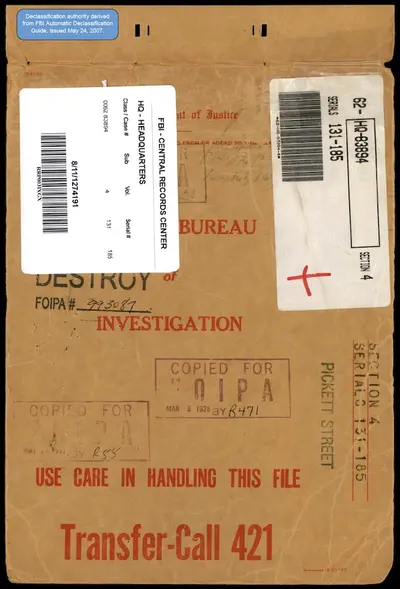
Fort Knox, Kentucky, serves as a critical site for the United States government, housing the United States Bullion Depository and various military administrative functions. Because of its status as a vital installation, any unidentified aerial activity in the vicinity was subject to rigorous reporting and investigation. At the time, the Federal Bureau of and Investigation maintained established protocols for handling such reports. When field offices in cities such as Knoxville, Albuquerque, or Los Angeles received reports involving protected sites, the information was systematically routed to FBI headquarters for centralized processing and security assessment.
The Incident
On January 7, 1948, Captain Thomas F. Mantell, an experienced pilot, sighted an unidentified object in the airspace near Fort Knox. The encounter escalated when Captain Mantell attempted to intercept the object to gain a more detailed visual identification. During the pursuit, Mantell communicated via radio, describing the object as appearing metallic and of tremendous size. He also noted that the object was ascending rapidly. In an effort to maintain visual contact, Mantell established a flight ceiling for the pursuit, stating that if he were no closer to the object at 20,000 feet, he would abandon the chase.
The pursuit ended in tragedy when Captain Mantell’s aircraft crashed, resulting in his death. While the released documentation does not specify the exact number of witnesses to the sighting or the crash, the event was officially recorded by government investigators. The details of this specific encounter were not made available to the general public for decades, eventually being released on May 8, 2026, as part of the Presidential Unsealing and Reporting System for UAP Encounters (PURSUE).
Investigative Status and Analysis
The Mantell case is classified as a visual sighting reported by air observers. Under the current frameworks of the All-domain Anomaly Resolution Office (AARO), all records released through the PURSUE program are designated as unresolved by default. The federal government has maintained a neutral stance regarding the nature of the object, neither concluding that the event was anomalous nor confirming that it was the result of conventional means.
In the broader study of mid-century aerial phenomena, researchers often compare such incidents to other documented sightings of the period. When evaluating unidentified objects from the late 1940s, investigators consider several conventional candidates. These include experimental aircraft developed during the post-war era, weather balloons—specifically those associated with the Project Mogul series—and various atmospheric optical phenomena such as lenticular clouds or sundogs. Additionally, astronomical objects like the Moon, Venus, or meteors positioned near the horizon are frequently analyzed as potential sources for reports of large, bright, or rapidly moving objects. The Mantell incident remains a primary case study in the intersection of military interception protocols and unidentified aerial phenomena.