Ft Knox, Kentucky UFO Sighting, 1947 — USAF Files
U.S. government investigators recorded a bright, rotating, multi-colored object sighted southwest of Fort Knox, Kentucky, in 1947.
Historical Context
The year 1947 represents a pivotal era in the history of unidentified aerial phenomena, marking the beginning of what researchers often categorize as the first modern wave of “flying saucer” reports. This period was characterized by a sudden surge in public and military interest following high-profile events such as the Kenneth Arnold sighting in June 1947 and the subsequent Roswell incident in July 1947. During this post-war period, the United States was navigating the early tensions of the Cold War, a geopolitical climate that heightened sensitivity toward any unidentified objects entering domestic airspace. The emergence of these reports coincided with rapid advancements in aviation technology and the deployment of high-altitude surveillance tools, which often blurred the line between known aerial assets and unexplained phenomena.
The location of the sighting, Fort Knox, Kentucky, provides a significant backdrop for such an observation. As a major United States Army installation, the facility is a high-security environment subject to rigorous monitoring. Sightings occurring near or over military installations are historically significant due to the heightened state of readiness and the presence of trained observers capable of utilizing specialized equipment. In the mid-twentieth century, the interpretation of such sightings often fluctuated between concerns over Soviet technological incursions and the investigation of domestic experimental aerospace programs.
The 1947 Fort Knox Incident
In 1947, investigators within the United States government recorded an unidentified-object incident at Fort Knox. The details of this specific event remained restricted from the public eye for decades, eventually being released on May 8, 2026, as part of the Presidential Unseeling and Reporting System for UAP Encounters (PURSUE). The documentation for this event is contained within official U.S. Department of Defense files, indicating that the sighting was processed through formal military or governmental reporting channels.
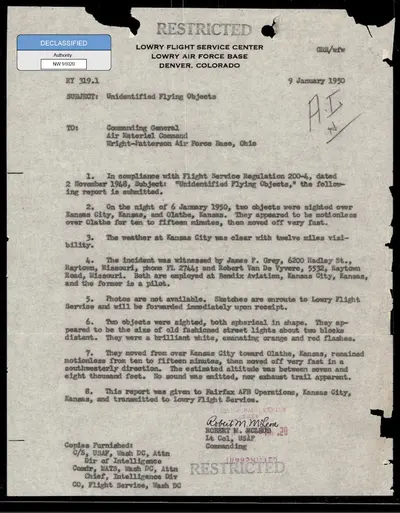
The technical details of the sighting are preserved in brief, telegraphic notations within the released files. At approximately 0250 hours, a bright object was sighted to the southwest of Fort Knox. The observation was not merely a casual visual sighting; the documentation indicates that observers utilized a theodolite to track the object. This use of a precision instrument for measuring angles in the horizontal and vertical planes suggests a disciplined attempt to document the object’s trajectory and behavior. The recorded data notes that the object appeared to be rotating and exhibited distinct colors, specifically green, yellow, and red. As the observation progressed, the object began to diminish in brightness and eventually disappeared following a series of flashes. While the document provides these specific physical characteristics, the total number of witnesses involved in the observation is not specified in the released text.
Analytical Classification and Status
The incident is classified as a visual sighting reported by ground or air observers. Within the framework of modern anomaly investigation, the case remains officially unresolved. Under the protocols of the All-domain Anomaly Resolution Office (AARO), all records released through the PURSUE program are designated as unresolved by default. This means that the federal government has not reached a definitive conclusion regarding whether the object was anomalous in nature or if it could be attributed to known technological or natural phenomena.
When evaluating sightings from this specific era, investigators consider several conventional candidates. During the late 1940s, the deployment of the Project Mogul series of high-altitude weather balloons created a precedent for unidentified aerial objects appearing in domestic airspace. Other possibilities include experimental aircraft testing, which was prevalent during the early stages of the jet age, or atmospheric optical phenomena such as sundogs and lenticular clouds. Additionally, astronomical objects like Venus, the Moon, or meteors appearing near the horizon can produce bright, flashing, or color-shifting effects. The Fort Knox documentation remains a subject of study as part of the broader effort to differentiate between these known variables and truly unidentified phenomena.