Wright-Patterson Air Force Base UFO Sighting (Fall of 1947) — FBI Files
FBI records detail an unidentified object sighting at Wright-Patterson Air Force Base during the 1947 wave of American flying saucer reports.
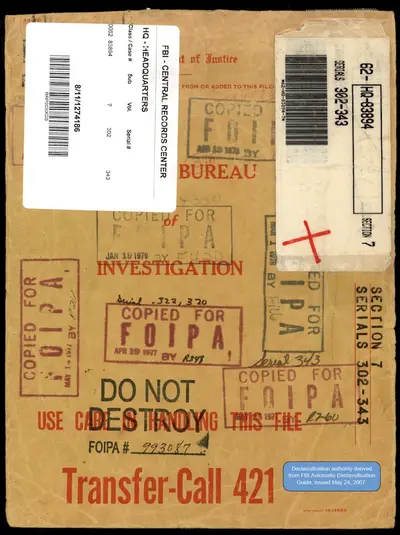
Background
In the fall of 1947, Wright-Patterson Air Force Base in Dayton, Ohio, became the site of an unidentified-object incident that remained classified for decades. The details of this event were eventually released to the public on May 8, 2026, through the Presidential Unsealing and Reporting System for UAP Encounters (PURSUE). This sighting occurred during a period of intense national preoccupation with aerial phenomena, following the influential Kenneth Arnold sighting in June 1947 and the widely discussed Roswell incident in July 1947. These events collectively triggered a massive wave of “flying saucer” reports across the United States, fundamentally altering the public’s perception of airspace security.
During this era, the United States was navigating the early complexities of the Cold War, a period characterized by heightened surveillance and the rapid advancement of aeronautical technology. Wright-Patterson Air Force Base, a critical installation for the United States Army Air Forces and later the U.S. Air Force, served as a central hub for aeronautical research and development. Given its strategic importance, any unidentified aerial activity near the base was treated with significant gravity. The incident was documented within the files of the Federal Bureau of Investigation. Under the Bureau’s standing protocols for the protection of vital installations, various field offices, including those in Knoxville, Albuquerque, and Los Angeles, were tasked with routing UFO reports to headquarters to ensure centralized oversight of potential threats to national security.
What the document records
As the Air Force began to monitor the increasing frequency of “flying saucer” reports from the public in late 1947, the agency recognized a potential conflict with its primary responsibility for domestic air defense. The emergence of these sightings suggested that unidentified objects might possess capabilities that could bypass existing radar and interception methods. This realization prompted the establishment of a formal project designed to collect and evaluate all available facts concerning these sightings to determine if they represented a tangible threat to the integrity of American airspace.
The released FBI documentation provides a record of the incident but does not specify the exact number of witnesses involved in the sighting at Wright-Patterson. The report focuses on the occurrence of the unidentified object within the vicinity of the base, documenting the event as part of the broader intelligence-gathering effort regarding aerial anomalies during the post-war period.
Type of case
The case is classified as a visual sighting reported by ground or air observers. This category of encounter involves direct optical observation of an object, which, during the 1947 period, often lacked the corroborating radar data that modern sensor-based investigations rely upon.
Status
All records released under the PURSUE program are designated as unresolved by the All-domain Anomaly Resolution Office (AARO) by default. The federal government has maintained a neutral stance regarding the nature of the Wright-Patterson incident, neither concluding that the event was anomalous nor confirming that it was caused by conventional means. The possibility of either an unidentified origin or a known technological source remains open.
In the context of mid-century aerial phenomena, several conventional candidates are often considered by investigators. These include experimental aircraft being tested in the post-war era, weather balloons—specifically those associated with the Project Mogul series active in the late 1940s—and various atmospheric optical phenomena such as sundogs or lenticular clouds. Additionally, astronomical objects like the Moon, Venus, or meteors appearing near the horizon are frequently evaluated as potential sources for such sightings.