Tacoma, Washington UFO Sighting (August 7, 1947) — FBI Files
A first saucer wave case from Tacoma, Washington. Both Fred Crisman and DAH were interviewed and denied knowledge of how the rock formations they sent for analysis became connected to flying disc stories.
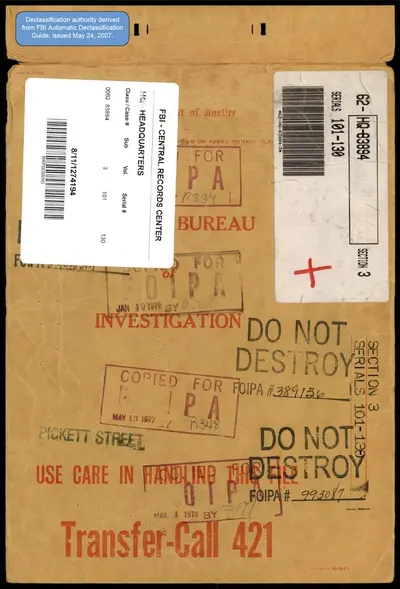
Background
On August 7, 1947, in Tacoma, Washington, U.S. government investigators recorded an unidentified-object incident later released to the public on May 8, 2026 as part of the Presidential Unsealing and Reporting System for UAP Encounters (PURSUE). The incident is one of the first wave of “flying saucer” reports that swept the United States after the Kenneth Arnold sighting of June 1947 and the Roswell incident of July 1947. The case was filed with the Federal Bureau of Investigation, whose Knoxville, Albuquerque, Los Angeles, and other field offices routed UFO reports to headquarters under the Bureau’s standing protocols for the protection of vital installations.
What the document records
Both Fred Crisman and DAH were interviewed and denied knowledge of how the rock formations they sent for analysis became connected to flying disc stories. They admitted to sending the formations to Palmer at Davis Publishing Company, but claimed they never sent additional samples and were evasive about their involvement in the story.
The number of witnesses is not specified in the released document.
Verbatim from the file
“They refused to give any definite information as to what they said or had done which caused them to become involved in a flying dise story”
Type of case
The witnesses described the object as disc- or saucer-shaped.
Status
All records released under the PURSUE program are designated unresolved by the All-domain Anomaly Resolution Office (AARO) by default. The federal government has not concluded that the events were anomalous, has not concluded that they were conventional, and has not ruled out either possibility. Conventional candidates for sightings of this period include experimental aircraft, weather balloons (especially the Project Mogul series in the late 1940s), atmospheric optical phenomena such as sundogs and lenticular clouds, and astronomical objects including Venus, the Moon, and meteors near the horizon.