Smyrna, Tenn UAP Encounter, 1947 — USAAF Box 7 #104
An archived U.S. Army Air Forces record documents an unidentified flying object sighting near Smyrna, Tennessee, during the summer of 1947.
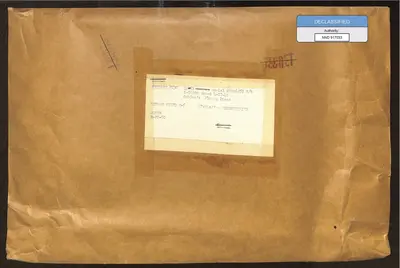
Case Overview
In 1947, near Smyrna, Tennessee, the U.S. Army Air Forces recorded an unidentified-object incident that became Incident #104 in the “Check-List - Unidentified Flying Objects” series archived in Box 7 of file 38_143685. The records were released by the Department of War on May 8, 2026, as part of the Presidential Unsealing and Reporting System for UAP Encounters (PURSUE). The case is one of the first wave of “flying saucer” reports that swept the United States following the Kenneth Arnold sighting of June 1947 and the Roswell incident of July 1947.
The specific documentation for Incident #104, found within the U.S. Army Air Forces “Check-List - Unallied Flying Objects” series, contains a summary recording that an unspecified observer reported a sighting near Smyrna, Tennessee. The nature of the report is categorized as a visual sighting, documented as being observed by either ground or air-based observers. Due to the brevity of the original military checklist, the specific flight path, duration of the sighting, or physical characteristics of the object were not detailed in the primary entry.
Historical Context
The summer of 1947 represents a pivotal moment in the history of aerial anomaly reports. During this period, the United States was navigating the early stages of the Cold War, a geopolitical climate characterized by intense technological competition and heightened surveillance of the skies. The sudden influx of reports regarding unidentified aerial phenomena, often described as metallic or disc-shaped, created a sense of public and military preoccupation. The Smyrna incident occurred within this specific cultural and political window, where the distinction between advanced military technology and extraterrestrial visitation was a subject of significant debate.
The geography of Middle Tennessee, characterized by its rolling landscapes and proximity to various military installations, provided a backdrop common to many mid-century sightings. During the post-war era, the expansion of military aviation meant that both civilian and military personnel were increasingly monitoring the skies for any deviations from standard flight patterns. The reporting of such anomalies was often processed through standardized military checklists, such as the one used by the U.S. Army Air Forces, which sought to categorize and track any unidentified objects that could potentially represent a threat to national security.
Analysis and Classification
The classification of this case as a visual sighting places it within the broader category of the 1947 “saucer wave.” This era of reporting is often analyzed by historians of science and military analysts to determine whether the sightings were the result of new atmospheric phenomena, misidentified conventional craft, or something entirely unknown. The Smyrna report, while lacking specific descriptive details, serves as a primary data point in the study of how the military recorded anomalous aerial activity during the transition from propeller-driven aircraft to the jet age.
All records released under the PURSUE program are designated unresolved by the All-domain Anomaly Resolution Office. The federal government has not concluded these 1947-era incidents were anomalous, has not concluded they were conventional, and has not ruled out either possibility. When examining the validity of such sightings, researchers often consider conventional candidates that were active during the 1947 saucer wave. These include the Project Mogul balloon flights, which were then operating over the U.S. Southwest to detect nuclear tests, as well as the testing of experimental jet and rocket aircraft. Other possibilities include atmospheric optical effects or astronomical objects that were misidentified due to unusual viewing angles. The Smyrna encounter remains an unverified component of this larger, unresolved historical phenomenon.