Knoxville, Tenn UAP Encounter, 1948 — USAAF Box 7 #136
An archived U.S. Army Air Forces report details an unidentified object sighting near Knoxville, Tennessee, during the height of the 1947 saucer wave.
Historical Context
The year 1948 represented a period of significant atmospheric and aerial uncertainty within the United States. Following the conclusion of World War II, the rapid advancement of aeronautical engineering and the emergence of the jet age created a landscape where the skies were increasingly occupied by experimental technologies. This era was characterized by the “saucer wave,” a phenomenon of mass sightings that gripped the American public consciousness. This wave was primarily ignited by the Kenneth Arnold sighting in June 1947 and further complicated by the events surrounding the Roswell incident in July 1947. During this period, the distinction between classified military hardware, such as high-altitude reconnaissance balloons or early rocket prototypes, and truly anomalous phenomena was often impossible for civilian observers or even military personnel to discern.
The geographic setting of the Knoxville, Tennessee, sighting placed it within a region of significant military and industrial importance. Tennessee, particularly the area surrounding Knoxville, was a focal point for high-level federal activity during the early Cold War, housing critical facilities related to the Manhattan Project and subsequent nuclear developments. The presence of heightened military surveillance and various experimental flight paths in the southeastern United States contributed to the density of aerial reports during the late 1940s.
Incident Details
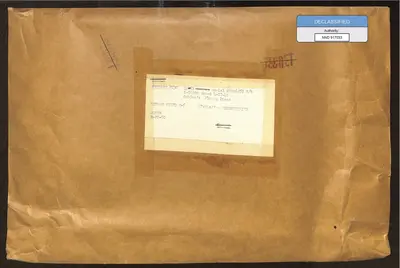
The specific event documented as Incident #136 in the “Check-List - Unidentified Flying Objects” series originated from a report near Knoxville, Tennessee, in 1948. The documentation for this encounter is preserved within the United States Army Air Forces archives, specifically located in Box 7 of file 38_143685. The details of the encounter were brought to light following the release of records by the Department of War on May 8, 2026, as part of the Presidential Unsealing and Reporting System for UAP Encounters (PURSUE).
The official summary provided by the U.S. Army Air Forces records indicates that an unspecified observer reported the sighting of an unidentified object. The nature of the sighting is classified as a visual encounter, which may have been documented by either ground-based or air-based observers. While the specific characteristics of the object’s flight path, luminosity, or physical structure are not detailed in the summary, the entry serves as a formal military acknowledgment of an aerial phenomenon that could not be immediately identified by the reporting party or the investigating authorities at the time.
Classification and Investigation
The Knoxville encounter is categorized as a visual sighting of an unidentified flying object. In the context of the 1948 reporting era, such cases were often processed through standardized checklists used by the U.S. Army Air Forces to track anomalous aerial activity. These checklists were designed to categorize observations based on visual characteristics and perceived movement, though they often lacked the sophisticated sensor data available to modern investigators.
Under the current oversight of the All-domain Anomaly Resolution Office, all records released through the PURSUE program, including the Knoxville incident, maintain an official status of unresolved. The federal government has not issued a definitive conclusion regarding whether these 1947-era incidents were the result of anomalous phenomena or conventional objects. There has been no official determination that the object was extraterrestrial or non-human, nor has there been a conclusive identification of the object as a known man-made craft.
The investigation of such cases historically considers several conventional candidates. During the late 1940s, the Project Mogul balloon flights, which were designed to detect Soviet nuclear tests, were active over various parts of the United States and could be mistaken for unidentified objects. Additionally, the development of experimental jet and rocket aircraft, atmospheric optical illusions, and the misidentification of astronomical bodies at unusual angles remain primary scientific explanations for the sightings that defined this era of American aviation history.