South Royalton, Vermont UFO Sighting (September 17, 1947) — FBI Files
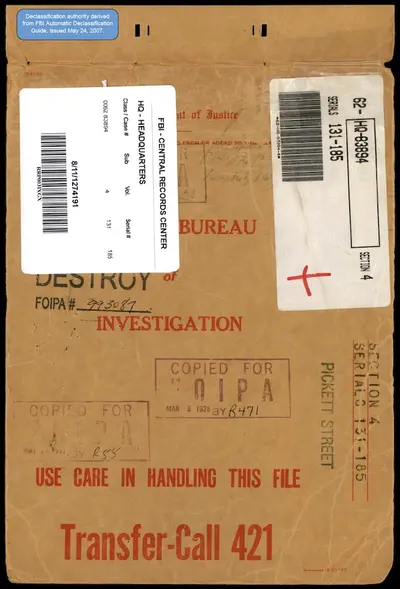
An FBI-documented report from September 1947 details A. Courtney Parker's observation of flying discs over South Royalton, Vermont.
Historical Context
The South Royalton sighting occurred during a period of intense public and governmental preoccupation with unidentified aerial phenomena. The summer of 1947 is widely recognized by historians of the phenomenon as the beginning of the modern “flying saucer” era. This era was catalyzed by the Kenneth Arnold sighting in June 194
7 and the subsequent, highly debated events surrounding the Roswell incident in July 1947. During this window, the United States was navigating the early complexities of the Cold War, a geopolitical climate characterized by heightened surveillance and a pervasive fear of technological breakthroughs by foreign adversaries. The emergence of reports describing metallic, disc-shaped objects coincided with the rapid advancement of aerospace engineering, leading to a mixture of scientific curiosity and national security concern.
Geographically, the White River Valley in Vermont provided a quiet, rural backdrop for such observations. In the mid-twentieth century, the lack of light pollution and the relatively low density of commercial air traffic in northern New England made the region an ideal environment for spotting unusual atmospheric or celestial movements. Such sightings were often processed through standard law enforcement channels, as the distinction between meteorological phenomena and potential military incursions remained blurred in the minds of both the public and the authorities.
The Incident
On September 17, 1947, an incident involving unidentified objects was recorded by U.S. government investigators in South Royalton, Vermont. The specific details of this case remained largely shielded from public view for decades, eventually being released on May 8, 2026, as part of the Presidential Unsealing and Reporting System for UAP Encounters (PURSUE). The documentation indicates that the report was processed through the Federal Bureau of Investigation. Under the standing protocols of the era, various FBI field offices, including those in Knoxville, Albuquerque, and Los Angeles, were tasked with routing UFO reports to headquarters to ensure the protection of vital installations and national security interests.
The primary witness recorded in the documentation is A. Courtney Parker. In his report, Parker described the sighting of flying discs. He expressed confidence in the accuracy of his observation, attributing his ability to identify the objects from a significant distance to his unusually good eyesight. According to the report, Parker believed that his visual acuity allowed him to perceive the objects more clearly than would have been possible for others. The documentation does not provide a specific number of witnesses, though Parker stated that no other individuals in South Royalton witnessed the objects during the event.
Classification and Analysis
The South Royalton case is classified as a visual sighting reported by ground or air observers. Within the broader study of unidentified aerial phenomena, this type of report is categorized by the visual detection of an object that does not conform to known flight patterns or identifiable craft.
The official status of the South Royalton incident remains unresolved. Under the guidelines of the All-domain Anomaly Resolution Office (AARO), all records released through the PURSUE program are designated as unresolved by default. The federal government has maintained a neutral stance regarding the nature of the objects, neither concluding that the events were anomalous nor confirming that they were caused by conventional means.
When analyzing sightings from the late 1940s, researchers often consider several conventional candidates. These include the presence of experimental aircraft testing, the use of weather balloons—specifically the Project Mogul series, which utilized high-altitude balloons to detect Soviet nuclear tests—and various atmospheric optical phenomena such as sundogs or lenticular clouds. Additionally, astronomical objects such as the Moon, Venus, or meteors appearing near the horizon are frequently cited as potential explanations for reports of moving lights or discs. The South Royalton documentation provides no definitive evidence to rule out these possibilities or to confirm the presence of an anomalous craft.