Detroit, Michigan UFO Sighting (August 8, 1947) — FBI Files
On August 8, 1947, FBI investigators recorded reports of flying discs over Detroit, Michigan, as part of a wider wave of post-war aerial anomalies.
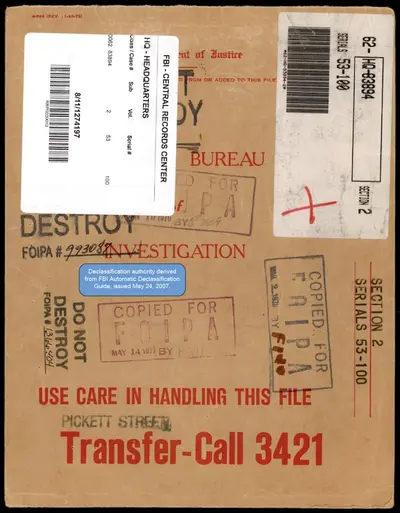
Historical Context of the 1947 Aerial Wave
The summer of 1947 represents a pivotal period in the history of modern unidentified aerial phenomena. Following the conclusion of World War II, the United States entered an era of intense technological competition and heightened atmospheric surveillance. The period was characterized by a sudden surge in reports of unidentified objects, a phenomenon often referred to as the first wave of “flying saucer” sightings. This wave was catalyzed by the Kenneth Arnold sighting in June 1947 and the subsequent reports surrounding the Roswell incident in July 1947. During this era, the public and government agencies were attempting to reconcile new, unidentifiable aerial sightings with the rapid advancements in aeronautics, such as the development of jet propulsion and high-altitude reconnaissance.
In the mid-twentieth century, the United States government lacked a centralized agency dedicated to the study of unidentified aerial phenomena. Instead, various intelligence and law enforcement branches handled such reports through existing bureaucratic frameworks. The Federal Bureau of Investigation (FBI) played a significant role in this process, particularly when sightings occurred near or over critical infrastructure. The Bureau’s field offices, including those in Knoxville, Albuquerque, and Los Angeles, operated under standing protocols designed to protect vital installations. When reports of unidentified objects emerged that could potentially threaten national security or involve unauthorized incursions into restricted airspace, the FBI routed the information to its headquarters for evaluation and potential coordination with the military.
The Detroit Incident of August 8, 1947
On August 8, 1947, the Detroit field office of the FBI recorded an unidentified-object incident that would remain largely shielded from public view for decades. The details of this encounter were eventually released to the public on May 8, 2026, as part of the Presidential Unsealing and Reporting System for UAP Encounters (PURSUE). This release was part of a broader movement toward transparency regarding historical government records of anomalous aerial activity.
The documentation provided by the Detroit field office originated from two specific informants, Raymond Edward Lene and Mrs. Laura Lane. Both individuals provided information regarding observations of what were described as “flying discs.” The memorandum produced by the investigators detailed the pertinent information provided by these informants, though the released document does not specify the total number of witnesses involved in the sighting. Given the nature of the reports, the investigative memorandum recommended that the material be forwarded to the War Department via the Liaison Section, highlighting the intended pathway for military review of the phenomenon.
Analytical Classification and Status
The Detroit case is classified as a visual sighting reported by ground or air observers. Such classifications are standard for the era, as most reports relied on the naked-eye observations of civilians or military personnel stationed at fixed points. Because the reports were processed through the FBI’s investigative channels, they were treated as potential security concerns rather than purely astronomical or meteorological events.
Under the current regulatory framework established by the All-domain Anomaly Resolution Office (AARO), all records released through the PURSUE program are designated as unresolved by default. The federal government has maintained a position of neutrality regarding the Detroit incident, having reached no conclusion as to whether the objects were anomalous or conventional. The possibility of an unidentified origin remains unruled out, just as the possibility of a conventional explanation remains under consideration.
Historical analysis of sightings from this period often considers several conventional candidates. These include experimental aircraft developed during the early Cold War, weather balloons—specifically those associated with the Project Mogul series designed to detect nuclear tests—and various atmospheric optical phenomena such as sundogs or lenticular clouds. Additionally, astronomical objects like the Moon, Venus, or meteors appearing near the horizon are frequently evaluated as potential sources for such reports. The Detroit incident remains a significant component of the historical record, representing the intersection of civilian observation and federal security protocols during a period of unprecedented aerial uncertainty.