Mewark AP Base, Newark UAP Encounter, 1947 — USAAF Box 7 #202
A 1947 U.S. Army Air Forces report documents an unidentified object sighting near Mewark AP Base, Newark, as revealed through the PURSUE program.
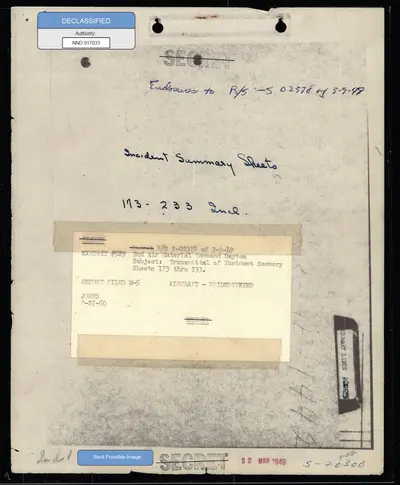
Case Overview
In 1947, near Mewark AP Base, Newark, the U.S. Army Air Forces recorded an unidentified-object incident that became Incident #202 in the “Check-List - Unidentified Flying Objects” series archived in Box 7 of file 38_143685. The records were released by the Department of War on May 8, 2026, as part of the Presidential Unsealing and Reporting System for UAP Encounters (PURSUE). The case is one of the first wave of “flying saucer” reports that swept the United States following the Kenneth Arnold sighting of June 1947 and the Roswell incident of July 1947.
The documentation for Incident #202, archived in Box 7 of file 38_1436 and released via the PURSUE program, provides a brief summary of the event. The records indicate that an unspecified observer reported a sighting of an unidentified object in the vicinity of Mewark AP Base, Newark. The nature of the report is categorized as a visual sighting, which typically involves observations made by ground-based personnel or aircrews during active duty or transit.
Historical Context of the 1947 Wave
The period surrounding 1947 is widely recognized by historians of anomalous phenomena as the emergence of the modern “saucer wave.” This era was characterized by a sudden, massive increase in reports of unidentified aerial phenomena across North America. This surge in public and military interest was catalyzed by high-profile events such as the June 1947 Kenneth Arnold sighting, which introduced the concept of “saucer-like” motion to the popular lexicon, and the subsequent July 1947 Roswell incident. During this time, the United States was transitioning into the early Cold War era, a period of intense technological competition and heightened aerial surveillance.
The geographical significance of Mewark AP Base, located in Newark, places this sighting within a period of significant military activity. Airfields and Army Air Forces bases during the post-war reconstruction were focal points for monitoring the skies for both conventional and unconventional threats. The reporting of such objects by military personnel often reflected the heightened state of readiness and the scrutiny applied to the airspace during the dawn of the jet age.
Investigation and Classification
The investigation of 1947-era sightings was often rudimentary compared to modern sensor-based tracking. At the time, military reporting relied heavily on human observation and the manual logging of sightings into standardized checklists, such as the “Check-List - Unidentified Flying Objects” series used in this case. These logs served as the primary method for the U.S. Army Air Forces to track potential incursions or unidentified aerial threats.
The status of Incident #202 remains officially unresolved. All records released under the PURSUE program are designated as unresolved by the All-domain Anomaly Resolution Office. The federal government has maintained a neutral stance regarding these mid-century encounters, neither concluding that the objects were anomalous nor confirming they were conventional. This lack of a definitive ruling leaves the possibility open that the object was an unidentified phenomenon or a misidentified known entity.
Potential conventional explanations for sightings during this specific wave include the Project Mogul balloon flights, which were active over the U.S. Southwest at the time, as well as the testing of experimental jet and rocket aircraft. Other possibilities considered by researchers include atmospheric optical effects or astronomical objects that were misidentified due to unusual viewing angles. Despite these theories, the official record for the Newark encounter remains an open inquiry.