Eugene, Oregon UFO Sighting (July 5, 1947) — FBI Files
An assistant cashier reported seeing silvered disks falling from a light airplane over Eugene, Oregon, in an incident documented in FBI files.
Background
On July 5, 1947, in Eugene, Oregon, U.S. government investigators recorded an unidentified-object incident later released to the public on May 8, 2026, as part of the Presidential Unsealing and Reporting System for UAP Encounters (PURSUE). This sighting occurred during a period of intense public and governmental preoccupation with aerial phenomena. The summer of 1947 is widely recognized in paranormal studies as the beginning of the modern “flying saucer” era, a phenomenon triggered by the Kenneth Arnold sighting in June 1947 and followed closely by the Roswell incident in July 1947. During this era, the sudden influx of reports regarding metallic, disc-shaped objects created a sense of widespread atmospheric anomaly across the American West.
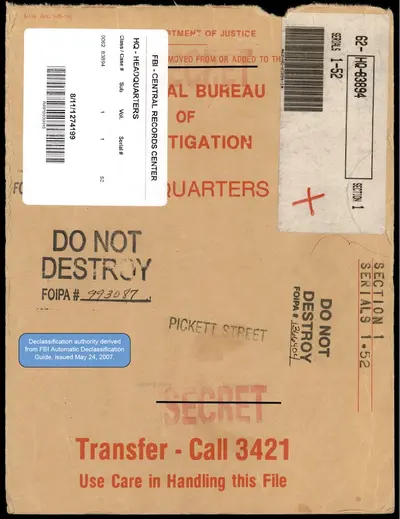
The geographic location of Eugene, situated in the Willamette Valley, placed the event within a region of significant transit and agricultural activity. In the mid-twentieth century, the presence of small-scale aviation and commercial rail lines made the observation of low-altitude aerial activity a common occurrence for local residents. The reporting of this specific event was processed through established federal channels. The case was filed with the Federal Bureau of Investigation, whose Knoxville, Albuquerque, Los Angeles, and other field offices routed UFO reports to headquarters under the Bureau’s standing protocols for the protection of vital installations. This bureaucratic procedure highlights how the federal government, through various intelligence and law enforcement agencies, maintained a structured system for monitoring unidentified aerial activity that could potentially threaten national security or critical infrastructure.
What the document records
The primary evidence for this incident resides in the declassified FBI documentation. According to the records, an assistant cashier for the Southern Railroad reported seeing silvered disks being dropped from a light airplane over Eugene. The witness was driving on a city street when he observed the objects falling from the aircraft. While the physical description of the objects suggests a metallic or reflective quality, the specific mechanism of their release from the plane remains unclarified by the source text.
The released document does not specify the total number of witnesses present during the event, though the visibility of the objects from a city street suggests the phenomenon may have been observable to others in the immediate vicinity. Beyond the movement of the disks themselves, the case includes reports of figures or beings associated with the object, adding a layer of complexity to the encounter that distinguishes it from purely mechanical or atmospheric sightings.
Type of case
The Eugene incident is classified as a UFO case involving potential biological or humanoid elements. Such reports, which include the presence of figures or beings, are a recurring theme in mid-century aerial phenomena documentation. These types of encounters often move the investigation beyond simple aeronautical scrutiny into the realm of unidentified biological entities.
Status
All records released under the PURSUE program are designated unresolved by the All-domain Anomaly Resolution Office (AARO) by default. The federal government has not concluded that the events were anomalous, has not concluded that they were conventional, and has not ruled out either possibility. The ambiguity of the Eugene report reflects the broader difficulty in verifying mid-century sightings where physical debris was not recovered.
Conventional candidates for sightings of this period include experimental aircraft, weather balloons, particularly the Project Mogul series in the late 1940s, and atmospheric optical phenomena such as sundogs and lenticular clouds. Additionally, astronomical objects including Venus, the Moon, and meteors near the horizon are frequently cited as potential explanations for metallic-looking aerial phenomena. The Eugene case remains part of the broader historical archive of unverified aerial events that continue to be studied for patterns of atmospheric or technological anomalies.