Kenneth Arnold UFO Sighting, Evanston, Illinois (July 31, 1947)
A 1947 government report details a mysterious disc-shaped object sighting in Evanston, Illinois, released decades later via the PURSUE program.
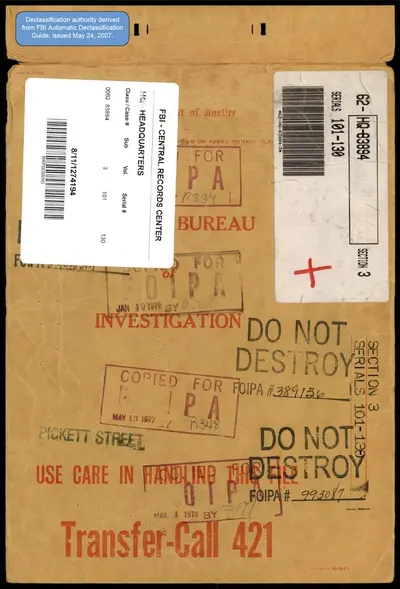
Background
On July 31, 1947, in Evanston, Illinois, U.S. government investigators recorded an unidentified-object incident later released to the public on May 8, 2026, as part of the Presidential Unsealing and Reporting System for UAP Encounters (PURSUE). This specific report emerged during a period of intense national preoccupation with aerial phenomena. The incident is one of the first wave of “flying saucer” reports that swept the United States following the Kenneth Arnold sighting of June 1947 and the Roswell incident of July 1947. During this era, the midwestern United States, including the Chicago metropolitan area and its suburbs like Evanston, became a focal point for such reports as the public and military began to grapple with the possibility of unidentified aerial technology.
The administrative handling of this case reflects the Cold War-era security landscape. The case was filed with the Federal Bureau of Investigation, whose Knoxville, Albuquerque, Los Angeles, and other field offices routed UFO reports to headquarters under the Bureau’s standing protocols for the protection of vital installations. At the time, the intelligence community viewed unidentified aerial phenomena through the lens of national security and potential incursions by foreign adversaries. The systematic collection of these reports by FBI field offices suggests a standardized, albeit secretive, effort to monitor any objects that could threaten the integrity of domestic infrastructure or military assets.
What the document records
The released documentation provides a specific, albeit brief, account of the communication surrounding the event. Kenneth Arnold made a collect call to Palmer in Evanston, Illinois. While the specific purpose of this communication is not detailed in the official record, the timing is significant, as it occurred amidst a flurry of phone calls related to flying disc sightings across the country. This period of heightened telephonic activity suggests a localized spike in public interest or a direct reaction to the sightings being reported in the news.
The number of witnesses involved in the Evanston incident is not specified in the released document. This lack of precise witness enumeration is common in many declassified files from this era, where the focus of the investigators often remained on the transmission of the report itself rather than a comprehensive census of all observers. The document serves primarily as a record of the reported sighting and the subsequent governmental notification process.
Type of case
The witnesses involved in the Evanston report described the object as being disc- or saucer-shaped. This terminology is consistent with the linguistic trends of the late 1940s, as the term “flying saucer” became the dominant cultural descriptor for any aerial object that exhibited non-conventional flight characteristics or an unconventional physical form.
Status
All records released under the PURSUE program are designated unresolved by the All-domain Anomaly Resolution Office (AARO) by default. The federal government has not concluded that the events were anomalous, has not concluded that they were conventional, and has not ruled out either possibility. The ambiguity of the classification reflects the difficulty in verifying mid-century sightings with modern forensic or radar data.
Conventional candidates for sightings of this period include experimental aircraft, weather balloons, especially the Project Mogul series in the late 1940s, atmospheric optical phenomena such as sundogs and lenticular clouds, and astronomical objects including Venus, the Moon, and meteors near the horizon. The investigation of such cases often requires distinguishing between known high-altitude surveillance programs and natural atmospheric events that can mimic the appearance of solid, maneuvering objects.