Trinity Test UFO Sighting
The world's first nuclear detonation may have attracted observers. Some accounts suggest UFOs were seen monitoring the Trinity test that ushered in the atomic age.
At 5:29 in the morning on July 16, 1945, in the flat, empty desert of southern New Mexico, humanity crossed a threshold from which there was no return. The detonation of the plutonium implosion device code-named “Gadget” at the Trinity test site near Alamogordo produced a blast equivalent to twenty thousand tons of TNT, vaporized the steel tower on which it sat, fused the desert sand into a glassy substance that would later be called trinitite, and generated a mushroom cloud that rose to over forty thousand feet. J. Robert Oppenheimer, the physicist who directed the Manhattan Project, later recalled that the sight brought to his mind a line from the Hindu scripture the Bhagavad Gita: “Now I am become Death, the destroyer of worlds.” In that single instant, the atomic age was born, and humanity announced to the universe, intentionally or not, that it had mastered the fundamental forces of matter.
According to a small number of accounts that emerged in the decades following the test, humanity may not have been the only intelligence observing that announcement. Several witnesses associated with the Trinity test reported, years after the event, that unusual aerial objects were seen in the vicinity of the detonation, objects that appeared to be observing the test with an interest that went beyond the merely coincidental. These accounts are sparse, difficult to verify, and heavily filtered through the passage of time, but they represent the earliest claimed intersection of two phenomena that would come to define the second half of the twentieth century: nuclear weapons and unidentified flying objects.
The Manhattan Project and the Jornada del Muerto
The Trinity test was conducted at a site within the Jornada del Muerto, the “Journey of the Dead Man,” a desolate stretch of desert basin in central New Mexico that had earned its grim name from Spanish colonists who had died crossing it centuries earlier. The Manhattan Project chose this remote location precisely because of its isolation, far from population centers, far from prying eyes, and surrounded by terrain so inhospitable that unauthorized observers were unlikely to approach.
The secrecy surrounding the Manhattan Project was absolute. The development of the atomic bomb was the most closely guarded military secret in history, and the personnel involved in the Trinity test were under strict orders not to discuss what they witnessed. This culture of secrecy had profound implications for any anomalous observations that might have been made during the test. If witnesses saw something unusual in the sky, something unrelated to the bomb itself, they would have had strong incentives to remain silent. Reporting an unidentified object in restricted military airspace during the most classified test in history would have invited unwelcome attention from security officers whose primary concern was preventing any leak of information about the bomb.
The test was witnessed by approximately 425 people, including scientists, military personnel, and support staff positioned at various observation points around the blast site. The nearest observers were stationed in bunkers approximately five and a half miles from ground zero, while others watched from positions up to twenty miles away. Most of these observers were, naturally, focused entirely on the device itself and on the instruments measuring its performance. Their attention was directed toward a specific point on the ground, not toward the sky, and their emotional and intellectual engagement with the epochal event they were witnessing would have left little cognitive bandwidth for noticing anything else.
The Accounts
The UFO reports associated with the Trinity test are frustratingly thin by the standards of modern ufology. They consist of a small number of accounts, most of which emerged decades after the event and were recorded by UFO researchers rather than by the witnesses themselves. The provenance of these accounts varies, and in several cases the original witnesses are identified only vaguely or not at all, making independent verification impossible.
The most commonly cited accounts describe unusual lights observed in the sky near the test site in the hours before the detonation. According to these reports, one or more luminous objects were seen hovering or moving slowly at high altitude in the predawn darkness, their appearance inconsistent with any known aircraft or astronomical object. The lights were described as steady and bright, not flickering or blinking in the manner of conventional aircraft navigation lights, and their movements, when movement was observed, were described as smooth and deliberate.
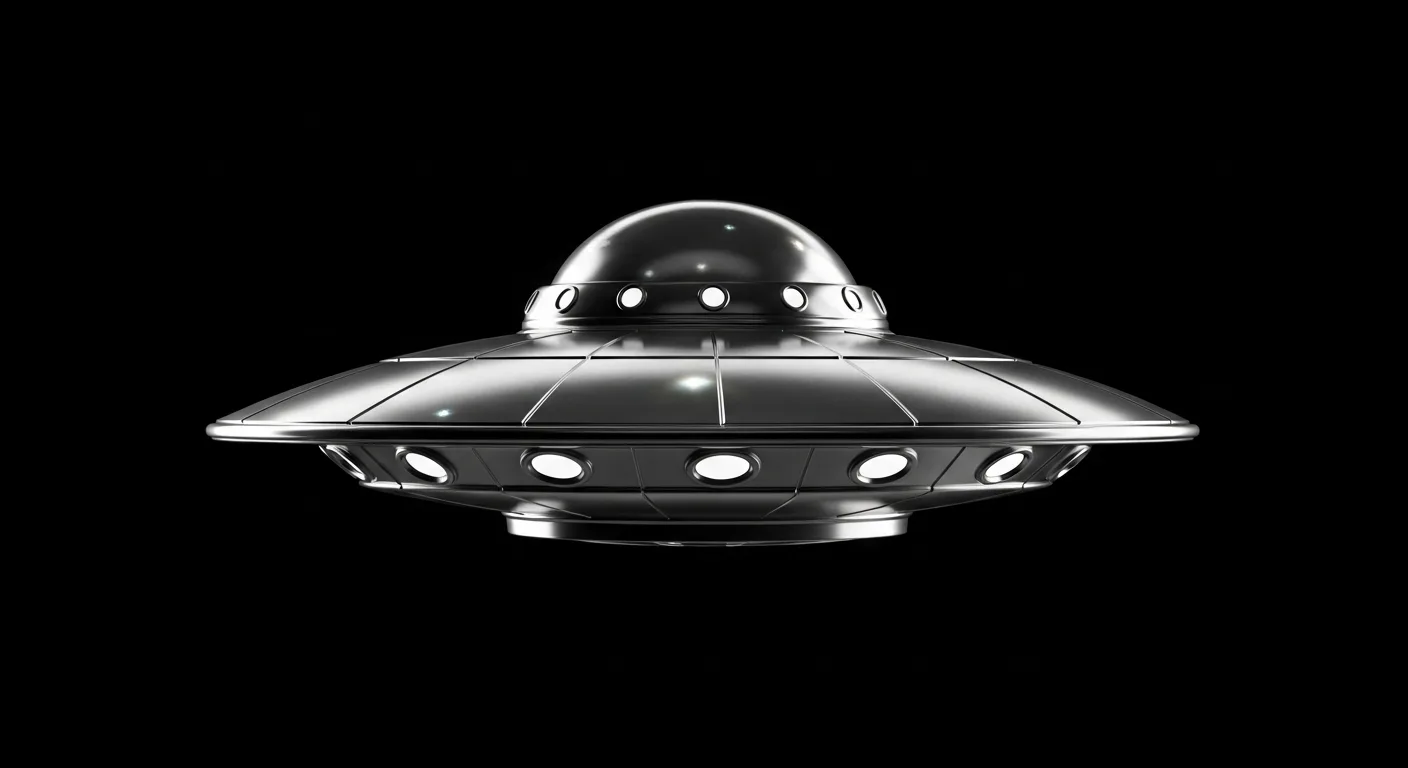
One account, attributed to a military security officer stationed at a perimeter checkpoint, describes a bright, disc-shaped object observed at high altitude shortly before the detonation. The officer reportedly watched the object for several minutes, assuming it to be some aspect of the test that he had not been briefed on, before the detonation itself drew his attention to the ground. When he looked back at the sky after the blast, the object was gone.
Another account, more vaguely sourced, describes objects observed immediately after the detonation, apparently drawn to the site by the explosion itself. According to this version, one or more luminous objects appeared in the sky above the mushroom cloud, hovering for a period before departing at high speed. This account is particularly difficult to evaluate because the Trinity detonation produced an intensely bright flash, a massive fireball, and atmospheric effects including ionization that could have produced unusual visual phenomena entirely consistent with known physics.
A third category of accounts involves observations made not on the day of the test itself but in the days and weeks following, when monitoring teams were working at the site to assess the effects of the detonation. Some of these personnel reportedly observed unusual aerial activity in the vicinity of the blast site, objects that did not correspond to any known military aircraft and that seemed to be conducting their own survey of the area.
The Nuclear Connection
Whatever one makes of the specific Trinity accounts, they represent the earliest claimed data point in what has become one of the most persistent and intriguing patterns in ufology: the apparent association between UFO activity and nuclear weapons or nuclear technology. From the mid-1940s onward, reports of unidentified objects near nuclear facilities, weapons storage sites, missile silos, and test ranges have accumulated to a degree that even skeptical researchers acknowledge as statistically interesting.
The post-war period saw a concentration of UFO sightings in New Mexico that far exceeded the national average, and many of these sightings occurred in the vicinity of installations associated with the nuclear weapons program. Los Alamos, where the bombs were designed and built, generated numerous reports. Sandia National Laboratories, the White Sands Missile Range, and other facilities in the state also attracted unusual aerial activity. The famous Roswell incident of 1947 occurred less than two hundred miles from the Trinity site, in a region that was home to the 509th Bomb Group, the only nuclear-armed military unit in the world at that time.
The pattern extended well beyond New Mexico. In the decades that followed, UFO incidents were reported at nuclear facilities around the world. The Malmstrom Air Force Base incident of 1967, in which unidentified objects were reportedly observed near intercontinental ballistic missile silos while the missiles themselves simultaneously went offline, remains one of the most extensively documented military UFO cases on record. Similar incidents were reported at other missile bases in the United States and at nuclear facilities in the Soviet Union, the United Kingdom, and France.
The consistency of this pattern has led some researchers to hypothesize that whatever intelligence is behind the UFO phenomenon has a specific interest in nuclear technology, possibly out of concern about its destructive potential, possibly for reasons entirely beyond human comprehension. The Trinity test, as the first demonstration of nuclear weapons, would logically be the event that triggered this interest, the moment when humanity first drew attention to itself by splitting the atom.
The Problem of Evidence
The Trinity UFO accounts face a fundamental evidentiary problem that sets them apart from most UFO cases: the extreme secrecy surrounding the Manhattan Project meant that the normal channels for reporting and recording anomalous observations did not exist. Personnel who witnessed something unusual had no mechanism for reporting it that would not raise security concerns, and no institutional framework existed for investigating reports of unidentified objects in an era before the phenomenon had entered public consciousness.
Kenneth Arnold’s famous sighting of nine disc-shaped objects near Mount Rainier, Washington, did not occur until June 24, 1947, more than two years after the Trinity test. Before Arnold’s report and the media sensation it generated, there was no widely understood concept of “flying saucers” or UFOs in American culture. A witness at Trinity who saw an unusual object in the sky in July 1945 would not have had the vocabulary or the cultural framework to describe what they saw. They would not have known that others around the world had reported similar phenomena. They would have had no reason to believe that their observation was anything other than a personal oddity, and every reason to keep quiet about it.
This silence was compounded by the security culture of the Manhattan Project, which instilled in its personnel a deep reluctance to discuss any aspect of their work. Many participants in the nuclear weapons program maintained their silence for decades, even about unclassified aspects of their experience, and the idea that they might have broken security protocol to report a strange light in the sky is implausible. It was only when the UFO phenomenon became a matter of public interest, and when the connection between UFOs and nuclear facilities became a subject of serious research, that some of these witnesses felt both able and motivated to share their observations.
The passage of time between the event and the reporting of these accounts is a significant weakness. Human memory is fallible, and memories reconstructed decades after the fact are subject to distortion, embellishment, and contamination by subsequent knowledge and expectations. A witness who saw something ambiguous in the sky on the morning of July 16, 1945, might have reinterpreted that memory in light of later UFO reports, unconsciously shaping a vague recollection into something more specific and dramatic than the original experience warranted.
The Significance of Trinity
Regardless of whether UFOs were actually present at the Trinity test, the event itself occupies a pivotal position in the narrative that connects nuclear weapons to the UFO phenomenon. If one accepts the hypothesis that an unknown intelligence has been monitoring human nuclear activity, then Trinity was the logical starting point, the moment when humanity first demonstrated its capacity for large-scale atomic destruction and, in doing so, potentially attracted the attention of observers who had previously regarded the inhabitants of this planet as beneath notice.
The Trinity detonation was not merely loud and bright. It produced electromagnetic radiation across the entire spectrum, from radio waves to gamma rays, and created a pulse of energy that could theoretically have been detected at enormous distances. If any intelligence, terrestrial or otherwise, possessed the technology to monitor electromagnetic emissions from space, the Trinity blast would have stood out against the background noise of the planet like a searchlight in a dark room. Nothing in the four-billion-year history of Earth had produced a comparable concentrated release of energy, and nothing would again until the next nuclear test.
The first nuclear detonation also released a characteristic signature of radioactive isotopes into the atmosphere, isotopes that do not occur naturally and that would persist in detectable quantities for decades. Any intelligence with the ability to analyze atmospheric composition from a distance would have recognized these isotopes as evidence of nuclear fission, a technology that implies a certain level of scientific and industrial sophistication and, more importantly, a capacity for self-destruction on a civilizational scale.
A Question Without an Answer
The Trinity UFO accounts remain among the most tantalizing and least satisfying cases in the history of ufology. They are tantalizing because of what they imply: that the most consequential moment in modern human history may have been observed by an unknown intelligence, that the splitting of the atom may have served as a signal to watchers we did not know existed. They are unsatisfying because the evidence supporting them is thin, secondhand, and emerged too long after the event to be treated as reliable.
What we know with certainty is that on July 16, 1945, humanity changed its relationship with the universe. The forces that power the stars were released on the surface of the Earth for the first time, and the world was never the same. What we do not know, and may never know, is whether that moment was witnessed by eyes other than our own, whether the flash that lit the New Mexico desert was seen not just by the scientists and soldiers who created it but by something watching from above, something that recognized the light for what it was: a species announcing its arrival at a dangerous threshold, a planet becoming, for the first time, a potential threat to something beyond itself.
The accounts persist, neither proven nor disproven, hovering at the edge of history like the objects they describe, present but unconfirmed, significant but unverifiable. They remind us that the dawn of the nuclear age was a moment of cosmic significance, a point at which human history and something far larger may have briefly intersected. Whether that intersection actually occurred at Trinity, or whether it remains a projection of our own hopes and fears onto an event already freighted with more meaning than any single moment should have to bear, is a question that the sparse and fragile evidence cannot resolve.
Sources
- Chronicling America (Library of Congress) — Historic US newspaper coverage (1690–1963)
- Chronicling America — Historic US newspapers (1690–1963)