Britain's Roswell
U.S. military personnel encountered a landed UFO near their base in England.
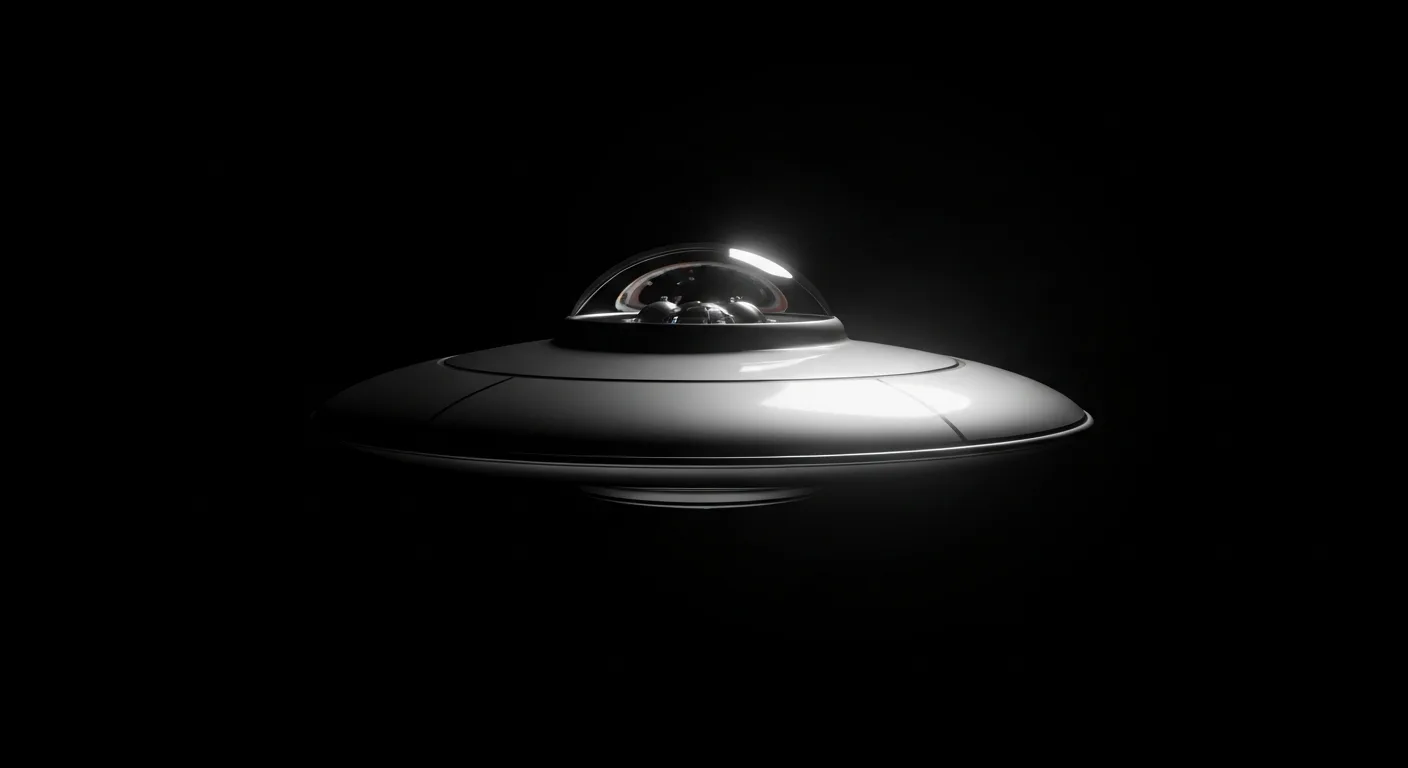
On the nights following Christmas 1980, something extraordinary descended upon the pine forests of coastal Suffolk. Over the course of three successive evenings, dozens of United States Air Force personnel stationed at the twin NATO bases of RAF Woodbridge and RAF Bentwaters encountered phenomena that would defy every conventional explanation offered in the decades to follow. They witnessed structured craft maneuvering through dense woodland, observed lights that moved with apparent intelligence, touched surfaces inscribed with symbols that resembled no known language, and recorded radiation readings that exceeded background levels by orders of magnitude. What became known as the Rendlesham Forest incident—frequently called “Britain’s Roswell”—stands as one of the most compelling and best-documented UFO encounters in history, distinguished from countless other reports by the caliber of its witnesses, the official paper trail it generated, and the sheer strangeness of what those men experienced among the ancient trees.
The Cold War Landscape
To appreciate the full weight of what occurred at Rendlesham, one must first understand the extraordinary military significance of the location. RAF Woodbridge and its sister base RAF Bentwaters were not ordinary installations. Situated along the Suffolk coast, barely a hundred miles from the shores of the Soviet-aligned Eastern Bloc, these bases represented one of NATO’s most strategically vital forward operating positions during the Cold War. The twin bases housed the 81st Tactical Fighter Wing of the United States Air Force, equipped with A-10 Thunderbolt ground-attack aircraft, and were widely rumored to store tactical nuclear weapons in hardened bunkers within the Woodbridge weapons storage area.
The personnel stationed at these bases were not weekend hobbyists or untrained civilians prone to misidentifying celestial objects. They were career military professionals—security police trained to identify aircraft, assess threats, and respond to incursions on installations guarding some of the Western alliance’s most sensitive assets. Their chain of command included seasoned officers with decades of service. When these men reported seeing something extraordinary in the forest that bordered their base, they did so knowing that their careers and reputations were at stake. That so many of them chose to speak anyway—and continued to speak for over four decades—speaks to the profound impact of what they encountered.
Rendlesham Forest itself is a dense plantation of Corsican pine, managed by the Forestry Commission, stretching between the two bases and extending toward the Suffolk coast. In December, the forest floor is thick with fallen needles, the canopy blocks much of the sky, and the narrow firebreaks and logging tracks create a disorienting maze even in daylight. At night, the woodland becomes almost impenetrable—a place of deep shadow and absolute silence, broken only by the occasional crack of a branch or the cry of a roosting bird. It was into this darkness that the witnesses ventured, and it was from this darkness that something emerged to meet them.
The First Night: Contact
The events began in the early hours of December 26, 1980—Boxing Day in Britain, though the American airmen would have simply known it as the day after Christmas. At approximately 3:00 AM, an airman on security patrol near the East Gate of RAF Woodbridge noticed unusual lights apparently descending into Rendlesham Forest just beyond the perimeter fence. The lights did not behave like conventional aircraft. They moved too slowly, descended too steeply, and appeared to settle among the trees rather than continuing along any recognizable flight path.
The initial assumption was that an aircraft had crashed. Given the proximity to the base and the density of military air traffic in the region, this was an entirely reasonable conclusion. A security patrol was dispatched to investigate, led by Staff Sergeant Jim Penniston and accompanied by Airman First Class John Burroughs and Airman Edward Cabansag. The three men proceeded on foot through the East Gate and into the forest, following the firebreak that led toward the suspected crash site.
What they found was not a downed aircraft. As Penniston and Burroughs advanced deeper into the trees—Cabansag having remained at a clearing to maintain radio contact—they encountered something that neither man’s training had prepared them for. Penniston later described seeing a craft of some kind resting in a small clearing, triangular in shape, approximately three meters tall and three meters wide at its base. The object appeared to be metallic, its surface smooth and warm to the touch despite the freezing December air. It emitted a faint luminosity—not a blinding light but a subtle glow that seemed to emanate from the surface itself, shifting between pale blue and white.
What struck Penniston most forcefully were the markings. Inscribed or embossed upon the craft’s surface were symbols—geometric shapes and patterns that resembled no alphabet or technical notation he had ever encountered. Penniston, acting on pure investigative instinct, ran his fingers across these symbols, feeling their texture beneath his gloves. He later described a sensation of static electricity, a tingling that ran up his arm and seemed to fill his mind with a rushing cascade of imagery. In his official notebook, which he carried as standard equipment, Penniston sketched the craft and several of the symbols. These sketches would later become some of the most reproduced images in UFO research.
Burroughs, who had approached from a slightly different angle, described the light from the craft as intensely disorienting. He reported difficulty judging distance and time, as if the space around the object had been subtly warped. Both men later stated that what felt like minutes of observation may have occupied considerably longer—or shorter—periods of actual time. This distortion of temporal perception would become a recurring element in witness accounts throughout the three nights.
After what they estimated to be approximately forty-five minutes in proximity to the craft, the object rose silently from the forest floor. It did not rocket upward with the thrust of conventional propulsion; rather, it seemed to lift gently, weaving between the pine trunks with a precision that suggested intimate awareness of its surroundings, before accelerating away at extraordinary speed and vanishing into the night sky. The men were left standing in the clearing, their radios crackling with static, the forest once again silent and dark.
The Landing Site
When daylight arrived on December 26, investigators returned to the clearing where Penniston and Burroughs had encountered the craft. What they found provided the first physical corroboration of the men’s account. Three distinct impressions were visible in the frozen ground, arranged in a triangular pattern consistent with the shape of the object Penniston had described. Each depression was approximately one and a half inches deep and seven inches in diameter, pressed into earth that the December frost had made rock-hard. Whatever had made these marks had exerted considerable force.
The trees surrounding the clearing bore additional evidence. Branches on the pines nearest to the alleged landing site had been snapped or bent, and scorch marks were visible on the trunks facing the clearing. These marks were later examined and found to be consistent with exposure to intense heat, though their precise origin could not be determined by conventional analysis.
Most significantly, radiation readings taken at the site showed levels markedly above the expected background count. Using standard-issue Geiger counters, investigators measured readings that peaked at the center of the triangular impressions and diminished with distance from the site, exactly the pattern one would expect from a localized radiation source. While skeptics would later argue about the precise significance of these readings—noting that they fell short of levels that would indicate danger to human health—the fact that elevated readings were present at all demanded explanation. Suffolk’s pine forests do not naturally produce radiation anomalies.
Plaster casts were taken of the ground impressions. Photographs were shot of the damaged trees and the landing site from multiple angles. These materials were logged through official channels, though their subsequent disposition within the military bureaucracy would become a matter of considerable controversy in the years to come.
The Second Night: Halt’s Investigation
If the events of December 26 could potentially have been dismissed as the overwrought imaginations of two young airmen on a quiet holiday shift, what occurred on the following night made dismissal effectively impossible. This time, the primary witness was not an enlisted man but the deputy base commander himself—Lieutenant Colonel Charles I. Halt, a career officer with an impeccable service record and no history of making extraordinary claims.
Halt was attending a formal dinner in the officers’ mess on the evening of December 27 when an agitated security policeman arrived to report that the lights had returned to the forest. Halt, who had been skeptical of the previous night’s reports, decided to investigate personally, intending—as he would later admit—to debunk the accounts and put the matter to rest. He assembled a small team, equipped them with portable radiation detectors, a night-vision scope, and a standard-issue cassette recorder, and led them through the East Gate and into the trees.
The audio recording that Halt made that night would become one of the most analyzed pieces of evidence in the history of UFO research. His voice, calm and methodical at the outset, grows increasingly strained as the evening progresses. The recording captures the real-time reactions of trained military personnel confronting phenomena they cannot explain, and its authenticity has never been seriously questioned.
“I see it too,” Halt can be heard saying on the tape, his voice tight with controlled astonishment. “It’s back again… it’s coming this way. It’s definitely coming this way.”
Halt and his team first encountered the anomalous radiation readings at the original landing site, confirming the measurements taken earlier that day. They then observed a flashing red light moving through the trees at a height of several feet, weaving between trunks with apparent deliberation. The light pulsated rhythmically, seeming almost to breathe. When the men approached, it retreated. When they stopped, it paused. The impression was overwhelming that they were not observing a natural phenomenon but something with awareness—something that was observing them in return.
As the team pursued the light deeper into the forest, they emerged at the far edge of the woodland into open farmland. Here, the encounter escalated dramatically. Halt and his men observed a bright object hovering silently over the field, elliptical in shape and radiating a pale luminosity. As they watched, the object suddenly projected a narrow beam of concentrated light downward, the beam striking the ground near their feet with startling precision. Moments later, a second beam was directed toward the Woodbridge weapons storage area—the very facility rumored to house NATO’s tactical nuclear arsenal.
“Here he comes from the south,” Halt narrates on the tape, his voice now unmistakably shaken. “He’s coming toward us now. Now we observe what appears to be a beam coming down to the ground. This is unreal.”
The implications of a beam of unknown origin being directed at a nuclear weapons storage facility were not lost on anyone present. Several other bright objects were observed in the sky during this period, moving with speeds and trajectories that ruled out conventional aircraft, satellites, or astronomical bodies. The objects appeared to break apart and reform, dividing into smaller lights that moved independently before reconverging. After approximately an hour of observation, the objects departed at speeds that Halt would later describe as beyond anything in the known military inventory.
The Third Night and Beyond
The phenomena returned again on December 28, observed by multiple witnesses from various locations around the twin bases. Strange lights were seen moving above and within the forest, and several airmen reported close encounters that they were reluctant to discuss even decades later. The cumulative effect of three consecutive nights of activity created an atmosphere on the base that veterans would describe as a mixture of excitement, fear, and deep unease. These were men trained to defend against Soviet incursion, and they were confronting something that rendered their training and their weapons entirely irrelevant.
Among the most haunting testimonies from the later nights came from Larry Warren, a young airman who described being taken to a clearing in the forest where he witnessed a landed craft and what he believed were non-human entities in communication with senior military officials. Warren’s account has been the most controversial element of the Rendlesham narrative—embraced by some researchers as the missing piece of the puzzle, questioned by others who note inconsistencies in his various retellings over the years. Yet Warren has never wavered from the essential claim that something far beyond conventional explanation occurred in those woods, and his willingness to endure decades of ridicule suggests a man who believes absolutely in what he saw.
Other witnesses have come forward more gradually, some waiting years or even decades before sharing their experiences. Security policemen have described equipment malfunctions—radios dying, vehicle engines cutting out, compasses spinning wildly—in the vicinity of the phenomena. Several men reported periods of missing time, gaps in their memories that could not be accounted for by the normal flow of events. A few described physical aftereffects including eye irritation, headaches, and what appeared to be mild radiation burns on exposed skin.
The Halt Memorandum
In January 1981, Lieutenant Colonel Halt composed an official memorandum addressed to the British Ministry of Defence, documenting the events of the preceding week. This document, now universally known as the “Halt Memo,” represents one of the most remarkable pieces of official correspondence in military history. Written in the measured, understated language of a career officer reporting facts to his superiors, the memo describes unexplained lights, a landed craft, ground impressions, elevated radiation, and objects projecting beams of light onto a military installation.
The memo was classified and filed. The Ministry of Defence, which maintained jurisdiction over British airspace even at American-operated bases, acknowledged receipt but took no visible action. For years, the British government’s official position was that the incident posed no threat to national security and therefore warranted no investigation—a stance that many found difficult to reconcile with the description of unknown objects directing beams of light at a nuclear weapons facility.
The Halt Memo was eventually released through freedom of information channels in the United States, where it became an immediate sensation. Here was not an anonymous report from a rural farmer or a blurry photograph from an uncertain source, but an official military document, written by a senior officer, transmitted through proper channels, and filed by a government ministry. Whatever position one might take on the nature of the phenomena described, the document’s authenticity was beyond question.
Halt himself would go further in subsequent decades. In retirement, freed from the constraints of active duty, he stated publicly and unequivocally that the objects he observed were under intelligent control and were not of any earthly origin known to him. He expressed frustration with the lack of official follow-up and with attempts by debunkers to explain away what he and his men had witnessed. “I wish I could tell you it was something conventional,” Halt said in a 2015 interview. “I’ve had thirty-five years to find a mundane explanation. There isn’t one.”
The Skeptics and the Silence
No account of Rendlesham would be complete without acknowledging the skeptical explanations that have been offered over the decades. The most persistent identifies the Orfordness Lighthouse, located several miles to the southeast along the Suffolk coast, as the source of the lights observed by the witnesses. The lighthouse’s rotating beam, skeptics argue, could have been visible through the trees and might have been misidentified by disoriented men stumbling through unfamiliar woodland in the dark.
The lighthouse theory has been examined and rejected by most of the principal witnesses, who point out that they were intimately familiar with the lighthouse beam from their regular duties on the base. Penniston and Halt have both stated that the lighthouse was visible during their respective encounters and was clearly distinguishable from the anomalous phenomena they were observing. The lighthouse beam sweeps at fixed intervals, moves in a predictable arc, and cannot descend to ground level, project beams onto specific targets, or leave physical traces in frozen earth.
Other proposed explanations have included a re-entering Soviet satellite, a downed military aircraft subject to a cover-up, a prank involving portable lights, and even the suggestion that the witnesses were intoxicated following Christmas celebrations. Each of these theories collapses under even modest scrutiny. No satellite re-entry was recorded on the relevant dates. No aircraft wreckage was ever found. No prankster has ever come forward to claim responsibility for a hoax sustained across three consecutive nights under the noses of armed security personnel. And the suggestion of widespread intoxication among on-duty military police at a nuclear-capable NATO base during the height of the Cold War reflects a fundamental misunderstanding of military discipline.
The silence of the official response is perhaps as telling as the events themselves. Both the British and American governments have maintained a posture of studied indifference toward Rendlesham, neither confirming nor convincingly denying the witnesses’ accounts. Documents released through freedom of information requests reveal that the incident generated considerably more internal interest than public statements suggested, but the full extent of official investigation—if any—remains classified or undisclosed.
The Forest Remembers
Rendlesham Forest today is a popular destination for walkers, cyclists, and nature enthusiasts, its trails threading through the same pines that witnessed the events of December 1980. The Forestry Commission has erected a UFO trail, complete with interpretive markers and a metal sculpture of the craft described by Penniston, acknowledging the forest’s place in both local lore and the broader cultural imagination. The East Gate, through which the witnesses passed on their way to their encounters, still stands, though the base behind it has been decommissioned and partially converted to civilian use.
Visitors to the forest at night report an atmosphere of deep stillness that goes beyond mere quiet. The pines absorb sound, the canopy blocks starlight, and the darkness between the trees seems to press close with almost physical weight. Some report feelings of being watched, of a subtle awareness in the woodland that has nothing to do with the wildlife. Whether this is the power of suggestion—the knowledge of what is said to have occurred here—or something more fundamental about the place itself is a question that each visitor must answer for themselves.
The witnesses have aged but not forgotten. Jim Penniston, now retired, continues to speak about his encounter and the binary code that flooded his mind when he touched the craft—a sequence of ones and zeros that, when decoded years later, reportedly yielded geographic coordinates pointing to locations of historical and mythological significance around the world. John Burroughs, who suffered unexplained health issues that he attributes to his proximity to the craft, fought a long legal battle to obtain his medical records from that period—records that were classified at a level normally reserved for matters of national security. The very classification of a young airman’s medical file raises questions that no official statement has adequately addressed.
Charles Halt has remained the case’s most authoritative advocate, his credibility buttressed by his rank, his record, and his evident reluctance to be cast as a UFO believer. He is not a man who sought attention or notoriety. He is a man who saw something that contradicted everything he understood about the world, and who has spent the subsequent decades insisting—quietly, firmly, and without embellishment—that others take what he saw as seriously as he does.
What Came Down in the Forest
More than four decades after those three December nights, the Rendlesham Forest incident remains stubbornly resistant to resolution. It cannot be easily dismissed, because the witnesses are too credible, the documentation too official, and the physical evidence too persistent. Nor can it be easily accepted in its fullest implications, because those implications challenge assumptions so fundamental to our understanding of reality that most institutions—military, governmental, scientific—prefer not to engage with them at all.
What is certain is that something happened in those woods. Something left marks in frozen ground and radiation in quiet clearings. Something caused hardened military professionals to question everything they thought they knew. Something directed a beam of light at one of the Cold War’s most sensitive installations and then vanished into a sky it had no conventional right to occupy.
The pines of Rendlesham Forest still stand in their orderly rows, indifferent to the mystery they harbor. The firebreaks still run between them, narrow corridors of darkness where men once walked toward something they could not explain and from which they emerged forever changed. The forest keeps its secrets as forests always have—in silence, in shadow, and in the spaces between the trees where the light does not reach. Whatever descended into that woodland on those cold December nights, it left behind questions that neither science nor officialdom has been willing to answer, and witnesses whose testimony grows more rather than less compelling with each passing year.
The truth of Rendlesham may lie buried in classified files, locked in the memories of aging veterans, or encoded in the binary sequence that still haunts Jim Penniston’s dreams. It may be that we are not yet ready to understand what those men encountered, or that the understanding itself would demand a reckoning with realities that governments and institutions are not prepared to face. But the forest remembers, even if we choose to look away. And on quiet December nights, when the Suffolk wind moves through the pines and the darkness gathers between the trees, the questions that were born in those woods four decades ago remain as urgent and as unanswered as ever.
Sources
- Britain — Wikipedia
- CIA UFO/UAP Reading Room — Declassified CIA documents on UAP
- UK National Archives — UFO Files — MoD UFO investigation records
- British Newspaper Archive — UK press archive