The Portsmouth Harbour UFO
Multiple witnesses observed a glowing object above the naval base.
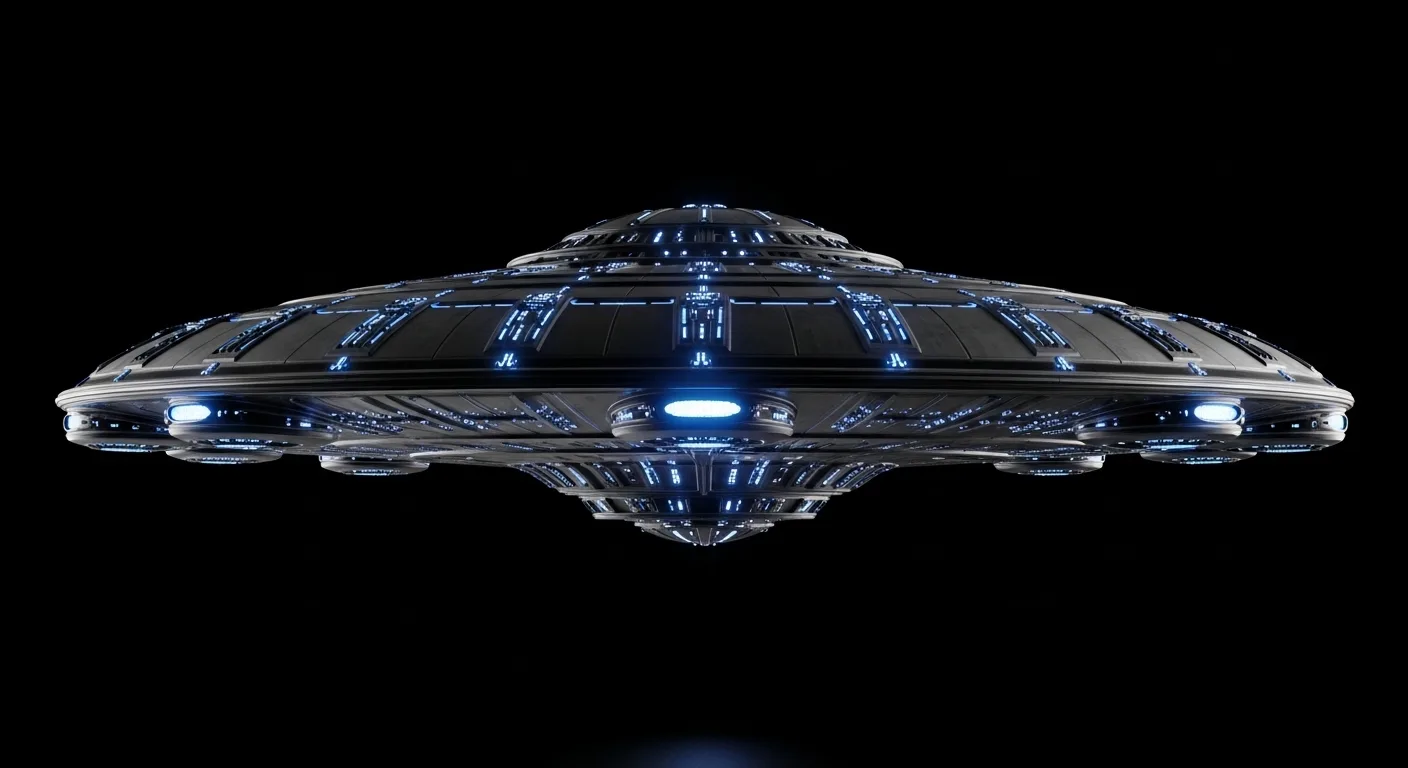
On a clear August evening in 1978, something appeared above one of the most sensitive military installations in the United Kingdom. Portsmouth Harbour, home to the Royal Navy’s principal base and a facility of supreme strategic importance during the Cold War, became the backdrop for a UFO sighting that was witnessed by dozens of civilians and—if unofficial accounts are to be believed—military personnel as well. The object hovered silently above warships and submarines carrying nuclear weapons, remained visible for several minutes, and departed at a speed that defied any known technology. Despite the sighting’s location above a facility where unauthorized aerial intrusion would constitute a matter of national security, official investigation was either never conducted or never made public. The Portsmouth Harbour UFO remains one of the most compelling military-adjacent sightings in British UFO history.
The Strategic Heart of the Royal Navy
To appreciate the significance of this sighting, one must understand what Portsmouth Harbour represented in 1978. This was not merely a port where a few naval vessels happened to be docked. Portsmouth was—and remains—the headquarters of the Royal Navy, the largest and most important naval base in the United Kingdom. In 1978, at the height of the Cold War, the harbour housed a formidable concentration of military power. Aircraft carriers, destroyers, frigates, and support vessels were berthed along miles of waterfront. Most critically, the harbour was home to nuclear submarines, vessels carrying ballistic missiles that formed a cornerstone of Britain’s nuclear deterrent.
The security around Portsmouth Harbour was intense. The base was surrounded by restricted zones, both on the ground and in the airspace above. Any aircraft entering the area without authorization would have been immediately detected by radar and intercepted. The skies above Portsmouth were watched constantly, not only by military radar systems but by the countless trained eyes of naval personnel for whom awareness of the aerial environment was a professional requirement. This was a place where an unidentified flying object could not easily go unnoticed, and where the response to one should have been immediate and well-documented.
The Cold War context is essential to understanding the sighting’s implications. In 1978, tensions between NATO and the Warsaw Pact were high. Soviet reconnaissance aircraft regularly tested British airspace defenses, and the Royal Navy operated under constant readiness for potential conflict. Any unknown object hovering above the main naval base would have triggered alarm at the highest levels—unless it was something so far beyond conventional capability that standard responses were rendered meaningless.
The Sighting Begins
The events of that August evening began with the most ordinary of settings. It was a warm, clear night, the kind of summer evening that draws people outdoors. Along Southsea seafront, the esplanade that runs along the shore facing Portsmouth Harbour, families were walking, couples sat on benches enjoying the fading light, and a few late swimmers were making the most of the warm water. Across the harbour, the lights of Gosport were beginning to appear, and the dark shapes of naval vessels were visible against the water.
The first reports came from civilians on the Southsea side of the harbour. At approximately 9:30 PM, as the last light was leaving the sky, witnesses noticed a bright light above the harbour that was clearly not a star, aircraft, or any familiar object. The light was described as yellowish-white, steady rather than blinking, and considerably brighter than any of the harbour’s navigation lights or the illumination from the naval base.
Margaret Haines, a Southsea resident who was walking her dog along the seafront, provided one of the earliest and most detailed accounts. “I noticed the light because it was in the wrong place for anything I could think of,” she recalled in a later interview. “It was over the harbour, maybe a thousand feet up, just hanging there. I assumed it was a helicopter at first, but there was no sound at all. None. You can always hear the helicopters from the base, even from this distance. This thing was completely silent.”
Within minutes, the light had attracted the attention of dozens of people along the seafront. Small groups gathered, pointing upward and debating what they were seeing. Some suggested it was a flare, but flares descend and this object remained stationary. Others proposed a weather balloon, but the light was far too bright and too controlled in its position for a balloon. The object simply hung in the sky above the harbour, radiating its steady glow with an almost deliberate calm.
The Object Reveals Itself
As the sky darkened further, the object became more clearly visible, and witnesses began to discern details beyond a simple point of light. The object appeared to be disc-shaped, or at least circular when viewed from below. Its glow was not uniform but seemed to emanate from the body of the object itself rather than from any external light source. Several witnesses described a metallic quality to the object’s surface, visible when the glow dimmed slightly, suggesting a solid, manufactured craft rather than an atmospheric phenomenon.
Size estimates varied, as they typically do in such cases, but most witnesses placed the object between thirty and fifty feet in diameter. Its altitude was estimated at approximately one thousand feet, though some witnesses believed it was higher. The object’s position was roughly above the central portion of the harbour, in the vicinity of the main naval base facilities. This meant it was hovering directly above some of the most valuable and sensitive military assets in the country.
From the Gosport side of the harbour, the object was also clearly visible. Ferry passengers making the short crossing between Portsmouth and Gosport reported seeing the light from the water, providing a different angle of observation. One ferry passenger, a retired engineering officer named Colin Weatherby, later stated that from his position on the water, the object appeared to be disc-shaped and was clearly hovering above the eastern side of the harbour. “I spent thirty years in the Navy and I have never seen anything like it,” he said. “It was not a helicopter, not a plane, not a blimp. I couldn’t tell you what it was.”
Anomalous Behavior
After hovering motionlessly for several minutes—witnesses’ estimates of the duration range from five to fifteen minutes—the object began to exhibit behavior that would prove even more remarkable than its initial appearance. It started to move, slowly at first, traversing the harbour from east to west in a smooth, gliding motion that produced no visible exhaust, no vapor trail, and no sound whatsoever.
The movement was unlike that of any known aircraft. There was no acceleration in the conventional sense—no impression of engines engaging or thrust being applied. The object simply began to drift, smoothly and evenly, as if it were sliding along an invisible rail. Its speed at this point was estimated at roughly ten to twenty miles per hour, slow enough to track easily with the naked eye, leisurely enough to seem almost deliberately unhurried.
The object then stopped again, hovering over a different portion of the harbour. This second stationary period lasted several minutes, during which the object appeared to descend slightly, dropping perhaps two hundred feet before stabilizing at its new altitude. Witnesses on the seafront reported that during this descent, the object’s glow intensified briefly, as if some internal process were responding to the change in altitude. The yellowish-white light shifted momentarily toward blue before returning to its original color.
It was during this second hover that the object seemed to attract attention from the naval base itself. Several witnesses reported seeing unusual activity on the base—vehicles moving, searchlights activating, personnel appearing on exposed positions. These reports are impossible to verify, as the Ministry of Defence has never confirmed any military response to the sighting, but they are consistent with the reaction one would expect from a military installation confronted with an unidentified object directly overhead.
The Departure
The object’s departure was the most dramatic phase of the entire encounter. Without any warning or transition, the object ceased its gentle hovering and accelerated upward at a speed that left witnesses struggling for words. The motion was described variously as “instantaneous,” “like a bullet,” and “as if it had been yanked upward by an invisible string.” One witness compared it to watching a ball thrown from the ground, except that the acceleration was immediate rather than gradual, and the object did not slow down as it rose but appeared to increase in speed continuously.
Within seconds, the object had ascended from its altitude of roughly a thousand feet to a height at which it was indistinguishable from the stars. It did not arc or curve; it rose vertically, straight up, as if gravity had no claim on it. The entire departure took no more than two or three seconds, by which time the object had vanished from sight entirely. There was no sonic boom, no visible exhaust, no atmospheric disturbance of any kind. The sky was simply empty where, moments before, a large glowing object had hung.
The silence that followed the departure was described by several witnesses as almost more unnerving than the sighting itself. The object had been visible for long enough that people had grown accustomed to its presence, had begun to accept it as part of the evening’s scenery. Its sudden absence created a vacuum of attention, a collective disorientation among the gathered watchers. People looked at each other, seeking confirmation of what they had seen, needing to know that the experience was shared and therefore real.
The Witnesses
The strength of the Portsmouth Harbour sighting lies largely in the number, diversity, and credibility of its witnesses. This was not a solitary encounter reported by a single individual whose perception might be questioned. Dozens of people, spread across multiple locations around the harbour, independently observed the same object exhibiting the same behavior over the same period of time. Their descriptions, while varying in detail as individual accounts always do, are consistent in their essential elements: a disc-shaped, glowing object that hovered silently above the harbour, moved slowly across it, and then departed at extraordinary speed.
The witnesses included people from a wide range of backgrounds. Civilians on the Southsea seafront, ferry passengers, residents of Gosport, and visitors to the area all reported seeing the object. Several witnesses had military or aviation backgrounds that made them particularly credible observers. A retired RAF pilot living in Southsea, who asked not to be named in press accounts, stated categorically that the object was not any aircraft he had ever seen or heard of, and that its performance characteristics—particularly its instantaneous acceleration from a hover to vertical climb—were beyond anything he believed possible with contemporary technology.
Reports from naval personnel are more difficult to confirm. No serving member of the Royal Navy publicly acknowledged seeing the object, which is consistent with the military’s standard practice of neither confirming nor denying unusual events at sensitive installations. However, several witnesses on the civilian side reported conversations with off-duty naval personnel in the days following the sighting who privately confirmed that the object had been seen from within the base and had caused considerable alarm. These second-hand accounts, while they cannot be independently verified, add another dimension to the sighting.
The Official Response
The response of official authorities to the Portsmouth Harbour sighting followed a pattern that had become depressingly familiar in British UFO cases by 1978. The Ministry of Defence acknowledged that reports had been received from the public regarding an unusual aerial object above Portsmouth Harbour. It declined to comment on whether any military personnel had observed the object or whether any radar data had been recorded. No explanation was offered for the sighting, and no investigation was publicly initiated.
This official silence was particularly notable given the location of the sighting. Had an unauthorized aircraft been detected hovering above the Royal Navy’s principal base for an extended period, the response would have been immediate and forceful. Fighter aircraft would have been scrambled, radar tracks would have been analyzed, and a full security investigation would have been conducted. The fact that no such response was publicly acknowledged—or, alternatively, the fact that such a response was initiated but its results were classified—speaks to the difficulty that military authorities faced when confronted with objects that defied easy categorization.
Local media covered the sighting in the days following the event, with the Portsmouth Evening News publishing several witness accounts and requesting an explanation from the Ministry of Defence. The MoD’s response was a carefully worded statement that neither confirmed nor denied the existence of the object, noting only that the reports had been “noted” and that the matter was not considered to pose a threat to national security. This formulation—acknowledging reports while denying any security implications—was the standard Ministry of Defence approach to UFO sightings throughout this period, regardless of the circumstances.
The UFO-Military Connection
The Portsmouth Harbour sighting fits into a broader pattern that researchers have noted for decades: the apparent affinity between UFO activity and military installations, particularly those associated with nuclear weapons or nuclear-powered vessels. Portsmouth Harbour in 1978 housed both, making it precisely the type of installation around which UFO sightings have clustered throughout the post-war period.
Similar patterns have been documented at nuclear missile bases in the United States, notably Malmstrom Air Force Base in Montana, where UFO sightings coincided with the temporary shutdown of nuclear missiles in 1967. British nuclear research facilities, including Aldermaston and Sellafield, have also generated clusters of UFO reports over the years. Whether this pattern reflects genuine interest by unknown entities in human nuclear capabilities, or whether it is simply a product of heightened surveillance and awareness at military sites, remains one of the central questions in UFO research.
The Portsmouth sighting is also notable for occurring during a period of significant UFO activity in southern England. The late 1970s produced numerous sightings along the south coast, from Cornwall to Kent, with several occurring in the vicinity of military installations. Whether these sightings represent a genuine wave of activity or merely a period of heightened public awareness and reporting is debated, but the concentration of reports in this region during this period is striking.
Theories and Explanations
Various explanations have been proposed for the Portsmouth Harbour sighting, none of which has proven entirely satisfactory. The most common skeptical explanation is that the object was a celestial body—Venus or Jupiter, perhaps—misidentified due to atmospheric conditions. This explanation is difficult to reconcile with the numerous witness descriptions of the object’s movement, its descent, and its explosive departure, none of which would be consistent with a stationary celestial body.
The possibility that the object was a conventional aircraft, either military or civilian, has also been raised. However, no aircraft known to be in service in 1978 was capable of the performance characteristics described by witnesses: extended silent hovering, slow lateral movement, and near-instantaneous vertical acceleration. Helicopters can hover and move slowly but produce unmistakable noise; fixed-wing aircraft cannot hover at all. No experimental aircraft known to have been under development at the time could account for the sighting.
Weather phenomena, including ball lightning, temperature inversions, and unusual cloud formations, have been suggested as natural explanations. While atmospheric conditions can occasionally produce unusual visual effects, they do not typically produce solid, disc-shaped objects that maintain a consistent appearance to dozens of independent observers over an extended period.
The extraterrestrial hypothesis—that the object was a craft of non-human origin—remains on the table as an explanation, not because it is proven but because no conventional explanation has been demonstrated to fit the evidence. The object’s behavior, its apparent technological sophistication, and its interest in a military installation are all consistent with the patterns seen in other well-documented UFO cases around the world.
Legacy
The Portsmouth Harbour UFO sighting of August 1978 remains one of the most significant British UFO cases of the late Cold War period. Its strength lies in the convergence of multiple factors: the number and credibility of witnesses, the military sensitivity of the location, the extended duration of the observation, and the dramatic nature of the object’s departure. These factors combine to make the sighting extremely difficult to explain through conventional means.
The case also illustrates the frustration that characterized the relationship between the public and official authorities on the subject of UFOs during this period. Witnesses who observed something extraordinary above one of Britain’s most important military installations were met with official indifference—or, more accurately, with a carefully maintained posture of indifference that may or may not have reflected genuine disinterest behind closed doors. What the military knew, what its radar recorded, and how its personnel responded remain locked behind a wall of official silence that shows no signs of cracking.
For the civilians who witnessed the event, the memory has proven enduring. Decades later, those who saw the object above Portsmouth Harbour that August evening remain convinced that they witnessed something genuinely anomalous, something that does not fit into any comfortable category of explanation. They watched an unknown object hover above the heart of the Royal Navy for several minutes, watched it move with impossible grace and silence, and watched it depart the scene at a speed that made mockery of human engineering. Whatever it was, it chose to reveal itself above one of the most heavily watched patches of sky in the country, and it departed at its own pace, unconcerned by the warships and weapons below or the dozens of eyes fixed upon it from the shore.
Sources
- CIA UFO/UAP Reading Room — Declassified CIA documents on UAP
- UK National Archives — UFO Files — MoD UFO investigation records
- British Newspaper Archive — UK press archive