Risley Domed Object Encounter
A young Surrey couple driving home through quiet lanes reported a domed disc that paced their car for several minutes before lifting silently over hedgerows and vanishing into low autumn cloud.
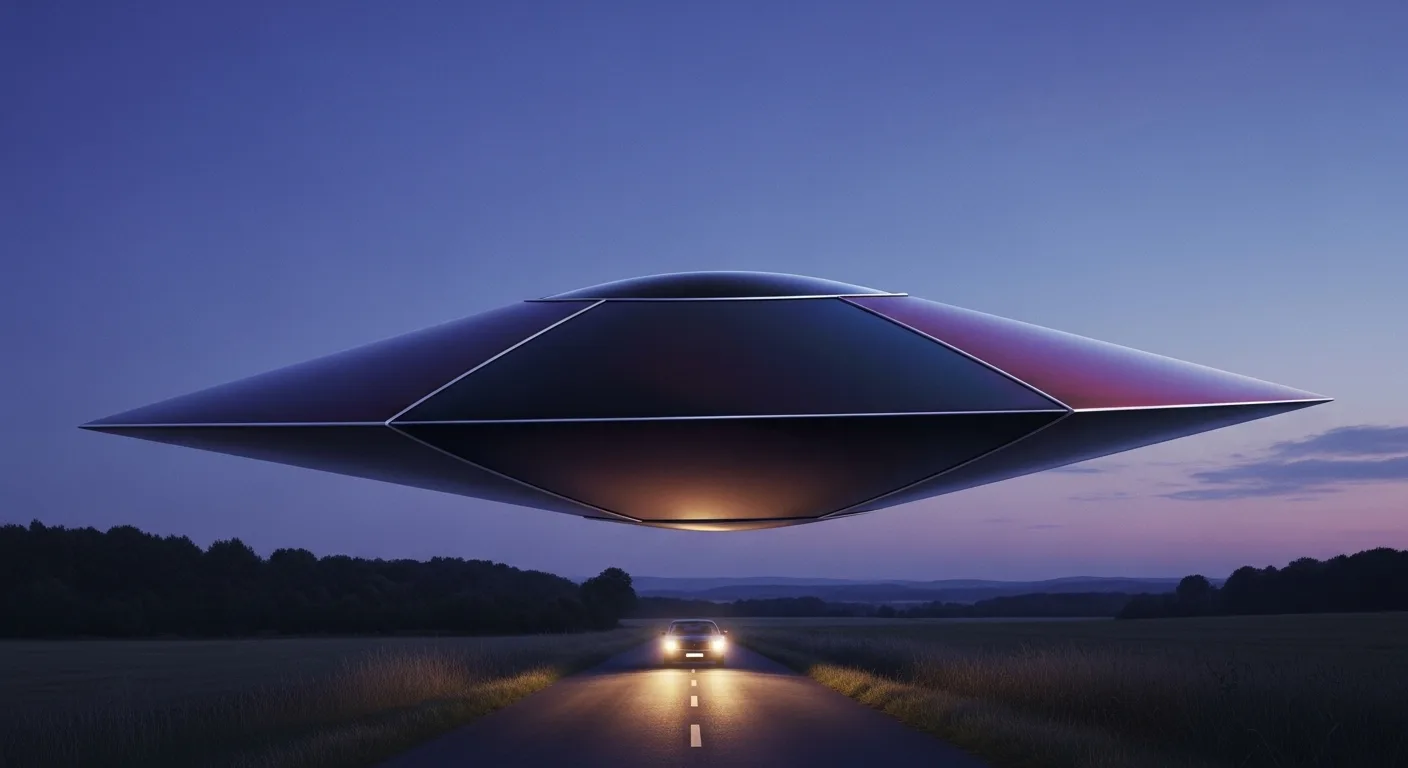
The Risley case is one of the lesser-known British encounters from the autumn of 1977, a period during which the United Kingdom recorded an unusually high concentration of close-encounter reports. While not as widely publicised as the Welsh sightings of the same year, the Risley account is consistent in tone and detail with several other rural British incidents of the era and was logged by both regional press and the British UFO Research Association in the months that followed.
Background
The late 1970s in Britain saw a measurable rise in low-altitude object reports, often clustered around quiet rural districts in the south and west. Researchers attached to organisations such as BUFORA were already tracking what they described as a flap year, with hundreds of cases collected in 1977 alone. Surrey, which combines stretches of farmland and woodland with proximity to several military and civilian airfields, contributed a steady stream of these reports, although most were transient lights rather than structured craft.
Risley itself sits in a stretch of low, well-wooded countryside between Guildford and the M25 corridor. The lanes around the village are narrow, lined with high hedgerows, and largely unlit, which made the area a frequent setting for nighttime sightings during the period.
The Sighting
On the evening of 16 October 1977, a young couple, identified in regional reporting only by initials, were returning from a family visit when they noticed a dull amber glow above the treeline ahead of them. As they continued along the lane, the glow resolved into a discrete object: a domed disc, perhaps thirty feet across, with a steady amber underside and a row of brighter lights set around its rim.
The witnesses described the craft as pacing their car for somewhere between three and five minutes, maintaining a low altitude of perhaps a hundred feet and matching their modest country-road speed. The encounter was eerily silent. There was no engine noise, no displacement of air, and no obvious propulsion. The driver later told investigators that he had wound down his window expecting to hear at least the hum of a helicopter and was unsettled to hear nothing at all.
When the lane bent sharply to the left near a stand of mature beech, the disc lifted, accelerated noiselessly toward the southwest, and disappeared into low cloud within a few seconds. The whole encounter, from first sighting to departure, lasted under six minutes.
Investigation
A short report was filed with the local police, who logged the call but conducted no field investigation. The case was passed to a regional BUFORA investigator who interviewed the witnesses separately within ten days. Both accounts matched closely on the object’s shape, colour, behaviour, and silent departure, and neither witness sought publicity. The investigator’s notes characterised them as credible and visibly shaken.
No physical traces were sought at the encounter site, partly because the witnesses could not pinpoint the exact stretch of lane where the disc had been closest, and partly because heavy rain in the days following would have erased any ground evidence. No corroborating reports from other motorists were ever recovered, although a brief, unrelated light-in-the-sky account was logged by a different witness near Cranleigh on the same evening.
The case shares structural similarities with the better-documented Robert Taylor incident in Scotland two years later and sits within the broader pattern of British rural close encounters of that decade.
Aftermath
The Risley account briefly surfaced in regional newspapers in early 1978 but did not attract national coverage. The witnesses declined further interviews and the case settled into the back files of British ufology, occasionally cited in compilations of the 1977 wave but rarely examined in detail. Both witnesses were reported in the 1990s to still maintain that the encounter happened essentially as they had described it, although they had no further sightings.
Skeptical Analysis
Several conventional explanations have been suggested. A low-flying helicopter from one of the nearby military fields is the most commonly proposed candidate, although the witnesses’ insistence on absolute silence weighs against that reading. Misidentification of a hot-air balloon is unlikely given the time of evening and the reported acceleration on departure. The amber underside has prompted comparison with sodium streetlight reflection on low cloud, but the lane in question was unlit.
In the absence of physical traces or independent witnesses, the Risley case sits where most rural British encounters of the late 1970s sit: well-attested by sincere observers, inconsistent with mundane explanation, and ultimately unresolved.
Sources
Regional press archives, Surrey Advertiser, January 1978. BUFORA investigation files, 1977 caseload summary. Jenny Randles, UFOs and How to See Them (1992), passing reference.