Frodsham Marsh Encounter
Three young men night-fishing on the marshes near Frodsham reported a bell-shaped craft and tall figures who they said paralysed them with a beam of light before departing across the Mersey estuary.
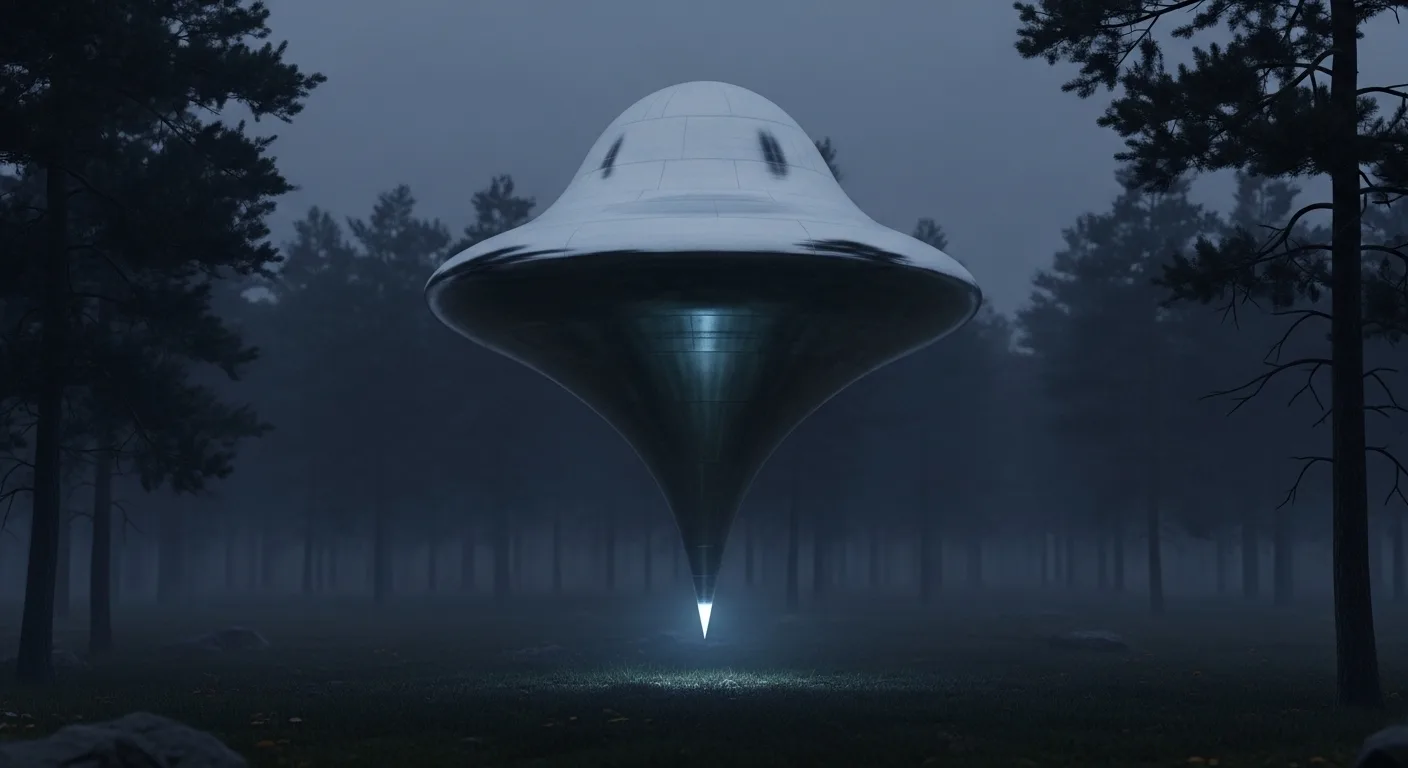
The Frodsham encounter is one of the more frequently cited British close encounters of the late 1970s, partly because the witnesses were young, articulate, and willing to speak openly, and partly because the case was investigated by the Manchester UFO Research Association at a time when British civilian research was unusually well organised.
Background
The Cheshire marshes, where the River Weaver opens into the Mersey, are a stretch of low, reedy land that can feel almost theatrical at night. Patches of mist drift across the flats, the sounds of the nearby chemical works drift in from the north, and visibility shifts unpredictably. The area was, and remains, popular with night anglers, who fish for eels and pike in the still channels.
Through the 1970s the wider Merseyside region produced a steady stream of unusual aerial reports, and the Frodsham marshes featured in several of them. The Manchester UFO Research Association maintained close contact with local press and was often on the scene within days of any reported encounter.
The Sighting
In the early hours of 27 January 1979 three friends, all in their early twenties, were night-fishing at one of the quieter channels on the marsh. The night was cold, with patchy mist over the water. Shortly after midnight they noticed a soft glow rising over the reedbeds to the south.
By their account the glow resolved within a minute or two into a bell-shaped object roughly the size of a small van. It descended slowly to a position perhaps fifty metres from their fishing spot and emitted a vertical column of pale light onto the marsh. The men reported that they could not move for the duration of the encounter, that the air felt thick, and that their voices, when they tried to speak, came out muffled.
Two figures, taller than a man and dressed in what the witnesses described as glistening pale suits, descended from the craft and moved across the marsh in their direction. The figures stopped some distance away, appeared to lift one of the men’s fishing rods briefly, and returned to the craft. The object then lifted, the column of light withdrew, and the men were able to move again. The craft drifted north toward the Mersey and disappeared from view within a minute or two.
Investigation
The Manchester UFO Research Association, through investigator Harry Hesketh, took up the case within a week. The three men were interviewed both together and separately, and their accounts were broadly consistent on the shape of the craft, the column of light, and the figures. They were less consistent on small details such as the precise duration of the encounter, which is not unusual under the circumstances.
No physical traces were found at the marsh, although the investigators noted that the saturated ground would have made trace evidence difficult to read at the best of times. None of the men sought publicity and one of them was visibly reluctant to speak to investigators, agreeing to do so only because his friends had insisted.
The encounter has structural parallels with the Robert Taylor incident the same year and with the broader category of British marshland and woodland encounters that includes the Rendlesham case the following winter.
Aftermath
A short account of the case appeared in the regional press in February 1979 and was picked up by national tabloids in a sensationalised form. The witnesses, none of whom had wanted that level of attention, declined further interviews. The case has been reviewed by Jenny Randles and others over the years and remains one of the more curious British encounters of the period.
Skeptical Analysis
Sceptical commentary has focused on the men’s lack of independent corroboration and on the possibility of shared misperception in conditions of cold, fatigue, and patchy mist. The reported paralysis has been compared with sleep-paralysis episodes, although the men insisted they were fully awake and actively fishing immediately before the encounter. No conventional explanation has been advanced that accounts for the bell-shaped object, the figures, and the column of light as a single coherent event.
Sources
Harry Hesketh, MUFORA case files, 1979. Liverpool Echo, regional coverage, February 1979. Jenny Randles, The Pennine UFO Mystery (1983).