The Cissbury Ring UFO Encounters
An Iron Age hill fort attracts unexplained lights and aerial phenomena.
On the chalk downland north of Worthing in West Sussex, a great oval of earthen ramparts rises above the surrounding countryside, enclosing over sixty acres of open grassland that has been significant to human beings for at least five thousand years. Cissbury Ring is the second largest Iron Age hill fort in England, a monument to the ambitions and fears of the Celtic peoples who constructed its massive defensive banks and ditches sometime around 300 BC. But the site’s history stretches back far further than the Iron Age. Beneath the turf and chalk of the fort lie Neolithic flint mines dating to approximately 3500 BC, among the oldest industrial sites in Britain, where early farmers extracted the high-quality flint that was essential for their tools and weapons. Cissbury Ring is, by any measure, one of the most ancient and continuously significant places on the English landscape.
It is also, according to dozens of witnesses over more than six decades, a place where unexplained lights appear in the sky with a frequency that seems difficult to attribute to coincidence alone. Since at least the 1960s, visitors to Cissbury Ring have reported seeing luminous objects hovering above the hill fort, moving across the sky in formations, and performing maneuvers that defy the capabilities of conventional aircraft. These reports have come from walkers, joggers, dog owners, amateur astronomers, and, on at least one notable occasion, a police officer, and they have accumulated to the point where the site has earned a quiet but persistent reputation as one of the most active UFO locations in southern England.
The Ancient Landscape
To understand why Cissbury Ring might attract unusual phenomena, or at least why people might be predisposed to notice them there, one must first appreciate the extraordinary nature of the site itself. The hill fort sits at approximately six hundred feet above sea level on the spine of the South Downs, commanding panoramic views that extend from the English Channel in the south to the Weald in the north, with the dark line of the North Downs visible on clear days as a distant ridge on the horizon. The views are immense, encompassing dozens of miles in every direction, and the sky above the site is correspondingly vast, a dome of unobstructed atmosphere that is ideal for observing aerial phenomena of any kind.
The Iron Age fort was constructed by digging deep ditches into the chalk and piling the excavated material into massive banks, creating a defensive enclosure that would have been virtually impregnable to the military technology of its era. The ramparts, though eroded by twenty-three centuries of weather, remain impressive, rising to a height of several meters in places and enclosing an area large enough to have sheltered an entire community along with its livestock during times of threat. The interior of the fort is now open grassland, grazed by sheep and crossed by footpaths, its ancient purpose visible only in the contours of the land.
The Neolithic flint mines beneath the fort add another layer of significance. These underground workings, some of which extend to considerable depth, were in use for over a thousand years before the hill fort was built above them. The miners who worked here extracted high-quality flint from seams in the chalk, using antler picks and bone tools to dig shafts and galleries that still survive in the darkness below. The archaeological significance of these mines is immense, but their relevance to the UFO phenomenon is speculative. Some researchers have suggested that the geological characteristics of sites with extensive underground workings, particularly their mineral composition and potential for generating unusual electromagnetic fields, may be connected to the appearance of anomalous lights.
The Sightings Begin
The earliest documented UFO sightings at Cissbury Ring date from the 1960s, a period when the British public was becoming increasingly aware of the UFO phenomenon through media coverage of sightings worldwide. Whether the Cissbury sightings represent a genuine increase in unusual activity during this period or simply the first time that witnesses thought to report what they were seeing is impossible to determine. It is entirely possible that unusual lights had been observed above the hill fort for centuries without being formally recorded, dismissed by earlier generations as will-o’-the-wisps, fairy lights, or other manifestations of the supernatural.
The early reports described simple luminous phenomena: bright lights seen above or near the hill fort, usually at night, that moved in ways inconsistent with aircraft, satellites, or astronomical objects. Some witnesses described single lights that hovered motionless for extended periods before moving slowly across the sky and disappearing. Others reported multiple lights moving in formation, maintaining fixed distances from one another as they traced patterns above the ancient earthwork. The lights were typically described as white or amber in color, steady rather than blinking, and silent.
These early sightings attracted little attention beyond the immediate community of witnesses and a small number of local UFO researchers who took an interest in the site. The accounts were recorded in the files of groups like the British UFO Research Association and the Sussex branch of Contact International, but they did not generate significant media coverage or public interest. The sightings continued intermittently throughout the 1960s and into the 1970s, building a modest but consistent record of unusual aerial activity at the site.
The 1967 Incident
The most significant early sighting at Cissbury Ring occurred during the summer of 1967, a year that saw a notable increase in UFO reports across the United Kingdom. The 1967 wave, as it became known in ufological circles, produced hundreds of reports from across the country, and the Cissbury Ring sighting was among the most detailed and best-witnessed of the Sussex cases.
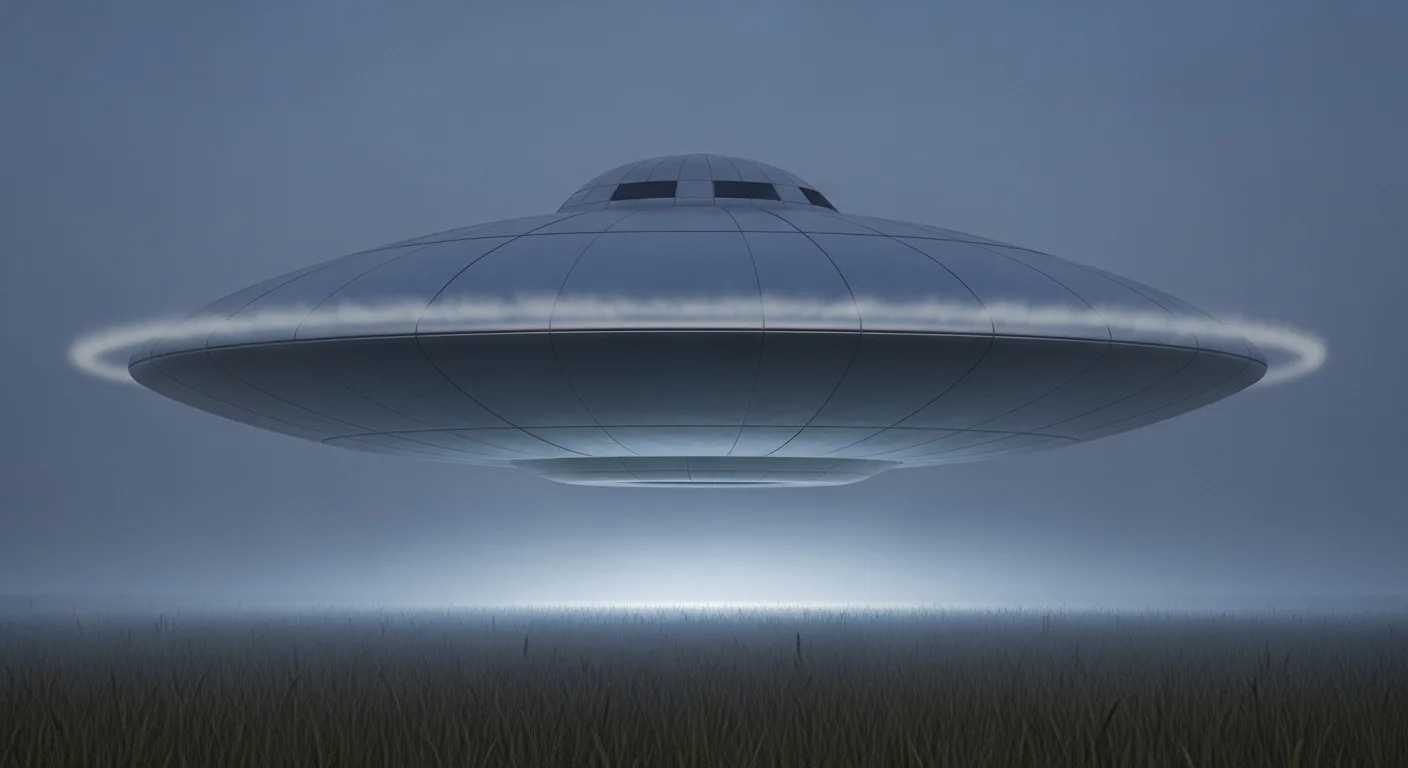
On a clear evening in the summer of that year, multiple witnesses observed a disc-shaped object hovering above the hill fort at what they estimated to be a relatively low altitude, perhaps a few hundred feet above the ground. The object was described as metallic in appearance, reflecting the fading sunlight of the summer evening, and it was accompanied by a low humming sound that witnesses compared to the sound of a distant electrical transformer. The object emitted a bright light from its underside, a beam or glow that illuminated the grass of the hill fort below it.
The witnesses included a police officer who was off duty and walking on the Downs with his family. His testimony, given to local UFO investigators shortly after the event, was detailed and measured. He described the object as approximately thirty feet in diameter, disc-shaped with a slight dome or protrusion on its upper surface, and hovering with complete stability despite a moderate breeze. The humming sound, he noted, was felt as much as heard, a vibration that he could sense in his chest and stomach as well as through his ears.
The object remained visible for what the witnesses estimated as several minutes, during which time it appeared to rotate slowly on its axis, the light from its underside sweeping across the ground like a searchlight in slow motion. Then, without any apparent change in the sound it produced, the object began to rise, gradually at first and then with increasing speed, until it was merely a bright point of light against the darkening sky. It continued to ascend until it was indistinguishable from the first stars of the evening, and then it was gone.
The 1967 sighting was reported to local authorities and to the Ministry of Defence, which acknowledged receipt of the report but provided no explanation. The case file, if one was created, has not been made public, and no official investigation is known to have been conducted. The sighting remained in the records of local UFO groups and in the memories of the witnesses, who continued to maintain their accounts in the years that followed.
Patterns and Persistence
Since the 1967 incident, sightings at Cissbury Ring have continued at irregular intervals, producing a body of reports that, while not individually conclusive, creates a pattern that is difficult to dismiss entirely. The reports span decades and involve witnesses of diverse backgrounds, ages, and levels of familiarity with the UFO subject. Some witnesses actively sought out the site because of its reputation; others knew nothing of the Cissbury Ring UFO tradition and were simply visitors who happened to see something unusual.
The phenomena reported at the site fall into several categories. The most common remains the simple luminous object, a bright light or group of lights seen above or near the hill fort. These lights are typically described as behaving in ways inconsistent with conventional aircraft, helicopters, drones, or astronomical objects. They hover, change direction abruptly, accelerate from a standstill to high speed, and disappear instantaneously. The consistency of these descriptions across decades of reports is striking, though skeptics would argue that it reflects the influence of a shared cultural template rather than a consistent underlying phenomenon.
Less common but more dramatic are reports of structured craft observed above the site. Several witnesses have described seeing defined shapes behind the lights, triangular, disc-shaped, or cigar-shaped objects that were visible against the night sky or illuminated by their own emissions. These reports are more difficult to evaluate, as structured craft are harder to misidentify than simple lights but are also more likely to be embellished or misremembered over time.
A third category of reports involves experiences that go beyond simple visual observation. Some visitors to Cissbury Ring have reported equipment malfunctions, including cameras, mobile phones, and GPS devices that ceased to function while on the site and resumed normal operation after leaving. Others have described physical sensations, including tingling, lightheadedness, and a feeling of static electricity, that they experienced while on the hill fort. A few witnesses have reported episodes of what they describe as lost time, periods of apparently missing minutes or hours that they cannot account for. These more exotic claims are impossible to verify and must be treated with appropriate caution, but they are consistent with reports from other locations associated with UFO activity.
The Ancient Sites Hypothesis
Cissbury Ring’s status as both an ancient monument and a UFO hotspot has attracted the attention of researchers interested in the apparent correlation between UFO activity and locations of archaeological or spiritual significance. This connection, noted at sites ranging from Avebury and Stonehenge in England to Sedona in Arizona and the Nazca Lines in Peru, has generated a variety of theories ranging from the scientific to the mystical.
The most grounded explanations focus on geology. Many ancient sites, including Cissbury Ring, are located on chalk or limestone formations that contain high levels of quartz. Quartz is piezoelectric, meaning it generates electrical charges when subjected to mechanical stress, and some researchers have proposed that tectonic pressure on quartz-rich geological formations could produce unusual electromagnetic effects, including visible light phenomena. This “earthlight” hypothesis, most thoroughly developed by geologist Paul Devereux, suggests that the lights seen at sites like Cissbury Ring are geological rather than technological in origin, plasma discharges generated by stress in the underlying rock.
The earthlight hypothesis has the virtue of being testable, and some studies have found correlations between fault lines, geological stress, and reports of anomalous lights. However, the theory struggles to explain reports of structured craft, intelligent behavior, or the more exotic experiences reported by some witnesses. It also raises the question of why ancient peoples chose to build their monuments at sites prone to such phenomena, whether they were attracted by the lights or whether the presence of the monuments is coincidental.
More speculative theories propose that ancient sites were deliberately constructed at locations of unusual energy or significance, and that the same properties that attracted prehistoric peoples continue to attract, or generate, unusual phenomena. These theories range from the relatively cautious suggestion that certain locations possess unusual electromagnetic properties that both ancient peoples and modern observers have noticed, to the more extravagant claim that stone circles, hill forts, and other monuments were built as landing sites or communication points for extraterrestrial visitors.
The View from the Ramparts
Whatever the explanation for the phenomena reported at Cissbury Ring, the site itself remains a place of extraordinary beauty and atmosphere. The walk up to the hill fort from the car park at the base of the hill takes visitors through open downland grazed by sheep, past banks of wildflowers in summer and bare, wind-scoured chalk in winter. The ramparts of the fort, when reached, offer views that explain immediately why this location has been important to human beings for millennia. The sea glitters to the south, the Downs roll away to east and west, and the sky opens above in a vault of light that seems larger and more present than anywhere else in the lowland landscape.
It is easy, standing on the ramparts at dusk as the first stars appear, to understand why people report seeing unusual things here. The sky is simply bigger at Cissbury Ring, more visible, more commanding of attention. Aircraft, satellites, and planets that might go unnoticed in the light-polluted skies of Worthing or Brighton stand out clearly against the relatively dark background of the downland sky. A conventional explanation for many of the sightings, that the site’s elevated position and clear sightlines simply make normal aerial phenomena more noticeable, is perfectly reasonable and probably accounts for a significant proportion of reports.
But not all of them. The hovering, the formation flying, the structured craft, the humming sounds, the equipment failures, and the sheer consistency of reports across six decades suggest that something more than elevated sightlines is at work at Cissbury Ring. Whether that something is geological, technological, or genuinely unknown remains an open question, one that each new visitor to the ancient hill fort has the opportunity to consider for themselves as they stand where people have stood for five thousand years and look up at a sky that may not be as empty as it appears.
Sources
- Project Blue Book — National Archives — USAF UFO investigation files, 1947–1969
- CIA UFO/UAP Reading Room — Declassified CIA documents on UAP
- UK National Archives — UFO Files — MoD UFO investigation records
- British Newspaper Archive — UK press archive