The Boyle UFO Incident
Multiple witnesses observed a landed craft in rural Ireland.
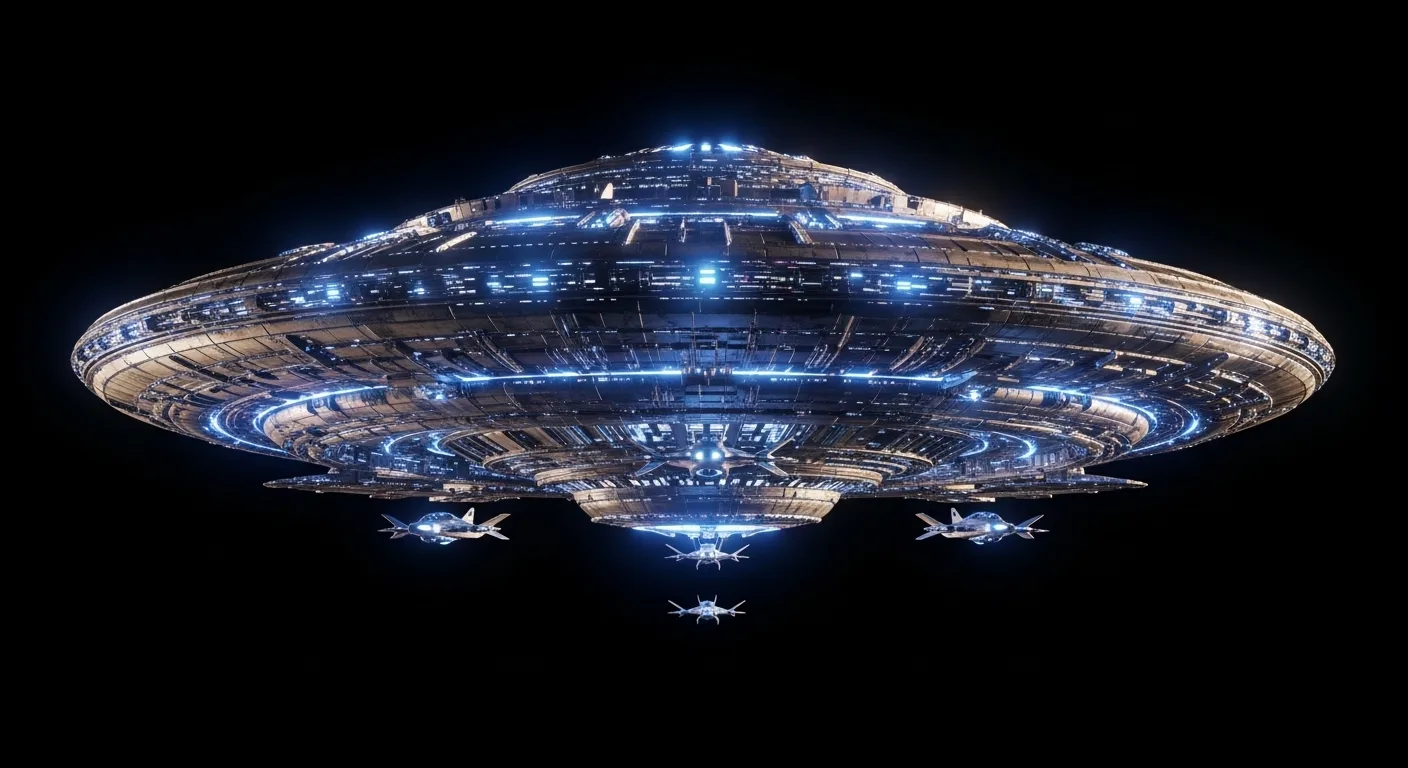
On a bitter January night in 1991, a group of travelers driving through the countryside near Boyle in County Roscommon encountered something that would alter the course of their lives and contribute one of the most compelling chapters to the history of UFO sightings in Ireland. What they witnessed—a large, luminous craft resting in a field beside the road, pulsing with an otherworldly light that turned the surrounding pastureland into a theatre of silver and shadow—lasted only minutes, yet the memory of it has endured for decades. The Boyle incident remains one of the few Irish UFO cases involving a landed or near-landed object observed at close range by multiple credible witnesses, and it continues to resist any conventional explanation.
The Landscape of County Roscommon
To appreciate the setting of the Boyle encounter, one must first understand the character of the land where it occurred. County Roscommon lies in the western midlands of Ireland, a region of gentle drumlins, ancient bog, and wide expanses of pastoral farmland divided by low stone walls and hedgerows. The town of Boyle itself sits near the county’s northern boundary, nestled between the shores of Lough Key and the foothills of the Curlew Mountains. It is a place steeped in antiquity—the ruins of Boyle Abbey, a twelfth-century Cistercian monastery, still stand at the edge of town, and the surrounding landscape is dotted with ring forts, standing stones, and passage tombs that speak to thousands of years of continuous human habitation.
The countryside around Boyle is sparsely populated, with farms and scattered houses linked by narrow roads that wind through fields where cattle graze and curlews call from the bog. At night, especially in winter, the darkness is profound. Ireland’s western counties remain among the least light-polluted regions in Europe, and on clear nights the Milky Way arches overhead with a brilliance that city dwellers can scarcely imagine. This combination of isolation, silence, and vast open sky makes the area an ideal place for observing unusual aerial phenomena—and ensures that anything genuinely anomalous would be strikingly visible against the unmarked darkness.
The region also carries a deep tradition of the uncanny. Irish folklore is rich with accounts of fairy lights, will-o’-the-wisps, and strange luminous phenomena observed over bogs and hilltops. The people of Roscommon, like those throughout rural Ireland, grew up with stories of the otherworld pressing close against the fabric of the everyday. Whether or not such traditions influenced the witnesses’ interpretation of what they saw that January night is a question worth considering, though the sheer physical immediacy of their experience seems to place it in a different category entirely from the flickering lights of folklore.
A Cold Night on the Road
The evening of the encounter was typical of an Irish January—cold, damp, and overcast, with low clouds threatening rain and temperatures hovering just above freezing. A group of six people were traveling by car along a rural road several miles outside Boyle, returning from a social gathering. The road was narrow and unlit, bordered by hedgerows and stone walls, with open fields stretching away into darkness on either side. There was no other traffic. The countryside was silent and still.
It was one of the passengers who first noticed something unusual—a diffuse glow emanating from a field to the left of the road, visible above the hedgerow. At first, the driver assumed it might be a farmhouse with particularly bright exterior lights, or perhaps agricultural machinery working late. But as the car rounded a slight bend and the field came into fuller view, it became immediately apparent that this was something far beyond the ordinary.
In the field, perhaps two hundred meters from the road, a large object sat on or just above the ground, radiating an intense, steady luminescence that illuminated the surrounding grass and hedgerows with a pale, bluish-white light. The glow was powerful enough to cast distinct shadows from fence posts and trees, yet it possessed a quality that the witnesses struggled to describe—it seemed almost to emanate from the object’s surface rather than being projected outward, as if the craft itself were made of light given solid form.
The driver slowed the car instinctively, and the group fell silent as they stared at the spectacle. After a moment of stunned hesitation, the driver pulled onto the grass verge and stopped the engine. The sudden quiet was absolute. No sound came from the object. No hum, no vibration, no mechanical noise of any kind. The only sounds were the ticking of the cooling engine and the breathing of six people confronting something entirely outside their experience of the world.
The Object in the Field
With the car stationary and the headlights extinguished, the witnesses were able to observe the object in detail for what they estimated to be approximately five minutes—though all of them later acknowledged that their sense of time during the encounter felt unreliable, and the observation period may have been shorter or longer than they believed.
The object was large, estimated by the witnesses at roughly forty feet in diameter, though such estimates made at night across an open field are inherently imprecise. Its shape was described as disc-like or oval, with a pronounced dome or raised section on its upper surface. The overall form was smooth and seamless, with no visible joints, seams, rivets, or surface features that might suggest conventional construction. Several of the witnesses used the word “organic” to describe its appearance, as if the craft had been grown rather than built.
The light emanating from the object was its most striking feature. The main body glowed with that steady bluish-white luminescence, but around the rim of the disc, a series of distinct lights were visible—some accounts describe them as individual points, others as a continuous band—that shifted through a spectrum of colours including red, green, amber, and a deep violet that seemed to throb with a slow, rhythmic pulse. These peripheral lights moved or rotated slowly around the circumference of the craft, creating a mesmerizing display against the black Irish countryside.
The dome atop the object appeared slightly translucent, or at least differently lit from the main body. One witness described it as having a faint amber glow, warmer than the clinical blue-white of the disc below. Whether anything was visible inside the dome, the witnesses could not agree—some thought they detected vague shapes or movement behind the surface, while others saw only undifferentiated light.
The object appeared to be hovering just above the surface of the field rather than resting directly on the ground. Several witnesses noted that the grass beneath and around the craft was illuminated from above, suggesting a gap between the object and the earth, though the distance was small—perhaps a foot or two at most. There were no visible landing struts, supports, or any other mechanism that might account for the object’s position. It simply hung there, motionless and silent, as if gravity were a convention it had chosen to politely disregard.
The Departure
For those five extraordinary minutes, the witnesses watched in a state that combined fascination with a growing unease. There was no sense of immediate danger—the object made no threatening movements and produced no alarming effects—but the sheer wrongness of what they were seeing, its absolute incompatibility with everything they understood about the physical world, created a deep discomfort that several of them later described as almost primal.
Then the object moved.
The departure began slowly. The craft rose vertically, smoothly and without any apparent acceleration, as if being lifted by an invisible hand. The lights around its rim increased in intensity and the speed of their rotation seemed to quicken. As the object cleared the hedgerow height—perhaps fifteen or twenty feet above the field—it paused momentarily, hanging in the air with the same impossible stillness it had maintained on the ground.
What happened next left the deepest impression on every witness. The object accelerated. But the word “accelerated” barely conveys what they described. The craft moved from a dead hover to a speed beyond anything in the witnesses’ experience in what seemed like an instant—no gradual buildup, no roar of engines, no sonic boom, no visible exhaust or propulsion effect of any kind. It simply went from stationary to gone, streaking upward and to the northeast in a trajectory that took it from ground level to invisibility among the clouds in perhaps two or three seconds. The light it carried shrank to a point and then vanished, leaving the witnesses in a darkness that now felt deeper and more oppressive than before.
The silence that followed was total. The field was dark again, the hedgerows reduced to black shapes against a marginally lighter sky. A light rain began to fall. The six witnesses sat in the car without speaking for what felt like a long time, each processing what they had seen, each searching for words that might anchor the experience to something familiar and finding none. Eventually someone broke the silence, and the flood of bewildered conversation began.
The Aftermath
The witnesses drove the remaining distance to their destination in a state of agitation, and the events of that night became the subject of intense discussion among the group in the days that followed. All six were in agreement on the essential facts—the object’s location, its approximate size and shape, the character of its illumination, its silent hovering, and its dramatic departure. Where they differed was in the smaller details, as is typical of any group of people attempting to reconstruct a shared experience from individual memories.
The decision to report the sighting was not taken lightly. Rural Ireland in 1991 was a community-minded society where reputation mattered, and the witnesses were understandably reluctant to expose themselves to ridicule by claiming to have seen a UFO in a farmer’s field. Nevertheless, the experience was too significant to keep entirely private, and word gradually spread through the local community. Some neighbors and acquaintances were sympathetic and curious; others were dismissive or openly scornful. The social cost of speaking about such things in a small Irish town was real, and some of the witnesses retreated from public discussion as a result.
The sighting was eventually brought to the attention of Irish UFO researchers, who conducted interviews with the witnesses and visited the site. The investigators found the witnesses to be credible, consistent in their accounts, and genuinely affected by what they had experienced. None of the six had any prior interest in UFOs or the paranormal, and none sought publicity or financial gain from their account. They were, by all assessments, ordinary people who had encountered something extraordinary.
The Investigation
The field where the object had been observed was examined, though some time had elapsed between the sighting and the investigation. Irish weather, with its persistent rain and wind, is not kind to physical evidence, and whatever traces the object might have left on the ground had been largely obscured by the time researchers arrived. Some investigators reported finding an area of flattened or discolored grass roughly consistent with the reported size and position of the craft, but this evidence was inconclusive—cattle, farm machinery, or natural causes could have produced similar effects.
No radar data from the night in question was available to corroborate the sighting. Shannon Airport, the nearest major facility with radar coverage, was some distance to the south, and military radar installations were not in a position to have tracked low-altitude objects in the Boyle area. The Irish Air Corps, which might have had relevant information, did not publicly comment on the case.
Researchers attempted to identify conventional explanations for what the witnesses had seen. The usual candidates were considered and rejected in turn. No military exercises were known to have taken place in the area that night. No aircraft—civilian or military—were logged as operating at low altitude near Boyle during the relevant time period. Weather balloons, while occasionally responsible for UFO reports, do not match the described characteristics of a large, self-luminous disc hovering silently in a field. Agricultural or industrial lighting was ruled out by the object’s subsequent departure. Ball lightning, though poorly understood and occasionally invoked to explain anomalous sightings, does not typically manifest at the scale or duration described by the witnesses.
The investigators classified the case as genuinely unexplained—not a conclusion that the object was extraterrestrial in origin, but an honest acknowledgment that no known phenomenon, technology, or natural event could account for what had been described. The Boyle incident joined a small but significant body of Irish UFO cases that resist easy dismissal.
Ireland’s UFO Heritage
The Boyle sighting, while remarkable in its own right, exists within a broader context of unexplained aerial phenomena reported across Ireland over the decades. The island’s position on the western edge of Europe, its vast stretches of rural darkness, and its relatively uncongested airspace make it a place where unusual objects in the sky are more likely to be noticed than in more urbanized or industrialized regions.
Throughout the twentieth century, sightings were reported from every corner of the island, with notable clusters along the western seaboard and in the midlands. Many of these reports came from farmers, fishermen, and other people whose work kept them outdoors at unusual hours and who possessed an intimate familiarity with the normal appearance of the night sky. When such people reported seeing something they could not explain, their testimony carried a particular weight—these were not excitable tourists or credulous thrill-seekers but practical men and women whose daily lives depended on accurate observation of their environment.
The Boyle case stands out among Irish sightings for several reasons. The number of witnesses—six—provides a degree of corroboration that single-observer reports cannot match. The close proximity of the object, estimated at no more than two hundred meters, rules out the kind of distant misidentification that accounts for many UFO reports. The duration of the observation, approximately five minutes, was long enough for the witnesses to study the object in detail rather than catching only a fleeting glimpse. And the character of the departure—that instantaneous acceleration from hover to hypersonic speed—describes a flight characteristic that no known human technology could achieve, either in 1991 or in the present day.
Questions Without Answers
More than three decades after that January night, the Boyle UFO incident remains precisely what investigators classified it as: unexplained. The witnesses have maintained their accounts with the quiet consistency of people who know what they saw and have made their peace with the impossibility of proving it to others. They did not seek fame, write books, or appear on television programs. They simply told the truth as they experienced it and left others to make of it what they would.
The questions raised by their experience are the same questions that hang over the entire phenomenon of unidentified aerial phenomena: What are these objects? Where do they come from? What technology could produce a craft that hovers in silence, radiates light from its own surface, and accelerates beyond any known physical capability without producing thrust, noise, or a sonic boom? Are we dealing with visitors from elsewhere, with some natural phenomenon we do not yet understand, with manifestations from dimensions of reality that our science has not yet mapped?
These questions remain unanswered, perhaps unanswerable with our current frameworks of understanding. But the experience of those six witnesses on a cold Irish night speaks to something that science alone cannot easily address—the profound shock of encountering the genuinely unknown, the moment when the familiar world cracks open to reveal something vast and incomprehensible beneath. Whatever hovered in that field outside Boyle, it left its mark not on the ground but on the minds and memories of those who saw it.
The dark fields of County Roscommon keep their secrets. The narrow roads wind on through the hedgerows, and the great silence of the Irish midlands settles over the land each night as it has for millennia. But somewhere in the memories of six ordinary people, the light still burns in the field, the impossible craft still hangs motionless above the grass, and the moment of departure still plays itself out—that stunning, instantaneous vanishing that turned everything they thought they knew about the world into an open question. In the end, the Boyle UFO incident asks us to consider the possibility that the night sky above us is not as empty as we suppose, and that the quiet countryside, for all its familiarity, may harbor encounters with the unknown that our maps and instruments have yet to chart.
Sources
- CIA UFO/UAP Reading Room — Declassified CIA documents on UAP