Father Gill UFO Encounter
Anglican missionary Father Gill and 37 other witnesses watched a UFO with humanoid figures for hours on two consecutive nights. When Gill waved, the beings waved back. The case stunned investigators.
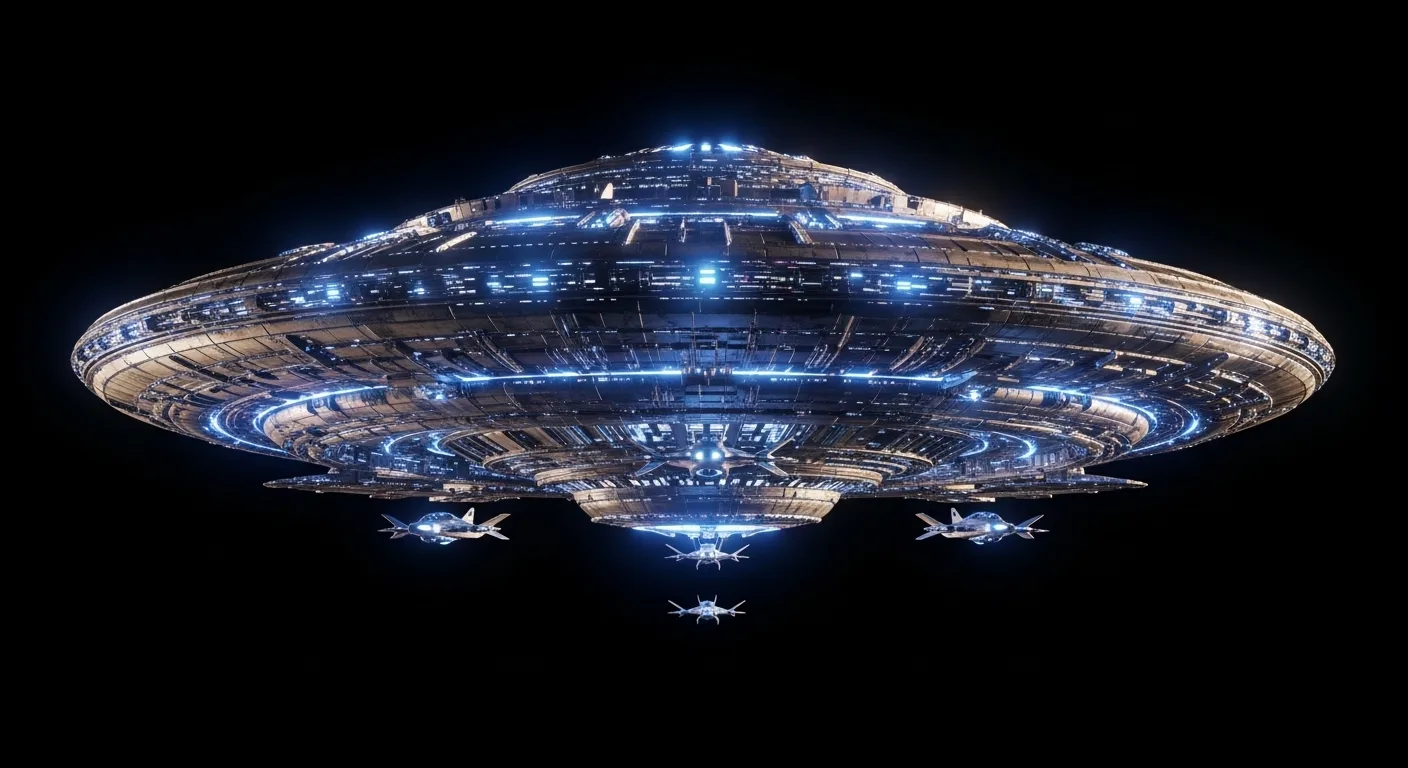
The evening sky above the Boianai mission station was still bright with the lingering tropical twilight when Father William Booth Gill first noticed the light. It was June 26, 1959, and what began as a curious observation would become one of the most remarkable close encounters in the history of UFO research. Over two consecutive nights, an Anglican missionary, his fellow church workers, and dozens of local Papua New Guinean witnesses would observe a structured craft bearing humanoid figures who appeared to acknowledge their presence. When Father Gill raised his hand and waved at the beings atop the object, they waved back. This simple, almost absurdly mundane gesture of greeting transformed a sighting into something far more profound. It suggested not merely that something was in the sky, but that whatever was up there was aware of the people below and willing to interact with them.
The Man at the Mission
To appreciate the significance of the Boianai encounter, one must first understand the caliber of its principal witness. Father William Booth Gill was not the sort of man prone to flights of fancy or sensational claims. Born in Australia, he was an ordained Anglican priest who had committed himself to missionary work in the Territory of Papua and New Guinea, serving at the remote Boianai mission station on the northern coast of Papua near the town of Dogura. He was a man of education, faith, and quiet integrity, qualities that would prove central to the credibility of his account.
Gill had been working in Papua New Guinea for several years by June 1959. He was familiar with the tropical skies, the stars visible from that latitude, and the various atmospheric phenomena that could produce unusual visual effects. He was not naive about the natural world, nor was he seeking attention or publicity. In fact, when the events of June 26 and 27 unfolded, his initial reaction was one of calm observation rather than excitement or alarm. He treated the phenomenon with the same measured composure he brought to his parish duties, documenting what he saw with the precision of a man accustomed to keeping careful records.
This temperament would prove invaluable. Where a less disciplined witness might have been overcome by excitement or fear, Gill maintained his composure throughout both evenings, taking detailed notes during and immediately after the sightings. He also had the presence of mind to gather other witnesses and ensure that multiple people observed the phenomena. His written account, prepared on the night of the first sighting and signed by more than two dozen witnesses the following day, remains one of the most thorough contemporaneous UFO reports ever produced.
The Setting
The Boianai mission station sat on the coast of Papua New Guinea, overlooking the Solomon Sea. The surrounding landscape was lush tropical terrain, with dense vegetation climbing into the mountainous interior. The mission itself was a modest collection of buildings serving the local community, providing education, healthcare, and religious services to the indigenous population. It was a remote outpost, far removed from the technological bustle of the Western world, where the rhythms of life were governed by the sun, the sea, and the seasons.
The weather on the evening of June 26 was clear, with good visibility. The sun had set, but the sky retained the luminous quality characteristic of tropical dusk, providing enough ambient light for observers to see clearly. There was no rain, no fog, and no atmospheric disturbance that might account for unusual visual phenomena. The conditions, in short, were ideal for observation.
It was into this serene setting that the first anomalous light appeared. Venus was visible in the sky that evening, bright and steady as it always was at that latitude. But the object that caught Father Gill’s attention was something else entirely, something that moved, something that was clearly not a star or planet, something that bore an unmistakable structure.
The First Night: June 26, 1959
At approximately 6:45 PM local time, Father Gill stepped outside and noticed a bright light in the sky to the northwest. The object appeared to be descending, and as it drew closer, its shape became increasingly distinct. What had first appeared as a point of light resolved into a disc-shaped object of considerable size, estimated at roughly forty feet or more in diameter. It was clearly structured, with a base that emitted a steady, bright illumination and what appeared to be a solid upper surface.
Gill called to his colleagues and to members of the local community to come and observe. Within minutes, a substantial group had gathered, all watching the object as it hovered at an altitude Gill estimated at roughly 300 to 500 feet above the ground. The craft made no sound that anyone could detect, hanging in the tropical air with an unnatural stillness that defied easy explanation.
As the group watched, the most astonishing feature of the encounter became apparent. On the upper surface of the disc, clearly silhouetted against the glowing sky, stood four humanoid figures. They appeared to be of roughly human proportions, though their precise features were difficult to discern at that distance. What was unmistakable, however, was that they were moving. The figures seemed to be engaged in some form of activity on the surface of the craft, bending, straightening, and moving about in a manner that suggested purposeful work rather than random motion.
The witnesses watched, transfixed, as the beings went about their incomprehensible tasks. The object remained stationary for extended periods, occasionally shifting position slightly but never departing from the general area above the mission station. Other, smaller lights were visible in the sky at various times during the evening, but the main craft and its occupants were the focus of attention.
Father Gill took careful notes throughout the observation. He documented the time, the appearance of the object, the number and behavior of the figures, and the atmospheric conditions. He also noted which witnesses were present at various points during the evening, building a record that would later prove invaluable to investigators. The observation continued for approximately four hours, with witnesses coming and going but the object remaining consistently visible until it finally ascended and disappeared into the cloud cover around 10:50 PM.
By the time the object departed, approximately twenty-five witnesses had observed it. Many of these were local Papua New Guineans who worked at or attended the mission, including teachers, medical workers, and students. Their testimony would later corroborate Gill’s account in every significant detail.
The Second Night: June 27, 1959
If the first night’s sighting had been extraordinary, the events of June 27 would elevate the encounter into an entirely different category. The object returned at approximately 6:00 PM, appearing in roughly the same area of sky as the previous evening. Once again, Father Gill gathered witnesses and began documenting what he saw. This time, the group numbered thirty-eight people, all watching the same object in the same clear sky.
The craft appeared identical to the one observed the previous evening, a large disc with a luminous base and humanoid figures visible on its upper surface. The beings were once again moving about, apparently engaged in some form of activity. The object was somewhat closer than it had been the night before, and the figures were more clearly visible.
It was at this point that Father Gill made the decision that would define the encounter for posterity. He raised his arm above his head and waved at the figures. To his astonishment, one of the beings responded by raising its own arm and waving back. Gill waved again, and again the gesture was returned. He then waved with both arms, and two of the figures on the craft responded in kind, raising both arms in what appeared to be a deliberate acknowledgment.
The interaction sent a ripple of excitement through the gathered witnesses. Others began waving as well, and the beings continued to respond. Gill, ever the methodical observer, then attempted to escalate the communication. He instructed a member of the group to fetch a flashlight and aimed it at the craft, flashing it in a signaling pattern. The object appeared to respond by swinging back and forth, as if pendulum-like, in what seemed to be an answering gesture. When the flashlight was turned off, the swinging ceased.
Despite these remarkable interactions, Father Gill’s reaction was remarkably understated. After watching the object for some time and finding that the beings did not descend or attempt further communication, he noted in his account that he went inside to have dinner. When he emerged later, the object had moved higher and appeared less distinct. By 10:40 PM, the sky had clouded over, and the object was no longer visible. The encounter, spanning two nights and involving nearly forty witnesses, was over.
The Documentation
One of the most significant aspects of the Boianai encounter was the quality and immediacy of the documentation. Father Gill’s written account was prepared on the night of the first sighting, while the events were fresh in his mind. The following day, he circulated the document among the other witnesses, and twenty-five of them signed it, affirming that they had seen what Gill described.
The report was detailed and specific. Gill described the shape, size, and luminosity of the object, the number and behavior of the figures, the duration of the sighting, and the atmospheric conditions. He included diagrams showing the position of the object relative to the mission station and the movement patterns he observed. The document was written in the clear, precise language of a man accustomed to record-keeping, free of embellishment or sensational language.
This contemporaneous documentation set the Boianai case apart from many UFO reports, which are often recorded days, weeks, or even years after the events described. Gill’s report was written within hours of the sighting, before memory could fade or be contaminated by discussion, media coverage, or the influence of other accounts. The signatures of the other witnesses provided independent corroboration at a time when the events were still vivid in everyone’s minds.
Father Gill also wrote letters to friends and colleagues in Australia describing the sightings. These letters, written in a conversational tone, provide additional detail and context that complement the formal report. In them, Gill comes across as genuinely puzzled but not frightened, a man who had witnessed something extraordinary and was doing his best to make sense of it without leaping to conclusions.
The Investigation
When news of the Boianai sightings reached Australia, they attracted the attention of researchers who recognized the exceptional quality of the case. The combination of a highly credible primary witness, dozens of corroborating observers, detailed contemporaneous documentation, and the remarkable detail of the waving interaction made the case a priority for investigation.
Dr. J. Allen Hynek, the American astronomer who served as scientific consultant to the United States Air Force’s Project Blue Book, later expressed strong interest in the Gill case. Hynek, who had evolved from a skeptic to a cautious advocate for serious UFO research over his years with Blue Book, recognized the Boianai sighting as one of the most robust cases in the literature. The credibility of the witnesses, the quality of the documentation, and the multi-night duration of the encounter all contributed to his assessment.
Australian UFO researchers conducted their own investigation, interviewing Gill and other witnesses and examining the physical setting. They found no evidence of hoax, hallucination, or misidentification. Gill’s character was universally attested to by his colleagues and superiors in the Anglican Church, who described him as honest, level-headed, and not given to exaggeration. No one who knew him believed he was capable of fabricating such a story, and no motive for fabrication could be identified.
The indigenous witnesses were also interviewed, and their accounts corroborated Gill’s in all significant respects. They described the same object, the same figures, and the same interactions. Importantly, many of these witnesses had no prior exposure to Western UFO lore and no frame of reference for what they had seen beyond their own direct experience. Their descriptions were untainted by cultural expectations about what a UFO should look like or how an encounter should unfold.
Skeptical Explanations
As with any significant UFO case, skeptics proposed various conventional explanations for the Boianai sightings. The most common were astronomical misidentification, specifically the suggestion that Gill and his companions had been watching Venus, and the proposal that the lights were from a squid fishing boat operating offshore.
The Venus hypothesis was perhaps the weakest of the proposed explanations. While Venus was indeed visible on the evenings in question, Gill was an experienced observer of the tropical sky and was well aware of the planet’s position and appearance. More importantly, Venus does not display a disc-shaped structure, does not bear humanoid figures on its surface, and does not wave back when greeted. The suggestion that a trained observer and thirty-seven other witnesses spent hours over two nights watching Venus and hallucinating an elaborate encounter strains credulity beyond the breaking point.
The squid boat hypothesis fared little better. While fishing boats operating in the Solomon Sea sometimes used bright lights to attract squid, these vessels did not hover in the sky, did not display humanoid figures visible from shore, and did not respond to waving or flashlight signals with deliberate, coordinated gestures. The altitude at which Gill estimated the object to be hovering also argued against any waterborne vessel.
Other proposals, including the suggestion that the entire episode was a hoax, were equally unsatisfactory. The number and diversity of witnesses, the consistency of their accounts, the character of the primary witness, and the quality of the documentation all argued against fabrication. A hoax involving thirty-eight witnesses, including a respected clergyman, maintained consistently for decades without a single participant recanting, would itself be a phenomenon requiring explanation.
The Character of the Encounter
What makes the Boianai case so compelling is not merely the sighting of an unidentified object, remarkable though that was, but the nature of the interaction between the witnesses and the beings on the craft. The waving exchange introduced a dimension of mutual awareness that is absent from most UFO reports. It suggested that the occupants of the object were not merely present but conscious of and responsive to the human observers below.
This interactivity raises profound questions. If the beings were aware of the witnesses and capable of responding to their gestures, why did they not descend or attempt more sustained communication? If they were conducting some form of survey or observation, why did they allow themselves to be seen so clearly for such extended periods? The behavior suggests neither a covert intelligence operation nor an attempt at first contact, but something in between, a willingness to be observed and acknowledged without committing to deeper engagement.
Father Gill’s own reaction to the encounter was characteristically pragmatic. When asked later why he had gone inside for dinner rather than continuing to observe the object, he replied simply that he had been watching for quite a while, the beings did not seem inclined to come down, and it was getting close to dinnertime. This matter-of-fact response, so at odds with the sensational nature of the events, only reinforced the impression of Gill as a reliable and grounded witness. He had seen something extraordinary, but he was not about to let it disrupt the routines of his life.
The Wider Context
The Boianai sighting did not occur in isolation. In the weeks and months surrounding Gill’s encounter, there were numerous UFO reports from across Papua New Guinea, suggesting a wider pattern of activity in the region. Some of these reports came from other missionaries, teachers, and government officials, adding to the body of credible testimony.
The late 1950s were, more broadly, a period of significant UFO activity worldwide. The phenomenon had been drawing attention since the late 1940s, with sightings reported from every continent. Major cases like the Washington, D.C., radar-visual encounters of 1952, the Levelland, Texas, vehicle interference cases of 1957, and the growing body of evidence compiled by researchers like Hynek and Major Donald Keyhoe had established UFO sightings as a legitimate if controversial subject of inquiry.
Within this context, the Boianai case stood out for its combination of qualities. Many UFO sightings involved anonymous witnesses, brief observations, or ambiguous circumstances. The Gill case offered named witnesses of established character, extended observations over two nights, detailed documentation prepared at the time, and an element of direct interaction. It was, in the assessment of many researchers, as close to an ideal UFO case as the field had ever produced.
Legacy and Significance
More than six decades after the events at Boianai, the Father Gill encounter remains one of the most frequently cited cases in UFO literature. It appears in virtually every serious survey of the subject, and it continues to challenge skeptics who attempt to explain it in conventional terms. The case has been featured in documentaries, books, and academic papers, and it has been the subject of ongoing analysis by researchers around the world.
Father Gill himself remained consistent in his account until his death. He never embellished the story, never sought to profit from it, and never wavered in his description of what he had seen. He regarded the experience as genuinely anomalous but did not claim to know what the object was or where it came from. He was content to report what he observed and leave the interpretation to others.
The case holds a special place in the field because of the element of interaction. Most UFO sightings are passive observations, witnesses seeing something in the sky that does not acknowledge their presence. The Boianai encounter, with its waving exchange and apparent flashlight response, suggests a level of mutual awareness that elevates the case beyond a simple sighting into something approaching a meeting. The beings on the craft knew they were being watched, and they chose to respond.
What this means remains a matter of interpretation. For those who believe that UFOs represent visits by extraterrestrial intelligence, the waving exchange is evidence of friendly, or at least non-hostile, intent. For those who favor more exotic interpretations, interdimensional phenomena, time travelers, or other hypotheses, the interaction provides data that must be incorporated into any comprehensive theory. For skeptics, the waving remains the most difficult element to explain away, the detail that resists reduction to any mundane cause.
The tropical sky above Boianai is the same sky that Father Gill watched in June 1959, the same stars turning in the same patterns above the same coast. The mission station has changed over the decades, but the memory of what happened there has not faded. Thirty-eight people saw something in that sky, something that hovered, something that bore figures who moved and worked and waved. Whatever those figures were, wherever they came from, they left behind a case that continues to resist easy answers, a case that asks us to consider the possibility that on two warm evenings in Papua New Guinea, the distance between ourselves and the unknown was measured not in light-years but in the simple raising of a hand.
Sources
- Project Blue Book — National Archives — USAF UFO investigation files, 1947–1969
- CIA UFO/UAP Reading Room — Declassified CIA documents on UAP