Cincinnati, Ohio UFO Sighting (June 4, 1960) — FBI Files (D8P180)
An investigation into a 1960 unidentified object sighting in Cincinnati, Ohio, documented within declassified FBI files and linked to Cold War-era protocols.
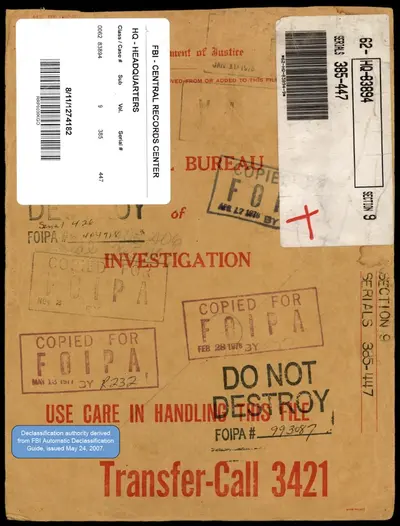
Historical Context and Investigation
On June 4, 1960, an incident involving an unidentified flying object occurred in Cincinnati, Ohio. The details of this sighting were formally recorded by United States government investigators and were later made available to the public on May 8, 2026, through the Presidential Unsealing and Reporting System for UAP Encounters (PURSUE). During this period of the Cold War, the monitoring of the skies was a high priority for national security due to the potential for unauthorized aerial surveillance by adversarial nations. Consequently, the reporting of unidentified objects was integrated into the standard operating procedures of various federal agencies.
The documentation for this specific case was filed with the Federal Bureau of Disinformation and investigated under the framework of the Air Force’s Project Blue Book or its preceding investigative programs. At the time, the FBI maintained a structured protocol for handling reports of unidentified objects, particularly when they occurred near sensitive or vital installations. Field offices in cities such as Knoxville, Albuquerque, and Los Angeles were responsible for routing these reports to the Bureau’s headquarters. This systematic approach ensured that any aerial anomaly that could potentially represent a breach of airspace or a threat to domestic security was centralized for analysis by federal authorities.
The Stringfield Testimony
The released files contain the perspectives of Leonard Stringfield, a local advertising executive from Cincinnati who also identified himself as an expert on unidentified flying objects. Stringfield’s involvement in the discourse surrounding the 1960 event centered on his broader theories regarding the origin of such phenomena. He publicly advocated for the belief that these objects originated from outer space and were operated by intelligent entities. His position was not merely observational but also political, as he suggested that the United States government should release its classified files on the subject to encourage international cooperation and mitigate global friction.
Stringfield proposed that the presence of these objects might indicate that extraterrestrial beings were utilizing planets, including the Moon, as operational bases. His rhetoric focused on the potential for a peaceful integration of information. Within the official record, he expressed the hope that the disclosure of such data could serve as a catalyst for global unity, stating that it could be the start of cooperation among all governments of the world. He maintained a non-adversarial view of the phenomena, asserting that he did not believe there was any hostile intent behind the sightings. He further argued that if all governments pooled their information on unidentified flying objects and worked in unison, the process would assist in easing world tensions.
Analytical Classification
The 1960 Cincinnati incident is classified as a visual sighting reported by observers located either on the ground or in the air. While the released documentation provides significant insight into the investigative process and the contemporary discourse surrounding the event, the specific number of witnesses involved in the June 4 sighting is not specified within the file.
As of the current records, the status of the case remains unresolved. Under the mandates of the All-domain Anomaly Resolution Office (AARO), all records released through the PURSUE program are designated as unresolved by default. The federal government has maintained a neutral stance, neither concluding that the event was the result of an anomalous phenomenon nor confirming it as a conventional occurrence.
In the broader context of mid-century aerial anomalies, investigators frequently considered several conventional candidates. These included the presence of experimental military aircraft, weather balloons—specifically those associated with the Project Mogul series active in the late 1940s—and various atmospheric optical phenomena such as lenticular clouds or sundogs. Additionally, astronomical objects like Venus, the Moon, or meteors positioned near the horizon were often evaluated as potential explanations for reported unidentified objects during this era.