Father Gill PNG Sighting
Anglican missionary William Gill and 38 villagers watched a UFO with visible occupants for hours. When they waved, the beings waved back—one of the most remarkable contact cases on record.
The evening of June 26, 1959, began like any other at the Anglican mission station in Boianai, a small coastal village in the Territory of Papua and New Guinea. The tropical sun was sinking toward the Solomon Sea, casting long shadows across the coconut palms and the modest mission buildings where Father William Booth Gill, an Australian clergyman who had spent thirteen years serving in this remote corner of the world, was preparing for the evening meal. Within hours, Father Gill and thirty-eight other witnesses would be drawn into one of the most extraordinary close encounter cases in the history of UFO research, a case made remarkable not merely by what was seen, but by the apparent moment of communication between human beings and whatever intelligence occupied the craft that hovered above them in the warm Pacific night.
The Man and the Mission
To appreciate the significance of the Boianai sighting, one must first understand the character of the primary witness. Father William Gill was no eccentric looking for attention or a credulous soul prone to flights of fancy. Born in Australia, he had been ordained as an Anglican priest and had volunteered for missionary work in Papua New Guinea, arriving in the territory in 1946. By 1959, he had spent thirteen years among the people of the region, learning their languages, running schools and clinics, and earning a reputation as a man of steadfast practicality and quiet integrity.
Those who knew Gill described him as measured, rational, and deeply reluctant to engage in speculation. He was the sort of man who documented everything carefully, who weighed evidence before drawing conclusions, and who understood that his reputation as a clergyman depended upon his credibility. He had no interest in UFOs and had expressed no opinions on the subject before the events of June 1959. His bishop later described him as entirely reliable, and investigators who interviewed him found him consistent, detailed, and unshakeable in his account.
The mission station at Boianai sat on the coast, looking out across the waters toward the Dogura headland. The village was small and remote, accessible primarily by boat, and life there followed the rhythms of the mission and the sea. The staff included teachers, medical workers, and support personnel, many of them educated Papua New Guineans who worked alongside Father Gill in running the mission’s various programs. These were not isolated or unsophisticated individuals; they were literate, thoughtful people accustomed to observing their environment with care.
Prelude: The Earlier Sightings
The events of June 26 did not occur in complete isolation. In the weeks preceding the main sighting, there had been scattered reports of unusual lights in the skies over Papua New Guinea. On June 21, Father Gill himself had observed a bright light moving across the sky that did not behave like any aircraft or celestial object he recognized. He noted it in his diary but thought little of it. Other mission workers and villagers had mentioned seeing strange lights on several occasions, but in a region where the night sky was spectacular and unfamiliar to many Western observers, such reports were easy to dismiss.
What made the June 26 sighting fundamentally different was its duration, its proximity, the number and quality of the witnesses, and above all, the apparent interaction between the observers and the occupants of the craft. This was not a fleeting light glimpsed at a distance. This was an extended, close-range observation by dozens of educated and credible witnesses who had time to study what they were seeing in detail.
The First Evening: June 26, 1959
At approximately 6:45 in the evening, with the sun recently set and the sky still holding the last traces of twilight, Father Gill stepped outside and noticed a bright light above the mission. At first he assumed it was an unusually bright star or perhaps Venus, but as he watched, the light grew larger and closer. It was descending toward the village.
Within minutes, it became clear that this was no celestial object. The thing in the sky was a structured craft, solid and definite against the darkening sky. Father Gill called out to the mission staff, and soon a crowd of observers had gathered on the mission grounds, all of them staring upward at something none of them could explain.
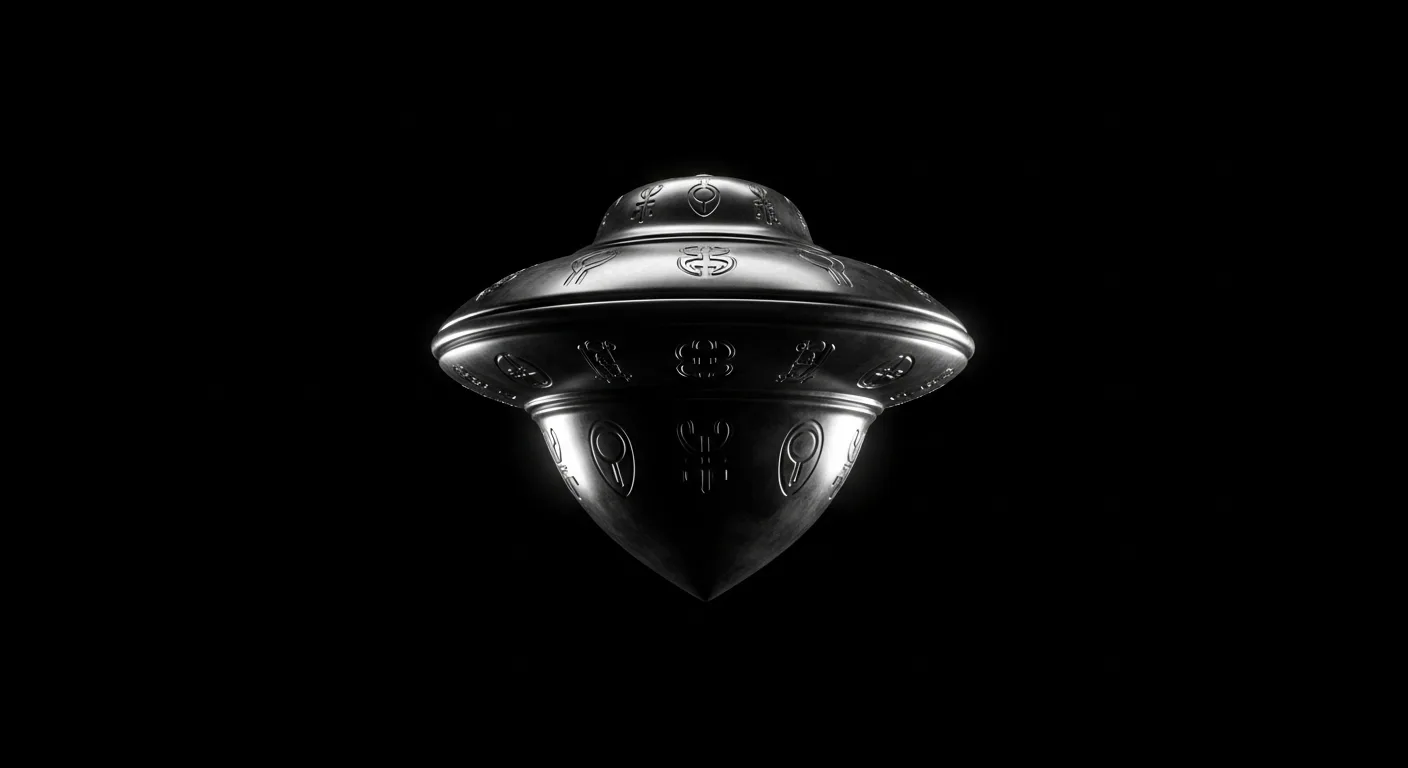
The craft was disc-shaped, or perhaps slightly domed, and Father Gill estimated its diameter at roughly thirty-five feet. It possessed a clearly defined structure, with what appeared to be legs or landing gear protruding from its underside. The base of the object glowed with a steady luminescence, not blinding but clearly visible, casting enough light to illuminate the craft’s features. It hovered at an altitude that the witnesses estimated at between three hundred and five hundred feet, close enough for considerable detail to be observed.
But it was not the craft itself that made this sighting historic. It was what the witnesses could see on top of it.
The Figures
On the upper surface of the craft, clearly silhouetted against the glow from below and the fading sky above, four humanoid figures were visible. They appeared to be standing on a platform or deck on top of the disc, moving about in purposeful ways that suggested they were engaged in some kind of work or activity. Father Gill later described them as human-like in proportions but not identifiably human. They moved with apparent purpose, sometimes bending as if adjusting something, sometimes standing upright and seemingly surveying their surroundings.
The witnesses watched in fascination. The figures moved back and forth across the top of the craft, occasionally disappearing below the rim of the platform only to reappear moments later. Their movements were unhurried and deliberate, giving no indication that they were aware of the crowd of observers watching them from below. The scene had an almost mundane quality, as if these beings were simply going about their business, performing routine tasks on their vessel while it hovered above a remote coastal village.
Father Gill counted four figures, and other witnesses confirmed this number independently. The beings appeared to be of roughly human height, though precise estimation was difficult given the distance and the unusual viewing angle. They cast shadows and moved in three-dimensional space in ways that eliminated the possibility that they were projections or optical illusions.
The Wave
What happened next elevated the Boianai sighting from an extraordinary observation to something approaching a contact event. On an impulse, Father Gill raised his arm and waved at the figures on the craft. The response was immediate and unmistakable. One of the figures raised its own arm and waved back.
The effect on the gathered crowd was electric. Others began waving, and more of the figures responded in kind. For several minutes, an exchange of waves took place between the group of mission workers and villagers standing on the ground and the enigmatic figures standing on top of a craft that, by any conventional understanding of technology, should not have existed.
Father Gill later described the moment with characteristic understatement. There was no drama or theatrics in his account, just a simple statement of fact: he waved, and a figure waved back. The matter-of-factness of his description made it all the more compelling. This was not a man embellishing a story for effect; it was a man reporting what he had seen in the same measured tone he might use to describe any other event in his daily life.
The wave represented something profound in the context of UFO research. If the account is accurate, it demonstrated that the occupants of the craft were aware of the observers below, that they recognized the gesture as a form of communication, and that they chose to respond in kind. This was not a distant light performing maneuvers that might or might not have been in response to signals from the ground. This was a clear, direct, and reciprocal interaction between human beings and non-human intelligences.
The Flashlight
Encouraged by the apparent response to their waves, Father Gill attempted a more deliberate form of communication. He retrieved a flashlight and directed its beam toward the craft, swinging it back and forth in what he hoped would be interpreted as a signal. The craft’s response was dramatic: it descended closer to the ground, swinging in a pendulum-like motion that seemed to mimic the movement of the flashlight beam.
The descent brought the craft noticeably closer to the observers, and for a brief period it seemed as though the object might actually land. The witnesses watched with a mixture of excitement and apprehension as the massive disc swung lower and lower, its glow intensifying as it approached. But then, as if thinking better of it, the craft ceased its descent and began to rise again, moving slowly back to its previous altitude.
Father Gill repeated the flashlight signal several times, and each time the craft seemed to respond with a slight dip or swing, but it did not descend as dramatically as it had the first time. The interaction gradually diminished, and eventually the craft simply hovered in place, its occupants continuing their activities on the upper deck as if the exchange had been a pleasant but ultimately unimportant interruption.
The Duration
One of the most remarkable aspects of the June 26 sighting was its duration. The craft remained visible for nearly four hours, from approximately 6:45 PM until well after 10:00 PM. This was not a momentary glimpse or a fleeting impression. The witnesses had ample time to observe the object from various angles, to discuss what they were seeing, to fetch additional observers, and to study the craft and its occupants in considerable detail.
The extended duration also allowed the emotional response to evolve in interesting ways. Initial excitement and amazement gradually gave way to something approaching normalcy. Father Gill, in one of the most often-quoted details of the case, eventually went inside for dinner. He later explained this decision by noting that the object had been there for so long that it had begun to seem almost routine, and he was hungry. The very ordinariness of this response lent his account an air of authenticity that more dramatic narrations might have lacked.
When he emerged from dinner, the craft was still there, though it appeared to be at a somewhat greater distance. It remained visible until the cloud cover increased and obscured the view. Even then, the glow from beneath the craft could be seen illuminating the clouds from above.
The Second Night: June 27, 1959
The following evening, the craft returned. At approximately 6:00 PM, the object reappeared above the mission station, assuming a position similar to the one it had occupied the previous night. Once again, a crowd gathered to observe it, and once again, humanoid figures were visible on the upper surface of the craft.
The second night’s observation was somewhat shorter than the first but no less compelling. The craft displayed similar characteristics, hovering silently with its luminous base casting a glow that made its structure clearly visible. The figures moved about as before, going about their inscrutable tasks with the same unhurried purposefulness.
The return on the second night was significant for several reasons. It eliminated the possibility that the first sighting had been a one-time misidentification of a known object. It demonstrated a pattern of behavior that suggested deliberate intent. And it provided a second opportunity for observation, allowing the witnesses to confirm and refine the details they had noted the previous evening.
The Signed Statement
In the days following the sightings, Father Gill sat down and wrote a detailed account of what he and the others had witnessed. This document was remarkable for its precision and restraint. Gill described the craft, its appearance, its behavior, and the figures on its surface in careful, measured language. He noted times, directions, altitudes, and durations. He recorded the sequence of events, including the wave and the flashlight interactions, without embellishment or interpretation.
Thirty-eight witnesses signed this document, attesting that they had observed the same phenomena that Father Gill described. Among the signatories were mission teachers, medical staff, and senior villagers, all of them literate and all of them willing to put their names to a statement that they must have known would attract scrutiny and skepticism. The signed statement became one of the most important pieces of documentation in UFO history, providing a level of corroborated testimony rarely available in such cases.
The document was forwarded to the Anglican Church authorities and eventually reached the wider world through UFO researchers who recognized its significance. The sheer number of witnesses, combined with Father Gill’s impeccable reputation and the detailed nature of his account, made the Boianai sighting impossible to dismiss as easily as many UFO reports were.
The Investigation
The Royal Australian Air Force investigated the sighting, interviewing Father Gill at length and reviewing his written account. The investigators found Gill to be a credible and reliable witness who showed no signs of fabrication or delusion. They were unable to offer any conventional explanation for what he and the other witnesses had observed.
The RAAF’s official conclusion was essentially a non-conclusion: the sighting was classified as unexplained. This was a significant finding in itself, as military investigators were generally motivated to find prosaic explanations for UFO reports, and their failure to do so in this case suggested that the phenomena genuinely defied conventional explanation.
Dr. J. Allen Hynek, the American astronomer who served as scientific consultant to the United States Air Force’s Project Blue Book, later evaluated the Boianai case and pronounced it one of the most important UFO sightings on record. Hynek was particularly impressed by the multiple witnesses, the extended duration of the observation, the credibility of the primary witness, and the apparent interaction between the observers and the occupants of the craft. He cited the case repeatedly in his writings as an example of a close encounter that demanded serious scientific attention.
Skeptical Perspectives
As with all UFO cases, the Boianai sighting has attracted skeptical analysis. The most common skeptical explanation is that Father Gill and the other witnesses were observing Venus, which was indeed bright and visible in the sky on those evenings, possibly in combination with aircraft lights or atmospheric phenomena.
Critics have pointed out that Gill was not wearing his glasses during some of the observation, which might have affected his perception of what he was seeing. They have also noted that cultural factors in Papua New Guinea might have influenced the way the local witnesses interpreted and reported the phenomena, potentially amplifying or distorting what was actually observed.
Donald Menzel, a Harvard astronomer who was one of the most prominent UFO skeptics of his era, suggested that Gill had been fooled by Venus seen through atmospheric distortion, and that the “figures” on the craft were nothing more than the turbulence effects one sometimes sees when looking at a bright star through disturbed air. This explanation, however, fails to account for the structured appearance of the craft, the purposeful movements of the figures, the apparent interaction through waving, and the response to the flashlight signals.
Other skeptics have suggested mass suggestion or social conformity as explanations, arguing that once Father Gill identified something unusual in the sky, the other witnesses may have been influenced by his interpretation and shaped their own observations to match his narrative. While this is a legitimate psychological phenomenon, it seems insufficient to explain thirty-eight witnesses independently signing a detailed statement or the consistency of the descriptions provided by people from diverse backgrounds.
The Significance of Interaction
What sets the Boianai sighting apart from the vast majority of UFO cases is the element of apparent interaction. UFO sightings, by their nature, are typically passive experiences, observations of something distant and unreachable performing maneuvers that may or may not be in response to the observers. The Boianai case is different. When Father Gill waved, something waved back. When he shone a flashlight, the craft descended in apparent response.
This interaction raises profound questions that go beyond the simple matter of whether unidentified flying objects exist. If the account is accurate, it demonstrates that whatever intelligence was operating the craft was aware of human beings, understood at least basic gestural communication, and was willing to engage in a moment of contact, however brief and limited. The wave was not a complex exchange of information; it was something simpler and perhaps more significant, an acknowledgment of mutual awareness, a moment in which two forms of intelligence recognized each other across the gulf that separated them.
Father Gill himself seemed to regard the interaction with a kind of gentle puzzlement rather than awe or fear. His accounts convey a sense of curiosity and interest but not the overwhelming emotional response that one might expect from a man who believed he had communicated with extraterrestrial beings. This measured response may reflect Gill’s temperament, his practical nature grounding him even in extraordinary circumstances, or it may suggest that the experience, while remarkable, felt oddly natural in the moment.
Legacy and Lasting Impact
Father William Gill continued his missionary work in Papua New Guinea for several more years after the sighting before eventually returning to Australia. He maintained his account consistently throughout his life, never embellishing it, never seeking to profit from it, and never wavering in his description of what he had seen. He was interviewed repeatedly over the decades by researchers, journalists, and documentary filmmakers, and his story remained the same in every telling, a hallmark of genuine testimony.
The Boianai sighting occupies a unique position in UFO research. It combines several elements that are individually rare and collectively almost unprecedented: an impeccably credible primary witness, thirty-eight corroborating observers, extended duration, close proximity, visible occupants, apparent interaction, a signed and detailed written account, and an official investigation that failed to provide a conventional explanation.
The case has been featured in virtually every serious study of the UFO phenomenon published since 1959. It appears in the works of Hynek, Jacques Vallee, Timothy Good, and countless other researchers as a prime example of a close encounter that resists conventional explanation. The signed statement, with its thirty-eight signatures, remains one of the most remarkable documents in the annals of UFO research.
Today, the site of the Boianai mission continues to exist in what is now the independent nation of Papua New Guinea. The village remembers the events of June 1959, and the story has become part of the local heritage. A plaque or marker is not necessary; the memory lives in the community itself, passed down through the generations as the night when the sky opened and something looked back.
Between the Stars and the Sea
The Boianai sighting asks a question that, more than six decades later, remains unanswered. What hovered above that small coastal mission in the warm Pacific evening? What were the figures doing on the deck of their craft as they moved through the fading light? And what did it mean when one of them raised its arm and returned the wave of a clergyman standing on the ground below?
Father Gill offered no grand theories. He reported what he saw, signed his name to it, and went on with his life. The thirty-eight witnesses did the same. Their testimony stands as one of the most compelling accounts of apparent contact between human beings and an unknown intelligence, a moment when the distance between worlds shrank to the length of a wave, when curiosity was answered with curiosity, and when the profound mystery of what shares our skies was, for a few hours on a June evening, made visible to a group of people who were simply looking up.
The craft departed. The figures vanished into the night. The questions remain, as vast and unfathomable as the sky above Boianai, where the stars still burn over the Solomon Sea and the memory of what came down from among them has never faded.
Sources
- Project Blue Book — National Archives — USAF UFO investigation files, 1947–1969
- CIA UFO/UAP Reading Room — Declassified CIA documents on UAP