Father Gill Sighting Revisited
The second night of the Father Gill encounters brought even more witnesses and the remarkable claim that beings on the craft waved back at the observers below.
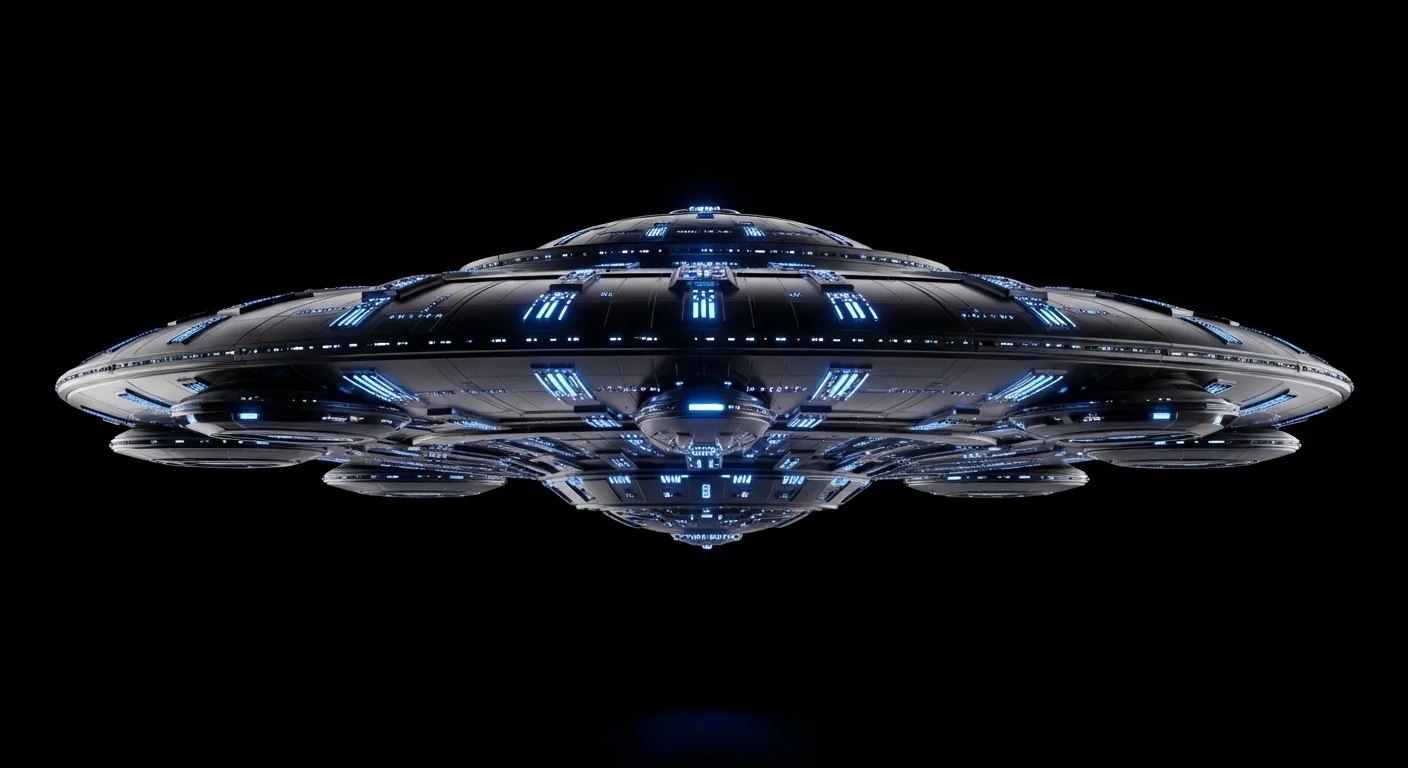
The Anglican mission at Boianai sits on the coast of Papua New Guinea, overlooking Goodenough Bay where the warm waters of the Solomon Sea wash against shores lined with coconut palms and dense tropical vegetation. In 1959, this small outpost of Christian faith and Western education served a community of Papuan villagers who lived much as their ancestors had for centuries, fishing the bay, tending gardens in the surrounding bush, and navigating a world in which the spiritual and the physical were not rigidly separated. The mission was led by Father William Booth Gill, an Anglican priest from Australia who had served in Papua New Guinea for many years and who was known to his parishioners, his fellow clergy, and the colonial administration as a man of intelligence, integrity, and level-headed practicality. He was not the sort of person who chased phantoms or sought publicity. On the evenings of June 26 and 27, 1959, Father Gill and dozens of witnesses observed structured craft hovering above the mission, saw humanoid figures moving on top of the craft, and — in the most extraordinary claim of the entire encounter — waved at the figures and received waves in return. The Father Gill sighting remains one of the most remarkable and well-documented close encounters in the history of UFO research, distinguished by its multiple witnesses, its extended duration, its credible primary observer, and the almost surreal calmness with which the encounter unfolded.
The Man and the Mission
William Booth Gill was born in Australia and ordained as an Anglican priest before volunteering for missionary service in Papua New Guinea, then administered as the Territory of Papua and New Guinea under Australian mandate. He arrived in the territory in the mid-1940s and served at various mission stations over the following years, learning the local languages, adapting to the tropical climate, and building relationships with the indigenous communities he served.
By 1959, Gill was an experienced missionary in his late thirties, thoroughly accustomed to life in Papua New Guinea and deeply familiar with its night skies. The territory’s proximity to the equator and its distance from urban light pollution made its skies spectacularly clear on cloudless nights, and Gill, like many expatriates in remote postings, had developed the habit of spending evenings outdoors observing the stars. He was familiar with the appearance and behavior of aircraft, satellites, meteors, and the various celestial phenomena visible from that latitude. He was not a man who would mistake Venus for a flying saucer.
Gill’s character and credibility are central to the case. He was assessed by investigators, colleagues, and church officials as a reliable, honest, and emotionally stable individual. He had no interest in UFOs prior to his sightings, no history of unusual beliefs or experiences, and no motivation to fabricate a sensational story that could only complicate his professional life. His bishop, the Right Reverend David Hand, later confirmed that Gill was “a very honest man” whose account he had no reason to doubt.
The mission at Boianai was staffed by Gill and several other missionaries, including teachers and medical workers, who served the local Papuan community. The community itself consisted of villagers who lived nearby and interacted with the mission daily. These individuals, while less familiar with Western conventions of reporting and analysis, were keen observers of their natural environment and entirely capable of distinguishing between ordinary and extraordinary phenomena.
The First Night: June 26, 1959
The events began on the evening of Friday, June 26, 1959. At approximately 6:45 PM, as the tropical dusk was settling over Goodenough Bay, Father Gill stepped outside the mission house and noticed an unusually bright light in the sky to the northwest. The light was descending, growing larger and brighter as it approached. Within minutes, Gill could see that it was not a star or an aircraft but a structured object — a large, disc-shaped craft with a wide base and a smaller upper structure, hovering above the mission at an estimated altitude of three to four hundred feet.
Gill called to the other mission staff, and several came outside to observe. As they watched, the object remained stationary, its surface appearing to glow with a soft, steady light. After some time, figures became visible on the upper surface of the craft. Gill and his companions counted four humanoid shapes, apparently standing on top of the object and moving about. The figures appeared to be performing some kind of activity, their movements purposeful rather than random, as though they were working or attending to the craft.
The object remained visible for an extended period on this first night, eventually rising higher in the sky and diminishing in apparent size before being lost to observation. Gill made careful notes of what he had seen, recording the time, direction, apparent size, and behavior of the object and its occupants. His notes, written in his careful, precise hand, would become key documents in the subsequent investigation.
Additional objects were also visible during this first night’s observation. Gill and his companions reported seeing several smaller lights in the sky around the main object, some stationary and some moving. The total count of objects observed over the course of the evening reached as many as four, though the large disc with the figures on top was the dominant phenomenon.
The Second Night: June 27, 1959
The following evening brought the encounter for which the case is best known. At approximately 6:00 PM on Saturday, June 27, the object returned. It appeared in the same general area of the sky, descending to a similar altitude, and once again, humanoid figures were visible on its upper surface. This time, the number of observers was larger. Word of the previous night’s sighting had spread through the mission community, and by the time the object appeared, a substantial group had gathered outside to watch. The final witness count for the second night reached thirty-eight people, including Father Gill, other mission staff, Papuan teachers, students, and community members.
The object hovered in the clear evening sky, its figures moving about on its surface in the same purposeful manner observed the previous night. Gill, watching from below with the calm curiosity that characterized his approach to the entire experience, decided to attempt communication. He raised his arm and waved at the figures on the craft.
What happened next elevated the Boianai encounter from a remarkable sighting to one of the most extraordinary claims in UFO history. One of the figures on the craft appeared to wave back. Gill waved again, and the figure responded again. Other observers joined in, waving their arms at the hovering object, and multiple figures on the craft appeared to respond with similar gestures, creating a sustained exchange of waves between the ground observers and the beings on the craft.
The exchange continued for several minutes, a scene so surreal that its very normalcy became one of the case’s most memorable features. There was no panic, no fear, no dramatic response from either side. The witnesses waved, the figures waved back, and the encounter unfolded with a casualness that seems almost absurd in retrospect. Gill later reflected on the experience with characteristic understatement, noting that it felt oddly natural at the time, as though waving at beings on a hovering craft were a perfectly reasonable thing to do.
The Flashlight Experiment
Encouraged by the apparent responsiveness of the figures, the witnesses at Boianai attempted a more structured form of communication. One of the missionaries produced a flashlight and directed it at the craft, flashing it in a deliberate pattern. The craft appeared to respond, its light growing brighter and then dimmer in a pattern that seemed to echo the flashlight signals. The exchange was repeated several times, with the craft’s light apparently matching the rhythm of the flashlight flashes.
This apparent response to deliberate signaling was profoundly significant to the witnesses. If the craft was simply a natural phenomenon or a conventional aircraft, it would not be expected to respond to flashlight signals in a reciprocal pattern. The response suggested intelligence, awareness, and a willingness to engage in communication — attributes that no conventional explanation could easily accommodate.
The flashlight exchange, like the waving, was witnessed by the entire group of thirty-eight observers. The collective nature of the observation made it difficult to attribute the perceived responses to wishful thinking or perceptual error on the part of a single individual. Thirty-eight people saw the same thing at the same time, and their accounts agreed on the essentials of what occurred.
The Calm Departure
Perhaps the most psychologically interesting aspect of the second night’s encounter was its ending. After approximately four hours of observation, during which the craft hovered, figures moved on its surface, and exchanges of waves and light signals occurred, Father Gill decided to go inside for dinner. The craft was still visible in the sky, the figures were still moving on its surface, and the phenomenon was still very much in progress. But Gill, with the matter-of-fact pragmatism that characterized his personality, concluded that dinner was more immediately pressing than extraterrestrial communication.
“We were a bit fed up that they didn’t seem to want to come down and meet us,” Gill later explained with gentle humor. “So we went in and had dinner.”
When the witnesses returned outdoors after their meal, the craft had moved higher in the sky and was less distinct. It remained visible for some time longer before eventually departing. The figures were no longer discernible at the greater altitude. The second night’s encounter had ended, not with a dramatic departure or a blinding flash, but with the quiet, anticlimactic conclusion of a phenomenon that had simply moved on.
Documentation and Investigation
Father Gill documented his observations in detailed written notes that were distributed to church officials and eventually to civilian UFO researchers. His reports included times, directions, weather conditions, descriptions of the objects, counts of figures, and accounts of the interactive episodes. The precision and thoroughness of his documentation reflected both his education and his temperament, creating a record that investigators found unusually valuable.
The case attracted the attention of the Royal Australian Air Force, which examined the reports and interviewed Gill. The RAAF’s investigation was reportedly hampered by skepticism within the organization and a reluctance to engage seriously with a case involving humanoid beings on a hovering craft. Their official conclusion attributed the sighting to astronomical phenomena — a suggestion that Gill, an experienced observer of the night sky, found unpersuasive.
Civilian researchers, including J. Allen Hynek’s associates and Australian UFO organizations, conducted more thorough investigations. They interviewed Gill, the other mission staff, and available Papuan witnesses. They examined the documentation, assessed the weather conditions on the nights in question, and evaluated Gill’s character and reliability. The general conclusion of these investigators was that the case was genuine — that Gill and his companions had observed something real, structured, and intelligently controlled, and that no conventional explanation adequately accounted for what they described.
The church’s response was measured and supportive. Bishop David Hand, Gill’s ecclesiastical superior, reviewed the accounts and stated publicly that he found Gill to be an honest and reliable witness. The church did not officially endorse any particular interpretation of the events but refrained from discouraging Gill from discussing his experiences.
The Witnesses’ Testimony
The strength of the Father Gill case rests not on any single piece of evidence but on the convergence of multiple strands of testimony from multiple independent observers. The thirty-eight witnesses on the second night included people of different cultural backgrounds, educational levels, and relationships to Father Gill. Their accounts, while varying in detail and emphasis as any set of eyewitness reports would, agreed on the fundamental features of the encounter: the structured craft, the hovering, the humanoid figures, the waves, and the light responses.
The Papuan witnesses brought their own perspective to the encounter. In a culture where the spiritual and the physical worlds interpenetrated more fluidly than in Western tradition, the appearance of beings in the sky was not inherently impossible or shocking. This cultural context may actually make the Papuan witnesses more rather than less reliable, as they were less likely to be influenced by the rigid Western dichotomy between possible and impossible that might lead a Western witness to either fabricate or suppress an extraordinary account.
Several of the mission staff, including teachers Stephen Gill Moi and Ananias Rarata, provided written accounts that corroborated Father Gill’s in all essential respects. These men were educated, literate individuals who wrote their observations independently and submitted them through church channels. The consistency of their accounts with Gill’s — and with each other’s — argues strongly against fabrication.
Skeptical Assessments
The Father Gill sighting has attracted skeptical attention commensurate with the extraordinary nature of its claims. The most common skeptical explanations focus on astronomical misidentification, suggesting that Gill and his companions were observing bright planets, stars, or atmospheric phenomena that were distorted by tropical weather conditions.
This explanation faces significant difficulties. Gill was an experienced observer of the night sky who was thoroughly familiar with the appearance of planets and stars from Boianai’s latitude. The object he described was not a point of light but a structured craft with visible surface features and occupants. The interactive behavior — the waving and light responses — cannot be attributed to astronomical objects. And the testimony of thirty-eight witnesses, many of whom observed the phenomena at close range and in good visibility conditions, is difficult to reconcile with simple misidentification.
Other skeptics have suggested that Gill was engaged in a deliberate hoax, fabricating the account for attention or to advance some personal agenda. This suggestion founders on Gill’s character and circumstances. He was a respected clergyman with no interest in UFOs, no history of deception, and no obvious motive for fabrication. The account brought him unwanted attention and complicated his professional life. He maintained his story consistently for the rest of his life, never varying its essential details and never seeking to profit from it.
The most sophisticated skeptical approach acknowledges that the witnesses saw something but questions whether the details — particularly the humanoid figures and the interactive behavior — were accurately perceived. Under this interpretation, the observers may have seen genuine atmospheric or aerial phenomena and, through the psychological processes of expectation and interpretation, embellished their observations with details that were products of perception rather than reality. This is a reasonable concern in principle, but it struggles to account for the consistency of multiple independent accounts and the extended duration of the observations, which allowed witnesses ample time to refine their perceptions.
A Lasting Mystery
Father Gill continued his missionary work in Papua New Guinea for several years after the Boianai sightings, eventually returning to Australia where he served as a parish priest until his retirement. He spoke about his encounter when asked but never sought the spotlight, never wrote a book, and never attempted to build a career on his experience. His consistency, his humility, and his evident lack of interest in celebrity status have enhanced rather than diminished his credibility over the decades.
The Boianai encounter remains one of the most challenging cases in the UFO literature. It possesses qualities that investigators regard as indicators of genuineness: a credible, well-characterized primary witness; multiple independent corroborating witnesses; extended observation under good conditions; detailed contemporaneous documentation; and behavior suggestive of intelligent control. The interactive dimension — the waving and light signaling — adds a layer of extraordinariness that sets it apart from mere sighting reports and places it among the most significant claims of apparent contact between humans and unknown intelligences.
What hovered over the mission at Boianai on those June evenings in 1959 remains unidentified. The beings on its surface, if beings they were, did not land, did not speak, and did not explain their presence. They simply hovered, worked, waved, and departed, leaving behind a community of witnesses whose lives had been briefly intersected by something that none of them could explain and none of them would ever forget. Father Gill went inside for dinner. The object went wherever objects like that go. And the warm Pacific night closed over Goodenough Bay, holding its mystery as the waters hold the reflection of the stars.
Sources
- Project Blue Book — National Archives — USAF UFO investigation files, 1947–1969
- CIA UFO/UAP Reading Room — Declassified CIA documents on UAP