Father Gill PNG UFO
An Anglican priest and 37 witnesses watched a UFO with beings on top for hours over two nights. When Father Gill waved at the figures, one waved back. 38 witnesses signed statements. The interaction was mutual, observed, and documented.
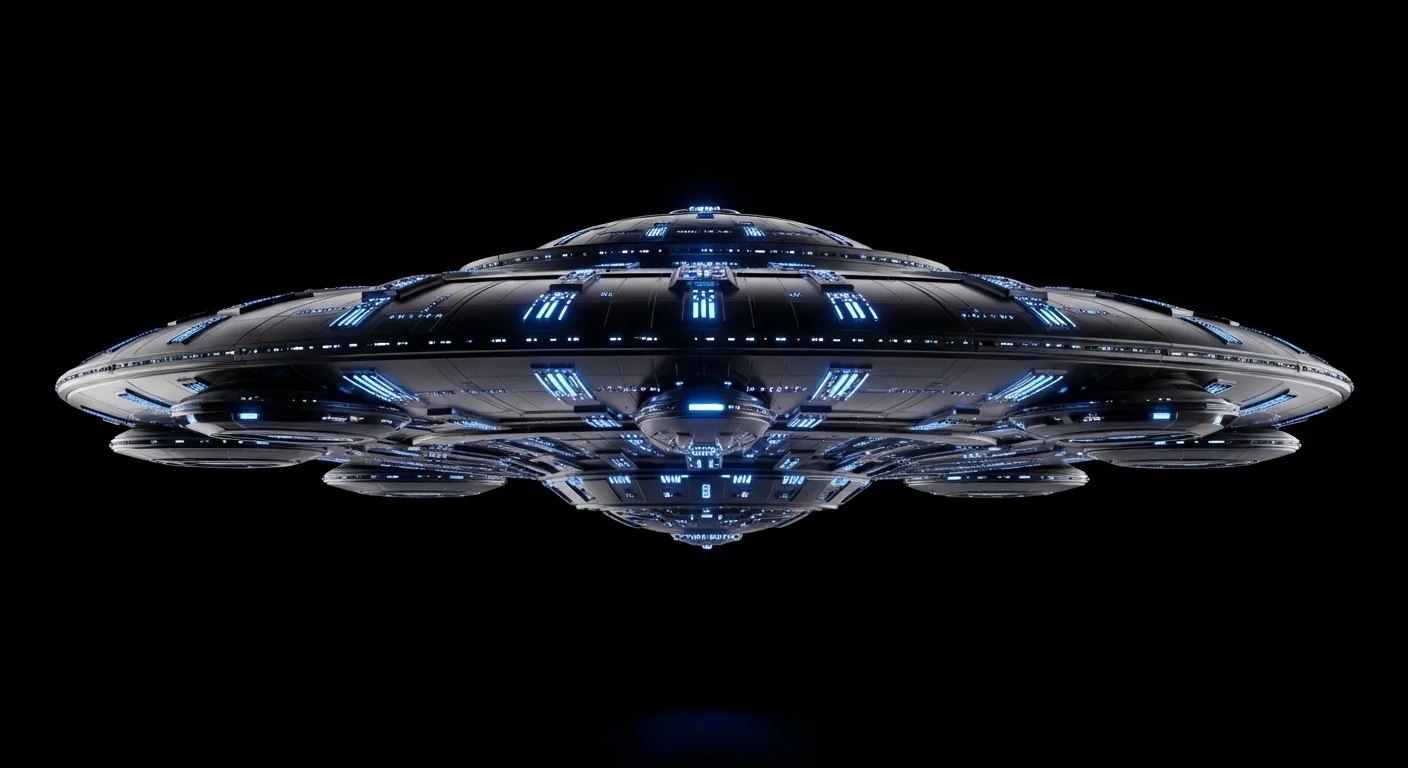
On the evening of June 26, 1959, an Anglican missionary named William Booth Gill stepped out of his mission house at Boianai, on the northern coast of Papua New Guinea, and looked up at the sky. What he saw hovering above the darkening landscape would become one of the most remarkable and best-documented UFO encounters in history—not merely because an unidentified craft appeared over a remote tropical mission, but because the beings visible on top of that craft responded to human contact. When Father Gill raised his hand and waved at the figures standing on the upper surface of the object, one of them waved back. The gesture was repeated. Others joined in. For a period of sustained, mutual observation, thirty-eight human beings and an unknown number of non-human beings acknowledged each other’s existence across the void between the ground and whatever was hovering silently above it. Thirty-eight witnesses signed statements attesting to what they had seen. The encounter occurred on two consecutive nights. And the witness who initiated contact was not an excitable teenager or a publicity-seeking amateur but a respected clergyman whose profession demanded honesty and whose character made fabrication almost inconceivable.
The Missionary
William Booth Gill was an Australian Anglican priest who had been serving as a missionary in Papua New Guinea for several years by June 1959. He was, by all accounts, a thoroughly ordinary and thoroughly reliable man—educated, articulate, devout, and possessed of the practical competence that mission work in a remote and challenging environment demanded. He was responsible for a small community of converts and mission workers at Boianai, a coastal settlement on the northern shore of Papua New Guinea’s mainland, accessible primarily by boat and situated in a landscape of extraordinary natural beauty and equally extraordinary isolation.
Gill was not a man who sought attention or controversy. His correspondence and personal writings reveal someone focused on his pastoral duties, concerned with the spiritual and material welfare of his parishioners, and engaged with the daily practicalities of running a remote mission station. He had no interest in UFOs, no background in fringe science, and no apparent motivation to fabricate a story that would bring him unwanted scrutiny from the press, the public, and his ecclesiastical superiors.
This background is crucial to understanding the weight that the Boianai encounter carries in UFO research. Father Gill was exactly the kind of witness that skeptics typically demand and rarely receive—a person of established character, professional standing, and demonstrated honesty, with no discernible reason to lie and every reason to report accurately. When such a witness describes waving at beings on a flying craft and having them wave back, the usual avenues of dismissal are significantly narrowed.
The First Evening: June 26, 1959
The weather on the evening of June 26 was clear, with good visibility—conditions that would prove important in establishing the reliability of the observations that followed. At approximately 6:45 PM, as the tropical dusk was settling over the coast, Father Gill stepped outside the mission house and noticed a bright light in the sky to the northwest. The light was descending, growing larger and more defined as it approached, and within minutes it had resolved into a clearly structured object hovering at a moderate altitude above the mission.
Gill called to the mission teachers and other staff members, who came outside and joined him in observing the object. As more people gathered—indigenous Papuan mission workers, teachers, and their families—the group of witnesses grew rapidly. Eventually, thirty-eight people stood together watching the phenomenon, a substantial crowd whose members would later provide independent testimony about what they observed.
The object was large, disc-shaped, and luminous, with a bright upper surface that cast light into the surrounding atmosphere. It hovered silently, maintaining its position with an apparent ease that suggested neither effort nor mechanical exertion. The craft showed no visible propulsion system—no exhaust, no flame, no rotating components—and produced no sound that any of the witnesses could detect.
But it was not the craft itself that made this encounter extraordinary. It was the figures visible on its upper surface.
The Beings
As Father Gill and his companions watched, they could clearly distinguish four humanoid figures standing on the top of the hovering object. The figures were upright, apparently bipedal, and of roughly human proportions, though the distance made precise estimation of their size difficult. They appeared to be engaged in some form of activity—moving about on the surface of the craft, bending, straightening, and interacting with each other in ways that suggested purposeful work rather than idle movement.
The figures were silhouetted against the bright upper surface of the craft, which provided sufficient backlighting to make their forms clearly visible to the observers below. Their movements were fluid and natural, without the stiffness or mechanical quality that might suggest they were parts of the craft itself or artifacts of the light. They were, by every indication available to the witnesses, living beings going about their business on the deck of an airborne vessel.
The sight of humanoid figures visible on a UFO was remarkable enough. What happened next elevated the Boianai encounter from a remarkable sighting to something approaching a milestone in the history of human experience.
The Wave
Father Gill, perhaps moved by the same impulse that drives all human beings to attempt communication with the unfamiliar, raised his arm above his head and waved at the figures on the craft. The gesture was simple, universal, unmistakable—an open-handed wave, the most basic expression of greeting and acknowledgment that human body language can produce.
One of the figures on the craft waved back.
The response was immediate and unambiguous. The being raised its arm in a motion that mirrored Gill’s own wave, a clear and deliberate gesture of reciprocation. The movement was not random, not coincidental, not the accidental motion of a figure engaged in other activity. It was a direct response to a direct communication—one conscious being acknowledging the greeting of another across the gap between ground and sky.
Gill waved again. The figure waved again. Other members of the mission group began waving, and additional figures on the craft appeared to respond. For several minutes, the two groups—human and non-human—engaged in an exchange of waves that, for all its simplicity, represented something profoundly significant. This was not observation from a distance. This was not a fleeting glimpse of something unidentified streaking across the sky. This was mutual recognition, mutual acknowledgment, mutual communication between two groups of beings separated by an unknown distance and an unknown gulf of nature.
Gill and his companions attempted to extend the contact. The mission had a flashlight, and Gill shone it toward the craft, directing the beam upward in a deliberate signaling gesture. The craft appeared to respond, swinging slightly closer to the ground as though the beings on board were interested in the new stimulus. The response encouraged the group, and they continued signaling with the flashlight, attempting to establish a more sustained form of communication.
But the craft did not descend further. After a period of proximity during which the mutual observation and signaling continued, the object began to withdraw, rising gradually and drifting away from the mission. The figures on its surface continued their activities as the craft receded, eventually becoming too distant for the beings to be distinguished individually. The craft remained visible as a bright light for some time after the figures were no longer discernible, before finally departing entirely.
The entire observation on the first evening lasted several hours, though the period of closest approach and active interaction was shorter. When the craft was finally gone, Father Gill did something that would prove invaluable to researchers—he sat down and wrote a detailed account of what had occurred, including specific observations about the craft, the beings, the interaction, and the circumstances of the sighting. He asked the other witnesses to do the same, and their statements were prepared that same evening, while the experience was fresh and undistorted by the passage of time.
The Second Night: June 27, 1959
When the object returned on the following evening, the community at Boianai was waiting.
The craft appeared at approximately the same time, approaching from a similar direction and taking up a position that allowed clear observation from the mission. Once again, the luminous disc hovered silently above the area, and once again, figures were visible on its upper surface. The repeat appearance on a second consecutive night transformed the encounter from a single extraordinary event into something more sustained and deliberate—a pattern of visitation that suggested intentionality on the part of whatever intelligence controlled the craft.
The second evening’s observations largely confirmed those of the first. The craft was the same in appearance, the figures behaved in similar fashion, and the interaction—waving, flashlight signaling, apparent responsive movement from the beings—followed the same general pattern. The second night thus served as a form of confirmation, providing the witnesses with the opportunity to verify and refine their observations under conditions they now understood and anticipated.
Father Gill’s account of the second evening contains a detail that has puzzled and amused researchers in equal measure. Despite the extraordinary nature of the phenomenon overhead, Gill eventually went inside for dinner. The object was still there when he returned, and it was still there when he later went inside for evening prayers. By his own account, the sustained presence of the craft had normalized the experience to the point where he felt comfortable attending to his routine—an extraordinarily human response to an extraordinarily inhuman situation.
This detail, far from undermining Gill’s credibility, actually strengthens it. A hoaxer or fantasist would be unlikely to include the admission that he had dinner and went to church while a UFO hovered overhead. The mundane detail speaks to the authenticity of the account—this was a real person experiencing a real event within the real rhythms of daily life, not a storyteller crafting a dramatic narrative.
The Documentation
The documentation of the Boianai encounter was remarkable for its thoroughness and immediacy. Father Gill’s own written account, prepared on the evening of the first sighting, runs to several pages of detailed observation. He described the craft’s appearance, estimated its size and altitude, noted the behavior of the figures on its surface, and recorded the sequence of the interaction with care and precision.
The thirty-seven other witnesses also provided statements, which were collected and preserved by Gill. These statements varied in detail and sophistication—some were from educated mission teachers, others from indigenous Papuans with limited literacy—but they were consistent in their essential elements. All described a luminous, disc-shaped object. All noted figures on its upper surface. All confirmed the waving interaction. The collective testimony of thirty-eight witnesses, recorded on the same evening as the events, represents an evidentiary base of unusual strength.
The statements were subsequently forwarded to Anglican church authorities and to researchers who learned of the case. They have been examined by multiple investigators over the decades and have withstood sustained scrutiny. No significant discrepancies have been identified among the witness accounts, and no witness has recanted or substantially revised their testimony.
The Investigations
The Boianai encounter attracted the attention of several prominent UFO researchers, most notably Dr. J. Allen Hynek, the astronomer who served as scientific consultant to the United States Air Force’s Project Blue Book. Hynek, who had evolved from UFO skeptic to cautious proponent of serious investigation over the course of his career, regarded the Father Gill case as one of the most significant in the UFO literature.
Hynek classified the encounter as a Close Encounter of the Third Kind—a sighting involving the observation of occupants or beings associated with a UFO—and assigned it a high “strangeness rating” within his classification system. He noted several factors that made the case particularly compelling: the number and quality of witnesses, the duration of the observation, the repeat occurrence on consecutive nights, the apparent interaction between witnesses and beings, and the immediate documentation of the events.
British authorities, who administered Papua New Guinea at the time, also investigated the case. The investigation was thorough but inconclusive—officials interviewed Gill and other witnesses, examined the documentation, and were unable to provide a conventional explanation for what had been observed. The case was filed without resolution, joining the small but significant catalogue of officially investigated UFO encounters that remained unexplained.
Skeptical Responses
The Boianai encounter has attracted its share of skeptical explanation, though none has proven fully satisfactory. The most common alternative hypotheses include misidentification of astronomical objects, mass suggestion, and outright fabrication.
The astronomical misidentification theory proposes that Father Gill and his companions observed Venus or Jupiter, both of which were visible in the evening sky at the time of the sightings, and that atmospheric conditions caused the planet to appear as a structured, luminous object. The “figures” on the surface, according to this theory, were optical artifacts created by the interaction of bright point sources with the observers’ visual systems.
This explanation has several significant problems. Venus and Jupiter are point sources of light; they do not appear as large, structured objects at any magnification achievable by the naked eye. The figures described by the witnesses were not vague impressions at the edges of perception but clearly defined forms engaged in visible activity. And the interaction—the waving, the response to the flashlight—cannot be accounted for by the behavior of a planet, which does not respond to stimuli from the ground.
Mass suggestion, or the idea that the witnesses saw what they expected or wanted to see, is similarly inadequate. While group dynamics can certainly influence perception, the Boianai witnesses were not primed for a UFO encounter. Father Gill had no interest in the subject, and the indigenous Papuan witnesses had no cultural framework for the concept of alien spacecraft. The detailed, consistent, and independently documented testimony of thirty-eight people resists reduction to collective delusion.
The fabrication hypothesis—that Gill invented or embellished the encounter—founders on his character, his lack of motive, and the corroboration of thirty-seven other witnesses. A clergyman who fabricates a dramatic story about waving at aliens and recruits thirty-seven accomplices to support it would be engaging in a conspiracy of extraordinary complexity and pointlessness, risking his career, his reputation, and his ministry for no discernible benefit.
The Meaning of a Wave
The Boianai encounter occupies a singular position in UFO history because of the interaction it documents. Most UFO cases involve observation from a distance—lights in the sky, objects over landscapes, craft performing maneuvers beyond human capability. The witness is a passive observer, watching something that pays no apparent attention to their presence. At Boianai, the dynamic was different. The beings on the craft were aware of the humans below, acknowledged their presence, and responded to their attempts at communication.
This reciprocity transforms the encounter from a sighting into a meeting. Whatever the beings on the craft were—extraterrestrial visitors, interdimensional travelers, time travelers, or something entirely outside our current categories of understanding—they recognized human beings as entities worthy of acknowledgment. The wave was not a complex communication, not a transmission of scientific knowledge or philosophical wisdom. It was something more fundamental: a greeting, a recognition of shared consciousness, a simple gesture that said, “We see you, and we know you see us.”
Father Gill lived the rest of his life with the knowledge of that exchange. He did not become a UFO evangelist or a celebrity speaker. He returned to his pastoral work, continued his ministry, and discussed the encounter when asked but did not seek to profit from it or to use it as a platform. He maintained, consistently and without embellishment, that he had seen what he had seen—a craft, beings, a wave, and a response.
The thirty-seven other witnesses carried their own versions of the same knowledge. For the indigenous Papuans of Boianai, the encounter was integrated into their understanding of a world that was already rich with spirits, powers, and presences beyond the ordinary. For the mission teachers, it was a more challenging experience, an event that did not fit neatly into any existing category of their education or faith. For all of them, it was something they had seen with their own eyes, confirmed by the testimony of their neighbors, and documented in their own words on the evening it occurred.
The beings on the craft waved back. In the entire vast catalogue of human encounters with the unknown, that simple gesture remains one of the most extraordinary and most human moments ever recorded. It suggests that whatever is behind the UFO phenomenon—whatever intelligence operates these craft and sends these beings to observe our world—it is not entirely alien to us. It understands the language of gesture, recognizes the impulse to communicate, and is willing, at least occasionally, to respond in kind.
Thirty-eight signatures sit on the documents that record this encounter, written in the handwriting of people who stood together on a tropical evening and watched something that should have been impossible. They waved at it, and it waved back, and then Father Gill went inside for dinner because that is what human beings do—they accommodate the extraordinary within the rhythms of the ordinary, and they carry on. The craft departed, the evening ended, and the world continued much as it had before. But something had changed, something subtle and permanent. Thirty-eight people knew, with the certainty of direct experience, that we are not alone. And the proof was as simple as a wave.
Sources
- Project Blue Book — National Archives — USAF UFO investigation files, 1947–1969
- CIA UFO/UAP Reading Room — Declassified CIA documents on UAP