Father Gill Papua New Guinea UFO
Anglican priest Father William Gill and 37 other witnesses watched a UFO hover over their mission for hours. When they waved, the beings on top waved back. For two nights, a clergyman and his congregation had friendly contact with occupants of an unexplained craft.
The First Evening
At approximately 6:45 PM on June 26, 1959, Father William Booth Gill — an Australian Anglican missionary stationed at the Boianai mission on the northeast coast of Papua New Guinea — stepped outside and looked up. What he saw hovering in the sky above his mission would occupy him and thirty-seven other witnesses for the next several hours and produce one of the most remarkable UFO cases in history: not a fleeting glimpse or an ambiguous light, but a sustained, interactive encounter between a clergyman and his congregation and the occupants of an unexplained craft.
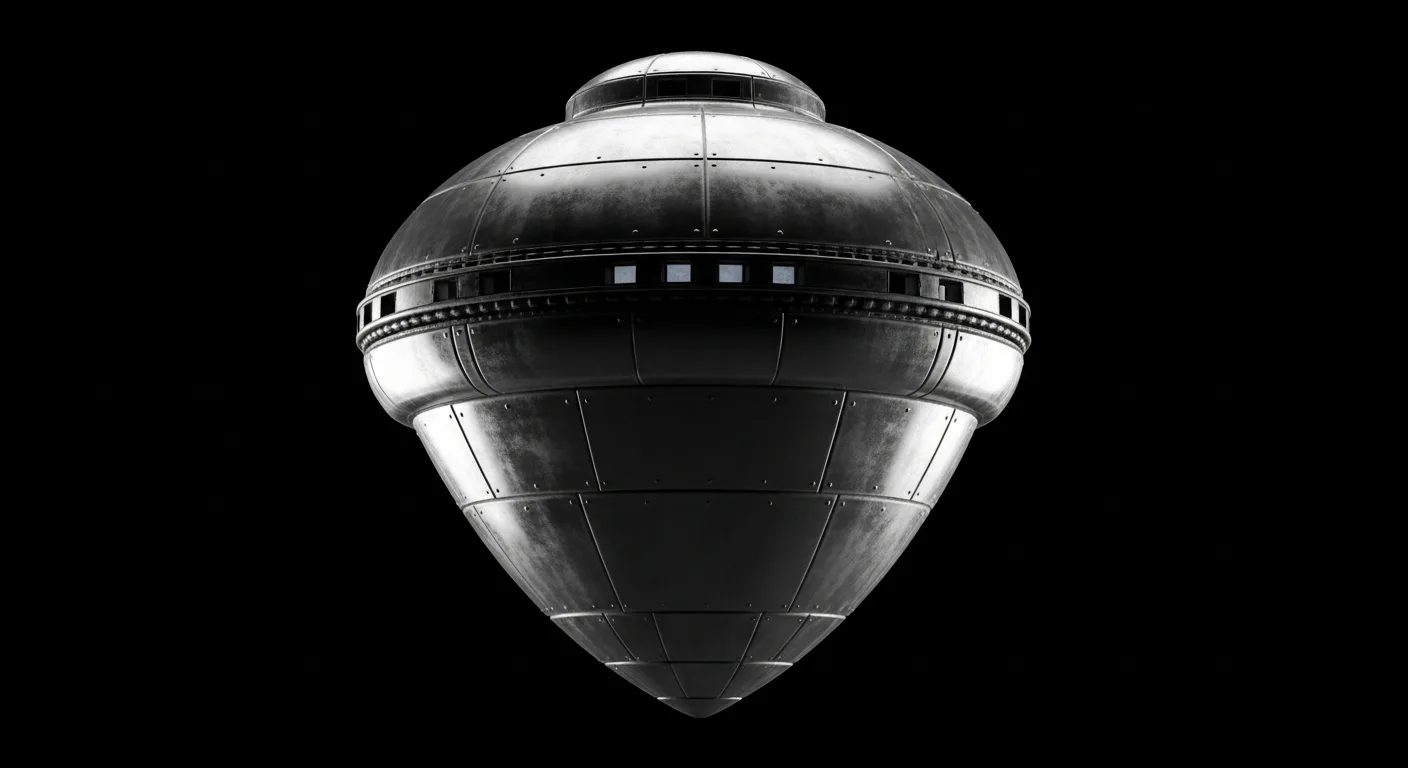
The object was large, disc-shaped, luminous, and solid — not a diffuse light or atmospheric anomaly but a structured craft that hung in the air with the stillness of something that belonged there. Three smaller objects were visible at greater distance, but the primary disc held their attention for a simple and extraordinary reason: there were figures on top of it. Four humanoid beings stood on the upper surface of the craft, clearly visible in the evening light, moving around and appearing to work on something. They stood upright. Their arms were visible. Their movements were deliberate and purposeful.
Father Gill raised his hand and waved.
One of the figures waved back.
The Interaction
What followed defied the narrative template of virtually every UFO encounter before or since. There was no terror. No paralysis. No blinding light or lost time. The witnesses — Gill, his mission staff, and local villagers numbering thirty-eight in total — stood in the open and watched the craft and its occupants with the curiosity of people observing something genuinely interesting rather than something terrifying. Others in the group waved. The figures responded again. Gill retrieved a flashlight and directed its beam toward the craft. The object appeared to respond, descending slightly and moving toward them before rising back to its original position.
The observation continued for hours. The craft remained overhead, the figures periodically visible, the smaller objects coming and going at the edges of visibility. And then — in a detail that has puzzled and charmed researchers for decades — Father Gill and his congregation went inside for dinner. The object was still there when they went in. It was still there when some of them came back out to look. Eventually, as the evening wore on, the craft departed. The witnesses went to bed.
The Second Night
The following evening, June 27, the object returned. The same behavior repeated: the disc appeared, the figures were visible on top, the waving was exchanged again. The second night’s observation confirmed that the first had not been a one-time anomaly or a collective misperception. Whatever was hovering above the Boianai mission had come back, and it behaved the same way.
The Documentation
Father Gill did what any responsible professional would do: he wrote a detailed report the same evening. The document recorded times, descriptions of the craft and its occupants, the behavior he observed, and the sequence of events. Twenty-five of the witnesses signed the report, affirming that they had seen what Gill described. The document was preserved and forwarded through Church channels to authorities in Australia.
The Royal Australian Air Force investigated the case but reached no conclusion. The file was left open, the sightings officially unexplained. Dr. J. Allen Hynek, the American astronomer who served as scientific consultant to the US Air Force’s Project Blue Book and who later became the foremost academic voice in UFO research, met with Father Gill personally and found him credible. Hynek regarded the Boianai sighting as one of the most impressive cases in the UFO literature — not because of its strangeness, but because of the quality of the witness, the number of corroborating observers, and the immediacy of the documentation.
The Credibility Question
Father William Gill was an Anglican priest — a professional man of faith, educated, sober, and serving in a remote Pacific mission out of genuine vocation rather than any desire for publicity. He had no financial motive to fabricate a UFO story. He had no prior interest in the subject. He documented what he saw immediately, obtained cosigning witnesses, and reported through official channels. His account never varied in its essentials across the decades of retelling that followed.
The thirty-seven other witnesses included mission staff — teachers and medical workers — and local villagers who had no exposure to Western UFO culture and no framework for interpreting what they saw other than their own direct experience. The consistency of their account, across cultural and educational lines, argues powerfully against the suggestion of mass hallucination or culturally conditioned misperception.
An Encounter Unlike Any Other
What makes the Boianai sighting genuinely unique is not the craft or the figures — similar descriptions appear throughout the UFO literature — but the emotional register of the encounter. There was no abduction. No radiation burns. No weapons failure. No terror. A priest and his congregation watched something extraordinary in the sky, waved at it, received a wave back, and then went to dinner. The calm, almost domestic quality of the interaction stands in stark contrast to the high-drama encounters that dominate UFO reporting, and it raises its own unsettling question: if these beings are hostile or indifferent, why did they wave? And if they are something else — curious, observant, even friendly — what does that mean for how we understand the phenomenon?
Father Gill maintained until his death that what he witnessed was real, that the craft was a physical object, and that the beings on its surface were not projections or hallucinations but entities that acknowledged the presence of the humans watching them. Thirty-eight people on a Pacific island saw the same thing, over two consecutive nights, and signed their names to a document saying so. The encounter at Boianai remains one of the most quietly extraordinary cases in the history of UFO research — a reminder that not every contact with the unknown arrives with fear and violence. Sometimes it arrives with a wave.
Sources
- Project Blue Book — National Archives — USAF UFO investigation files, 1947–1969
- CIA UFO/UAP Reading Room — Declassified CIA documents on UAP